
Lighting
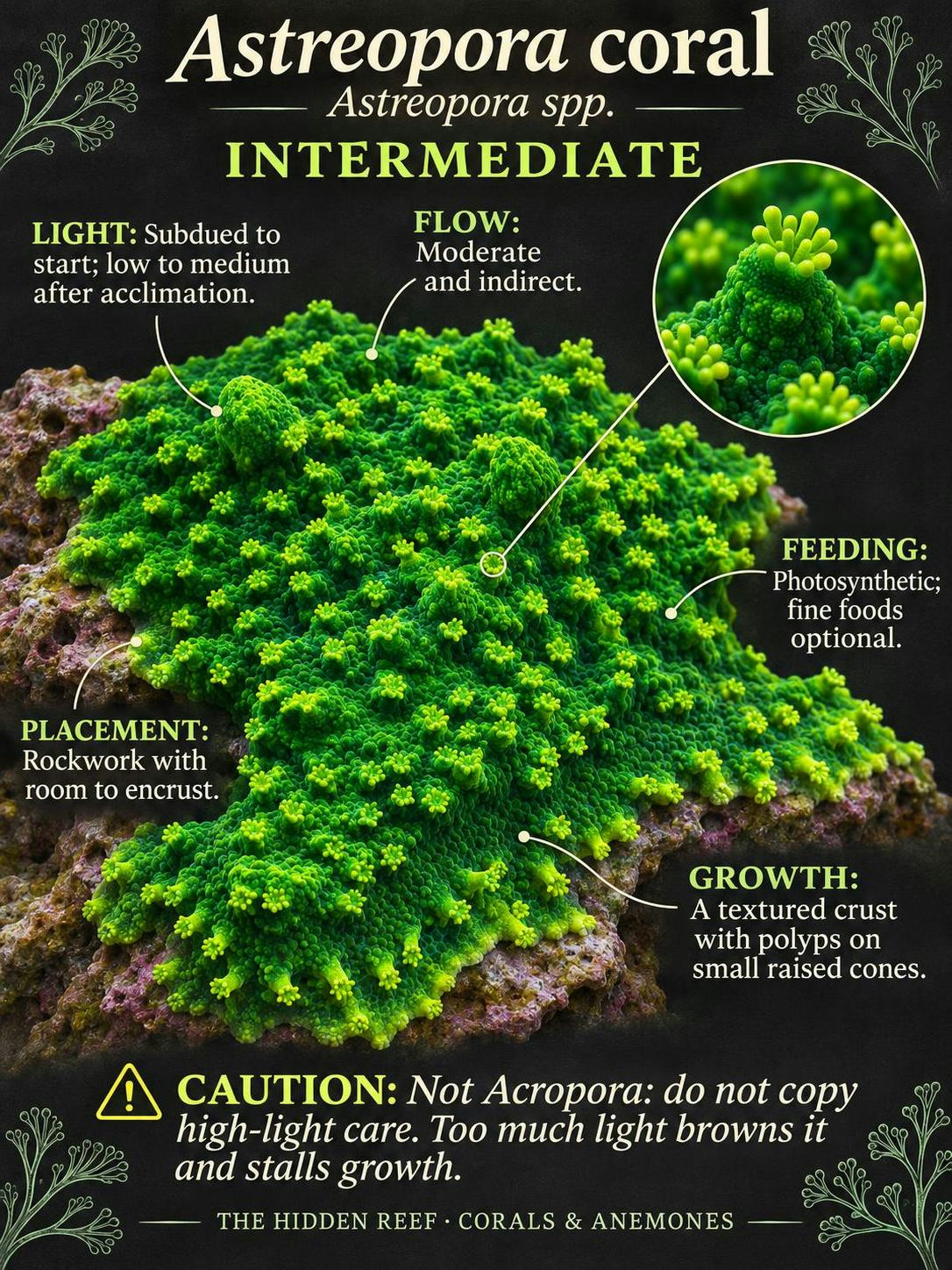
Start in subdued light and acclimate gradually. Growers report success from low to medium light, well below typical Acropora levels.
Water flow
Moderate indirect flow, enough to keep debris off the surface.
Placement & space
Rockwork, usually in the lower or middle part of the tank, with room to encrust.
Feeding
Photosynthetic; fine coral foods are optional rather than required.
Growth & adult form
A textured crust with polyps carried on small raised cones; some forms grow as plates.
Names you may see in stores
Dinosaur Skin and Neon are color trade names. Easily confused with Cyphastrea, which carries its polyps flush with the surface. Astreopora is in the same family as Acropora but is kept very differently. This guide covers encrusting aquarium forms; some sellers list it as LPS.
A stable reef comes first
Match the seller’s established conditions, acclimate gradually, and monitor temperature, salinity and water chemistry. Light and flow vary with the specimen and aquarium; these labels are starting guidance, not a universal setting.
Sources & review
Care summaries are synthesized from the references below. Difficulty and availability labels are editorial judgments; neither implies current store stock.
- Reef Builders — Astreopora and Cyphastrea — so similar, yet different. Consulted November 15, 2026.
- Bulk Reef Supply — WWC Neon Astreopora care notes. Consulted November 15, 2026.
- Frag Box Corals — Astreopora coral care notes. Consulted November 15, 2026.
- World Register of Marine Species — Astreopora — taxonomy record. Consulted November 15, 2026.
Biological reference: World Wide Corals specimen photograph. Independently composed educational illustration; the source photograph is not reproduced. Colors and composition are illustrative, not a specimen for sale.