
Lighting
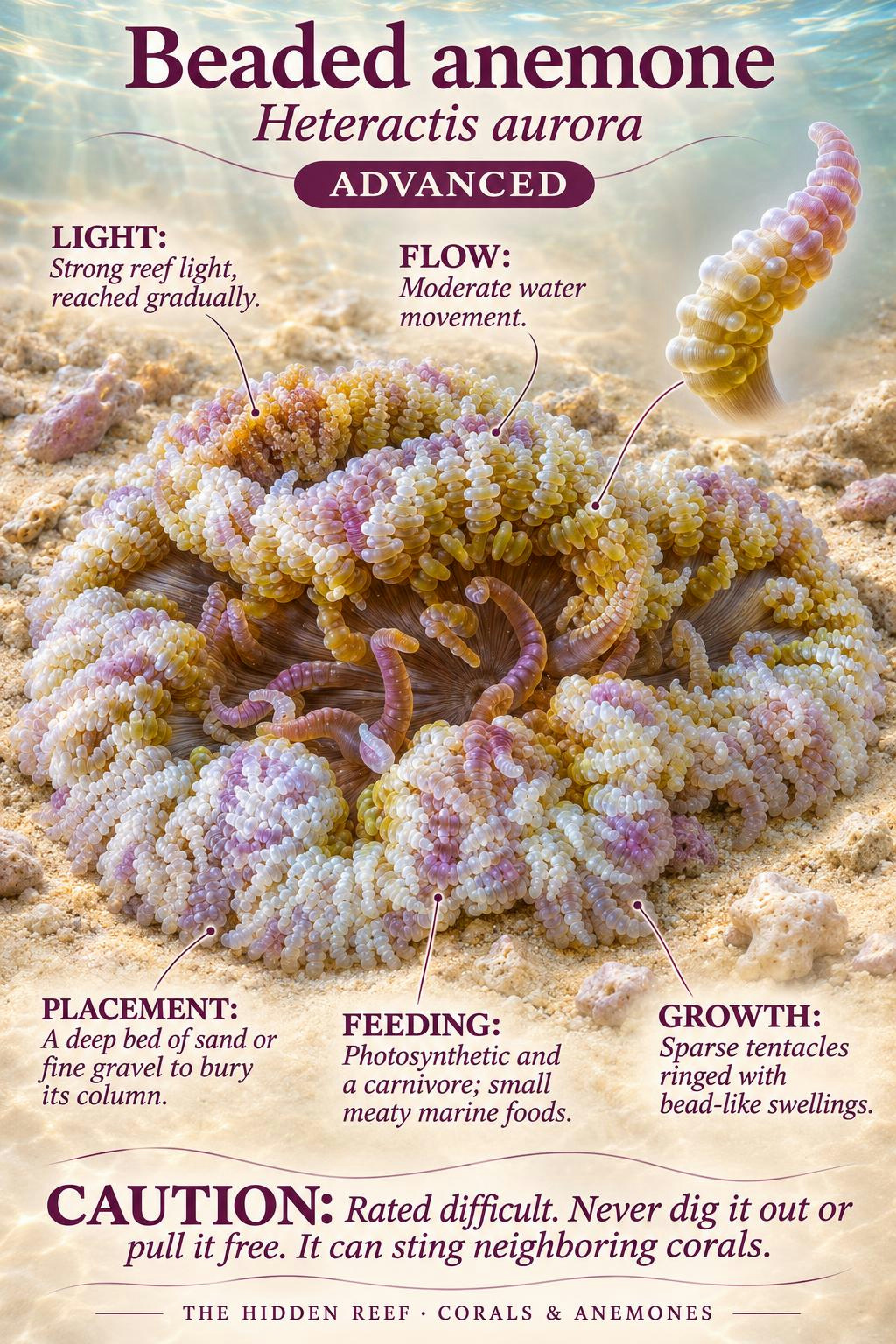
Strong reef lighting, acclimated gradually. It carries symbiotic algae.
Water flow
Moderate water movement.
Placement & space
A deep bed of sand or fine gravel so the column can bury itself and anchor to something solid beneath. In the wild it lives in sand pockets and rubble beside reefs.
Feeding
Photosynthetic and a carnivore. The one husbandry reference found suggests a weekly feed of chopped marine fish or shrimp; watch the response and adjust.
Growth & adult form
A flat disc up to about 30 cm across with sparse tentacles ringed by bead-like swellings; the disc and mouth stay visible between them. It pulls right into the sand when disturbed.
Names you may see in stores
Also sand, aurora or beaded sea anemone. The World Register of Marine Species accepts Heteractis aurora; the anemones long sold as Heteractis magnifica, crispa and malu are now placed in Radianthus. White, brown, beige, purplish and greenish animals occur, so a “white” label alone says nothing about health. Some are only lightly or partly beaded and can be mistaken for sebae or long-tentacle anemones. A natural host for several clownfish, but pairing is never guaranteed.
A stable reef comes first
Match the seller’s established conditions, acclimate gradually, and monitor temperature, salinity and water chemistry. Light and flow vary with the specimen and aquarium; these labels are starting guidance, not a universal setting.
Sources & review
Care summaries are synthesized from the references below. Difficulty and availability labels are editorial judgments; neither implies current store stock.
- Saltcorner — Heteractis aurora species account. Consulted November 15, 2026.
- Zootaxa — The clownfish-hosting sea anemones: updated nomenclature, biogeography, and practical field guide (Titus et al., 2024). Consulted November 15, 2026.
- www.actiniaria.com — Heteractis aurora identification notes. Consulted November 15, 2026.
- World Register of Marine Species — Heteractis aurora — taxonomy record. Consulted November 15, 2026.
Biological reference: Morgan Bennett-Smith, Benjamin M. Titus and Scott Johnson (Titus et al. 2024, Zootaxa) specimen photograph. Independently composed educational illustration; the source photograph is not reproduced. Colors and composition are illustrative, not a specimen for sale.