
Lighting
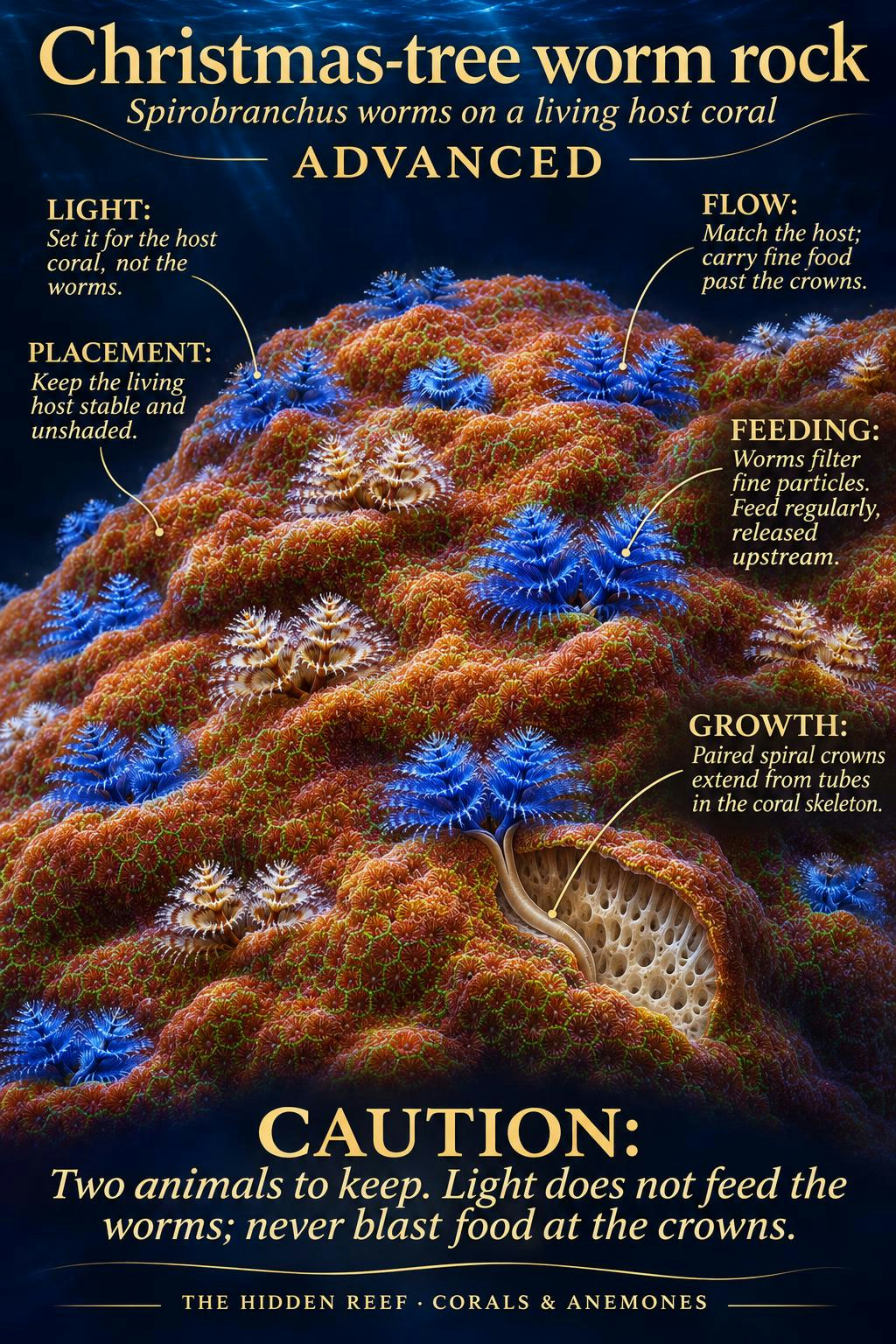
Set the light for the host coral. Porites hosts usually want bright light; Cyphastrea hosts want much less.
Water flow
Match the host coral, with enough movement to carry fine food past the worm crowns.
Placement & space
Keep the living host stable and unshaded, away from animals that prey on worms.
Feeding
Light may feed the coral but not the worms: they filter fine particles from the water. Offer fine suspended foods regularly, released upstream rather than sprayed at the crowns, and avoid overfeeding.
Growth & adult form
Paired spiral crowns extend from tubes embedded in the coral skeleton and snap back when disturbed.
Names you may see in stores
Also sold as Bisma worm rock, often labelled Spirobranchus giganteus; several kinds of Spirobranchus are involved, so treat that as a trade label. The host is usually Porites, sometimes Cyphastrea. Worms sometimes survive the loss of the host coral, but aim to keep both. Listed with SPS because the usual host is a small-polyp stony coral.
A stable reef comes first
Match the seller’s established conditions, acclimate gradually, and monitor temperature, salinity and water chemistry. Light and flow vary with the specimen and aquarium; these labels are starting guidance, not a universal setting.
Sources & review
Care summaries are synthesized from the references below. Difficulty and availability labels are editorial judgments; neither implies current store stock.
- CORAL Magazine — Bisma worms: a keeper's guide. Consulted November 15, 2026.
Biological reference: Ben Clark, via CORAL Magazine specimen photograph. Independently composed educational illustration; the source photograph is not reproduced. Colors and composition are illustrative, not a specimen for sale.