
Lighting
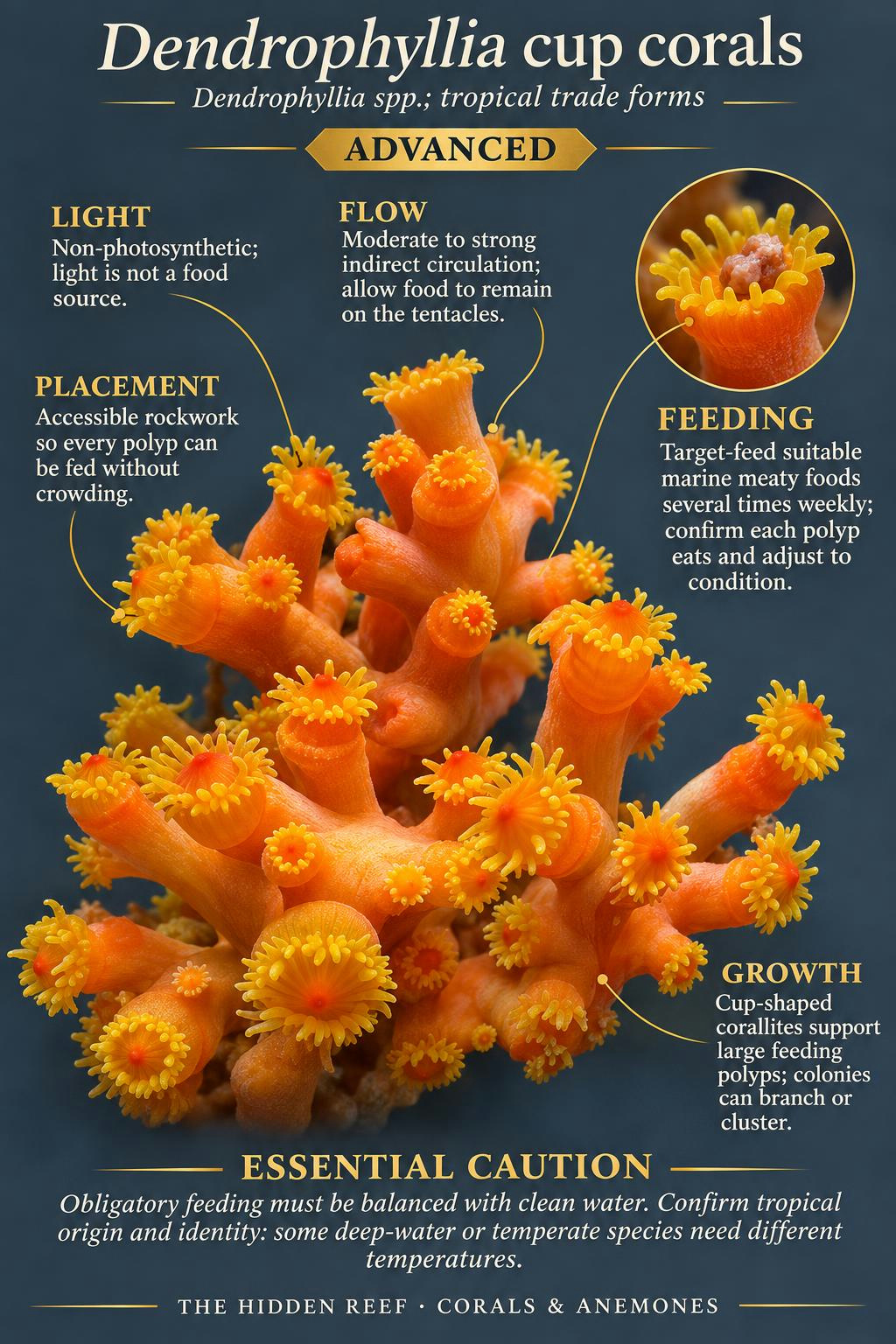
Non-photosynthetic; light is not a food source.
Water flow
Moderate to strong indirect circulation; allow food to remain on the tentacles.
Placement & space
Accessible rockwork so every polyp can be fed without crowding.
Feeding
Target-feed suitable marine meaty foods several times weekly; confirm each polyp eats and adjust to condition.
Growth & adult form
Cup-shaped corallites support large feeding polyps; colonies can branch or cluster.
Names you may see in stores
Dendro is a loose trade label, not proof of species. This is not a guide for every member of the family or for photosynthetic Duncan corals.
A stable reef comes first
Match the seller’s established conditions, acclimate gradually, and monitor temperature, salinity and water chemistry. Light and flow vary with the specimen and aquarium; these labels are starting guidance, not a universal setting.
Sources & review
Care summaries are synthesized from the references below. Difficulty and availability labels are editorial judgments; neither implies current store stock.
- Detroit Reef Club — Dendrophyllia colony frag. Consulted November 15, 2026.
- Reef Builders — A reefkeepers guide to nps corals. Consulted November 15, 2026.
- Salty Underground — Dendrophylliidae corals. Consulted November 15, 2026.
Biological reference: Reef Builders; individual photographer unverified specimen photograph. Independently composed educational illustration; the source photograph is not reproduced. Colors and composition are illustrative, not a specimen for sale.