
Lighting
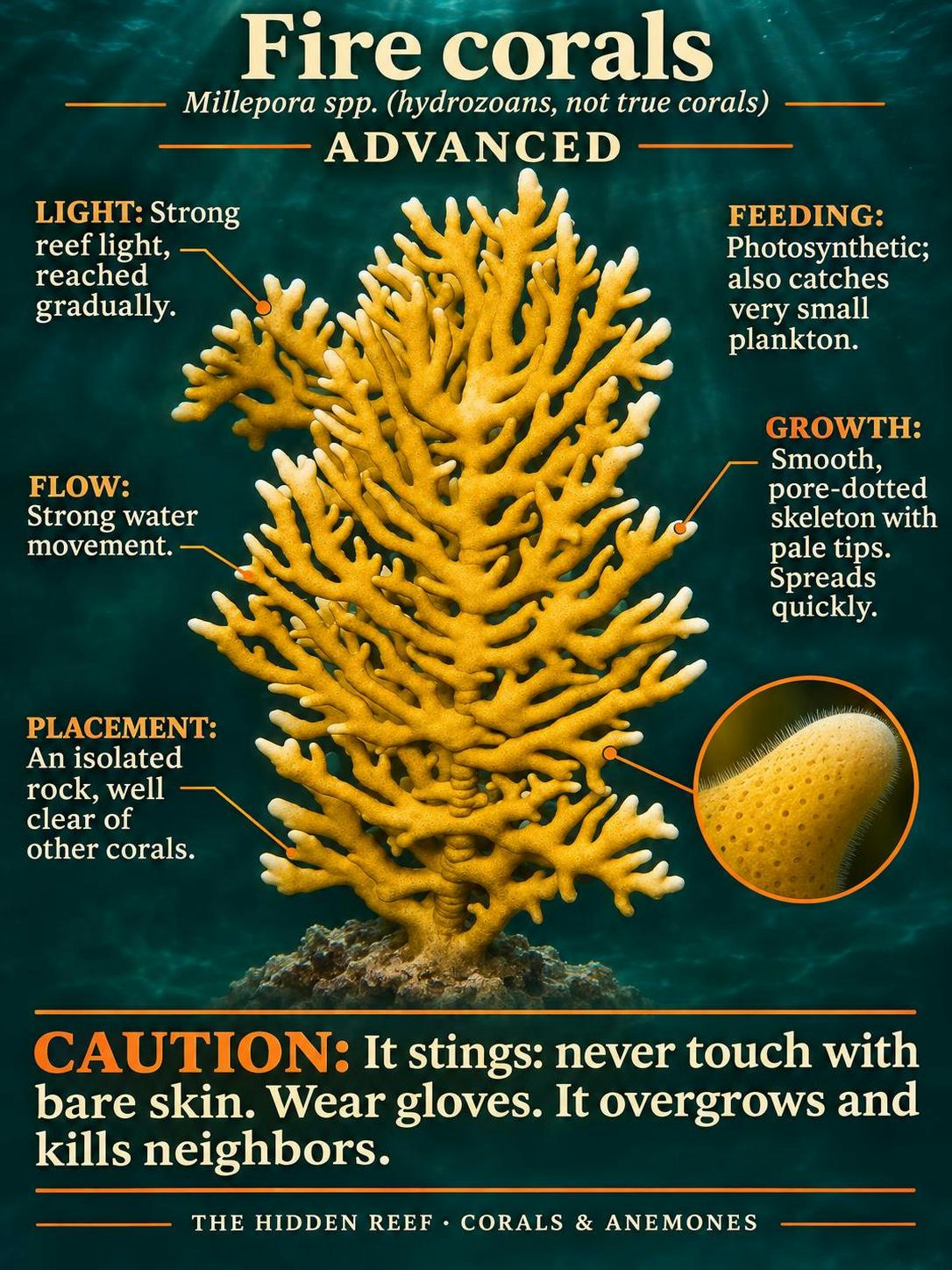
Strong reef lighting, reached by gradual acclimation. It relies heavily on its symbiotic algae.
Water flow
Strong water movement.
Placement & space
An isolated rock it can cover, kept well clear of other corals, especially sea fans, which it overgrows.
Feeding
Photosynthetic. Fine stinging hairs also catch very small plankton; fine foods are a supplement, not a necessity under strong light.
Growth & adult form
A smooth skeleton dotted with tiny pores and no visible polyps, often mustard-brown with pale tips. It encrusts, then forms blades or branches, and spreads quickly.
Names you may see in stores
Fire corals are hydrozoans, closer to hydroids and jellyfish than to stony corals; they sit with SPS here only for browsing. Species are hard to tell apart because the shape changes with conditions and with whatever the colony has overgrown. Not related to Acropora millepora, a true stony coral. Some harmless corals look similar, so the seller’s identification matters.
A stable reef comes first
Match the seller’s established conditions, acclimate gradually, and monitor temperature, salinity and water chemistry. Light and flow vary with the specimen and aquarium; these labels are starting guidance, not a universal setting.
Sources & review
Care summaries are synthesized from the references below. Difficulty and availability labels are editorial judgments; neither implies current store stock.
- Reefkeeping Magazine — Venomous corals: the fire corals (Eric Borneman, 2002). Consulted November 15, 2026.
- Saltcorner — Millepora complanata species account. Consulted November 15, 2026.
- Divers Alert Network — Fire coral: injury, prevention and first aid. Consulted November 15, 2026.
- World Register of Marine Species — Millepora (class Hydrozoa) — taxonomy record. Consulted November 15, 2026.
Illustration adapted with a real specimen reference: Nick Hobgood (CC BY-SA 3.0). Reference and adapted illustration license. Colors and composition are illustrative, not a specimen for sale.