
Lighting
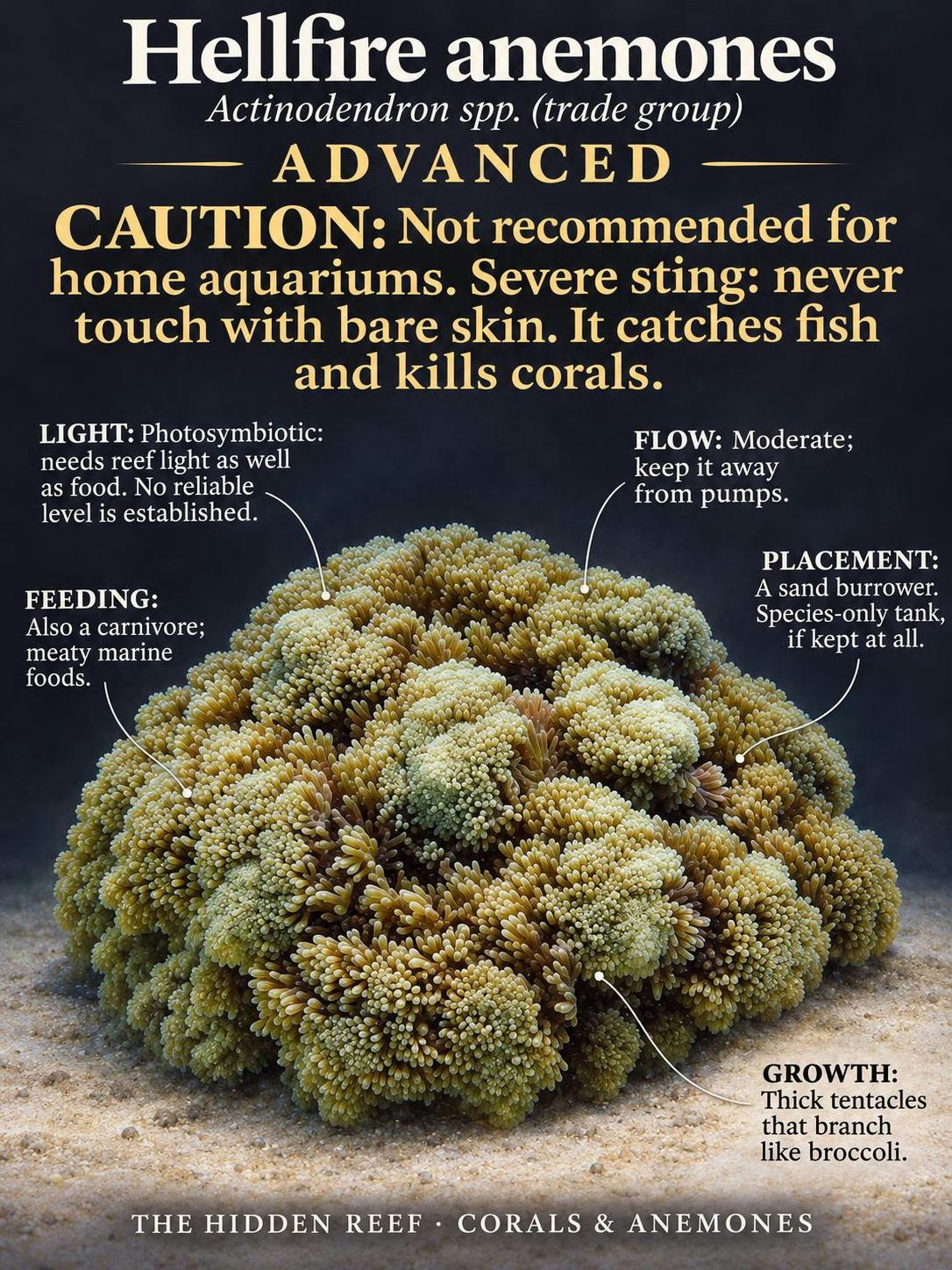
Photosymbiotic: a museum survey records Actinodendron arboreum as carrying symbiotic algae, so it needs reef lighting as well as food. An older hobby account that calls it purely carnivorous is not supported. No reliable light level has been established.
Water flow
Moderate flow, according to the one supplier guide found. Keep it well away from pumps and wavemakers.
Placement & space
A sand burrower: the column sits in soft sediment and the animal pulls into the sand when disturbed. If it is kept at all, a species-only tank with a sand bed, no corals and no fish you would mind losing.
Feeding
Carnivorous as well as photosymbiotic. Keepers’ accounts suggest meaty marine foods once or twice a week.
Growth & adult form
Up to 48 thick tentacles that branch again and again, so the animal looks like a head of broccoli or a small soft coral. Usually sand-colored; brown, purple, blue, yellow and green animals also occur.
Names you may see in stores
Also hell’s fire, fire, tree or branching anemone, and sold under names such as multicolor hellfire. Trade animals are rarely identified to species; several Actinodendron species exist, and related genera have more simply branched tentacles. Easily mistaken for a soft tree coral, which does not sting. Not a clownfish host.
A stable reef comes first
Match the seller’s established conditions, acclimate gradually, and monitor temperature, salinity and water chemistry. Light and flow vary with the specimen and aquarium; these labels are starting guidance, not a universal setting.
Sources & review
Care summaries are synthesized from the references below. Difficulty and availability labels are editorial judgments; neither implies current store stock.
- Raffles Bulletin of Zoology — Sea anemones of Singapore: abundant and well-known shallow-water species (Fautin, Tan & Tan, 2009). Consulted November 15, 2026.
- Saltcorner — Actinodendron plumosum species account. Consulted November 15, 2026.
- reefchasers.com — Fire anemone care guide. Consulted November 15, 2026.
- World Register of Marine Species — Actinodendron — taxonomy record. Consulted November 15, 2026.
Illustration adapted with a real specimen reference: Ahmed Abdul Rahman (CC BY-SA 4.0). Reference and adapted illustration license. Colors and composition are illustrative, not a specimen for sale.