
Lighting
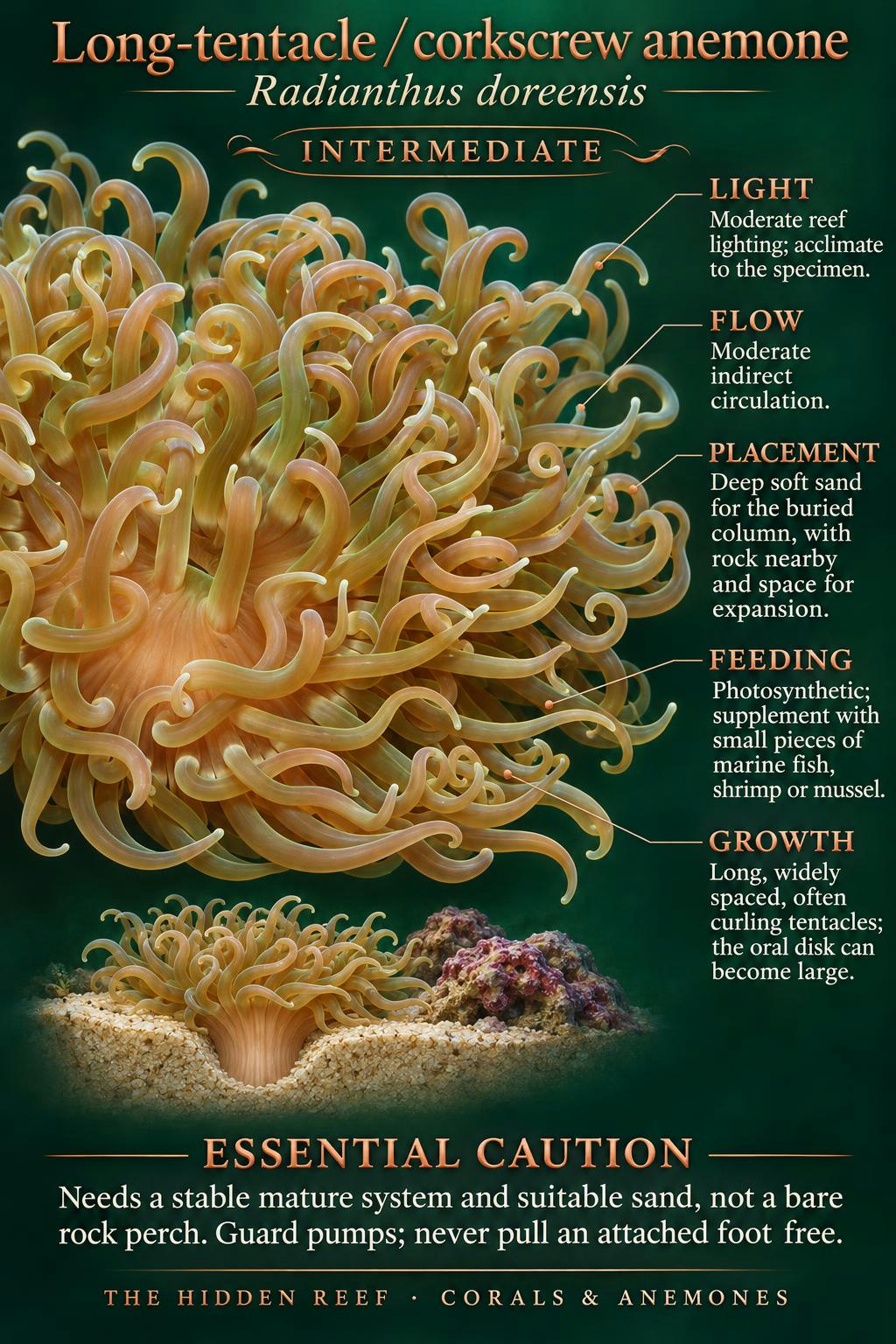
Moderate reef lighting, acclimated to the specimen.
Water flow
Moderate indirect circulation.
Placement & space
Deep soft sand for the buried column, with rock nearby and space for expansion.
Feeding
Photosynthetic; supplement with small pieces of marine fish, shrimp or mussel.
Growth & adult form
Long, widely spaced, often curling tentacles; the oral disk can become large.
Names you may see in stores
Commonly sold as Macrodactyla doreensis, also listed as Heteractis doreensis; current WoRMS accepts Radianthus doreensis. Not the Caribbean curly-Q.
A stable reef comes first
Match the seller’s established conditions, acclimate gradually, and monitor temperature, salinity and water chemistry. Light and flow vary with the specimen and aquarium; these labels are starting guidance, not a universal setting.
Sources & review
Care summaries are synthesized from the references below. Difficulty and availability labels are editorial judgments; neither implies current store stock.
- LiveAquaria — Long tentacle anemone. Consulted November 15, 2026.
- World Register of Marine Species — Radianthus doreensis — taxonomy record. Consulted November 15, 2026.
Biological reference: LiveAquaria specimen photograph. Independently composed educational illustration; the source photograph is not reproduced. Colors and composition are illustrative, not a specimen for sale.