
Lighting
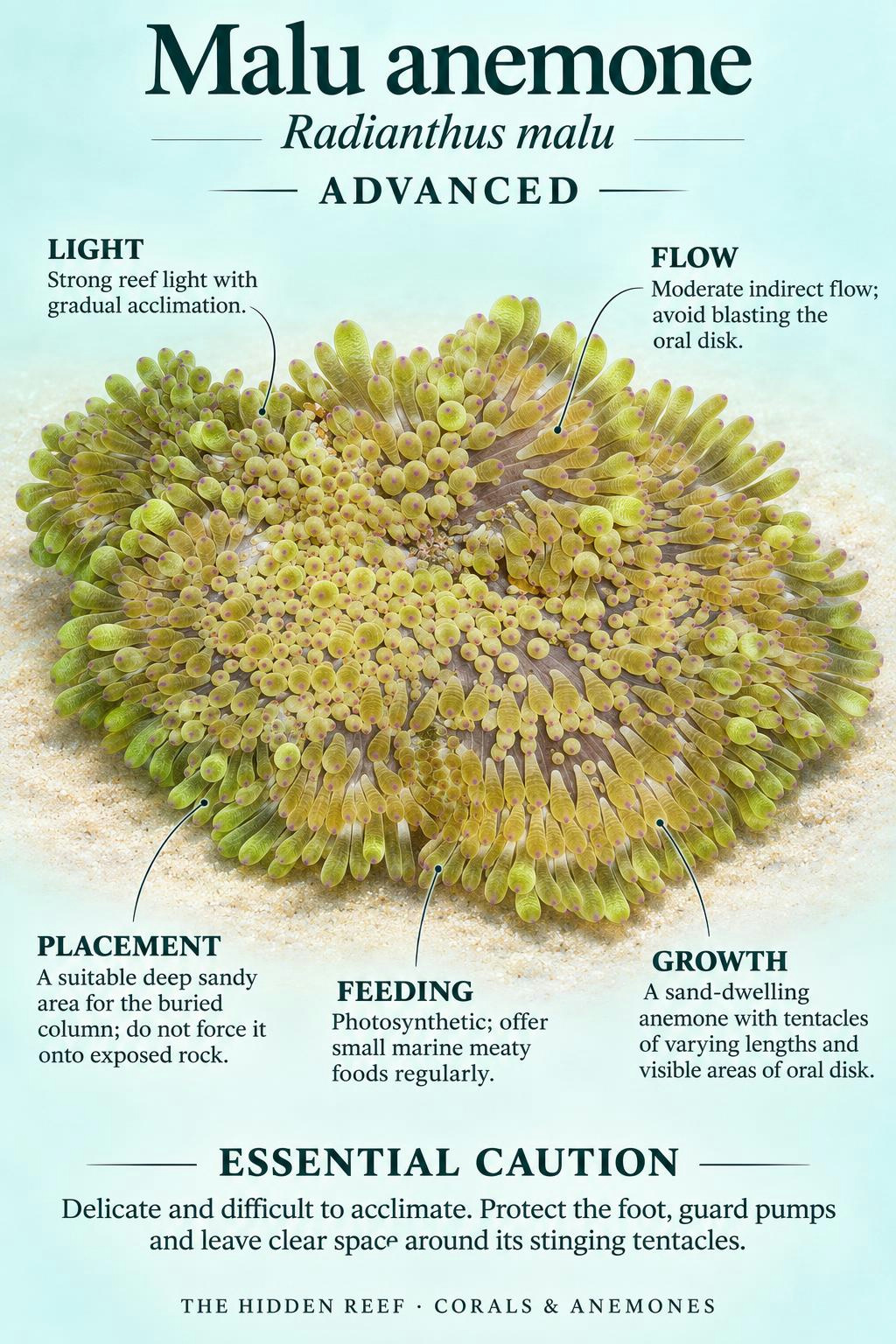
Strong reef light with gradual acclimation.
Water flow
Moderate indirect flow; avoid blasting the oral disk.
Placement & space
A suitable deep sandy area for the buried column; do not force it onto exposed rock.
Feeding
Photosynthetic; offer small marine meaty foods regularly.
Growth & adult form
A sand-dwelling anemone with tentacles of varying lengths and visible areas of oral disk.
Names you may see in stores
Often sold as Heteractis malu or Sebae. WoRMS accepts Radianthus malu. Sebae alone does not distinguish it from crispa.
A stable reef comes first
Match the seller’s established conditions, acclimate gradually, and monitor temperature, salinity and water chemistry. Light and flow vary with the specimen and aquarium; these labels are starting guidance, not a universal setting.
Sources & review
Care summaries are synthesized from the references below. Difficulty and availability labels are editorial judgments; neither implies current store stock.
- LiveAquaria — Malu seabae anemone. Consulted November 15, 2026.
- www.actiniaria.com — Radianthus_malu.php. Consulted November 15, 2026.
- World Register of Marine Species — Radianthus malu — taxonomy record. Consulted November 15, 2026.
Biological reference: Carlos Faria, via Actiniaria.com specimen photograph. Independently composed educational illustration; the source photograph is not reproduced. Colors and composition are illustrative, not a specimen for sale.