
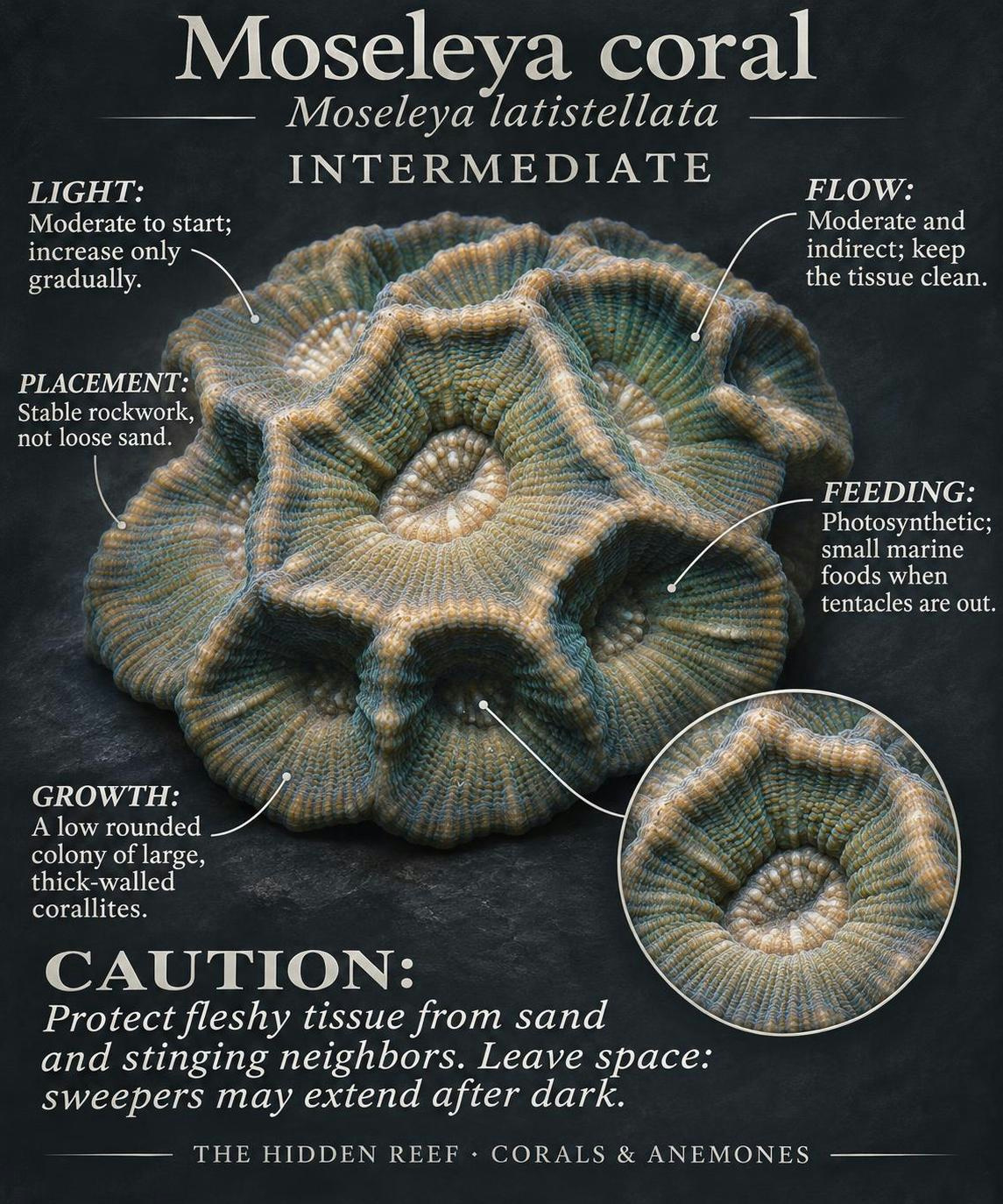
Lighting
Moderate light to start; increase only gradually once it has settled.
Water flow
Moderate indirect flow that keeps the surface clean without pressing tissue onto the skeleton. Sources range from gentle to fairly brisk.
Placement & space
Stable rockwork or a secure ledge rather than loose sand, with space from neighbors.
Feeding
Photosynthetic; offer small marine foods when the feeding tentacles are out, usually after dark, without leaving excess waste.
Growth & adult form
A low rounded colony of large, thick-walled corallites, rounded to polygonal in outline, under puffy tissue.
Names you may see in stores
The only species in its genus. Usually grey, brown or green; bright green pieces are uncommon. Also sold as pineapple coral, a name shared with unrelated corals. Label spellings such as latistella are not additional species. Older references place it in Faviidae; the World Register of Marine Species lists it in Lobophylliidae.
A stable reef comes first
Match the seller’s established conditions, acclimate gradually, and monitor temperature, salinity and water chemistry. Light and flow vary with the specimen and aquarium; these labels are starting guidance, not a universal setting.
Sources & review
Care summaries are synthesized from the references below. Difficulty and availability labels are editorial judgments; neither implies current store stock.
- Saltcorner — Moseleya latistellata species account. Consulted November 15, 2026.
- The Happy Reef — Moseleya coral care notes. Consulted November 15, 2026.
- Reef Builders — Moseleya latistella — the first colony I had to have. Consulted November 15, 2026.
- World Register of Marine Species — Moseleya latistellata — taxonomy record. Consulted November 15, 2026.
Biological reference: Corals of the World, via Reef Builders specimen photograph. Independently composed educational illustration; the source photograph is not reproduced. Colors and composition are illustrative, not a specimen for sale.