
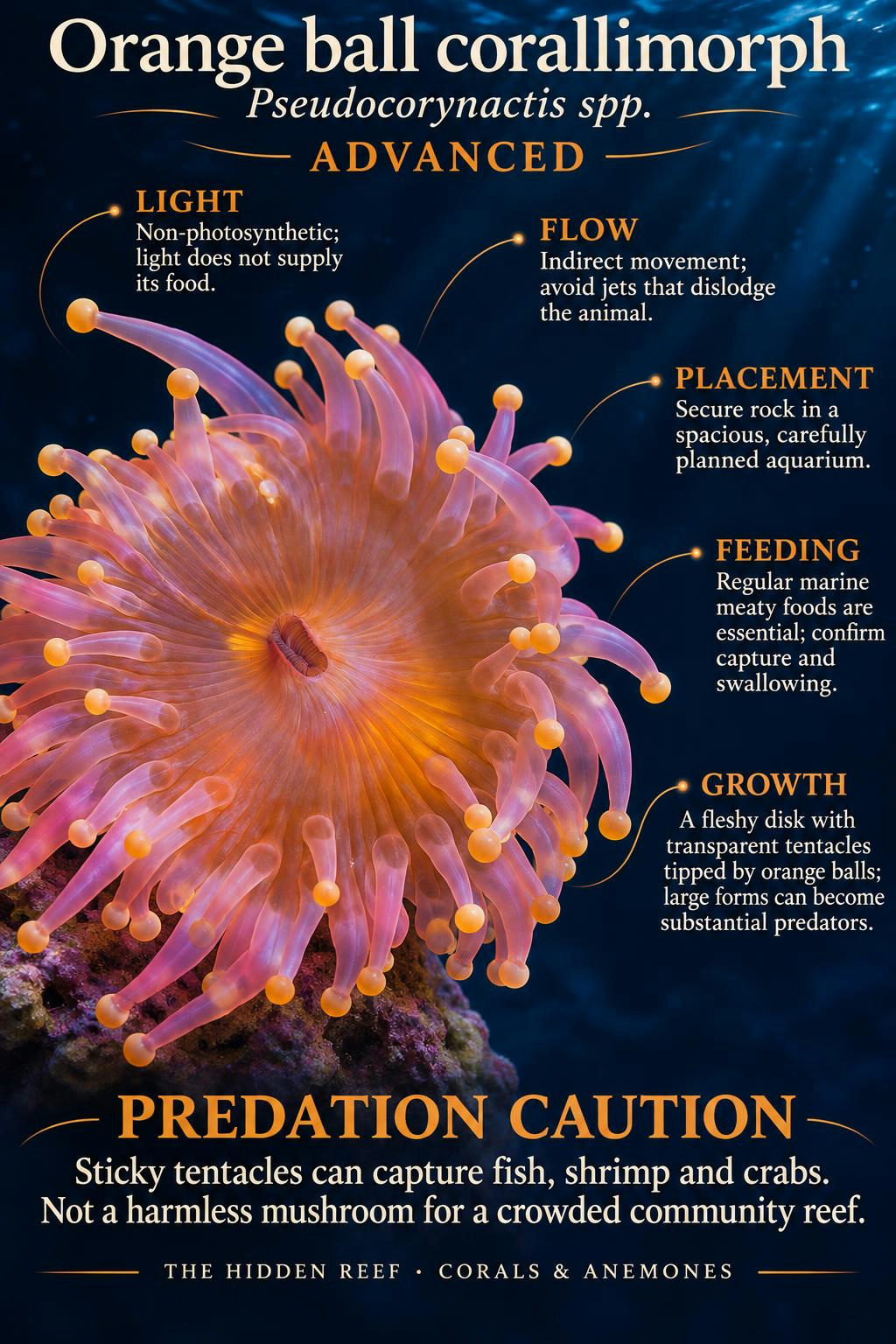
Lighting
Non-photosynthetic; light does not supply its food.
Water flow
Indirect movement; avoid jets that dislodge the animal.
Placement & space
Secure rock in a spacious, carefully planned aquarium.
Feeding
Regular marine meaty foods are essential; confirm capture and swallowing.
Growth & adult form
A fleshy disk with transparent tentacles tipped by orange balls; large forms can become substantial predators.
Names you may see in stores
Ball anemone is an ambiguous trade name. This guide concerns large Pseudocorynactis forms, not every tiny Corynactis-like hitchhiker. Corallimorphs are grouped with soft corals for browsing.
A stable reef comes first
Match the seller’s established conditions, acclimate gradually, and monitor temperature, salinity and water chemistry. Light and flow vary with the specimen and aquarium; these labels are starting guidance, not a universal setting.
Sources & review
Care summaries are synthesized from the references below. Difficulty and availability labels are editorial judgments; neither implies current store stock.
- Tidal Gardens — Stock orange ball pseudocorynactis. Consulted November 15, 2026.
Biological reference: Tidal Gardens specimen photograph. Independently composed educational illustration; the source photograph is not reproduced. Colors and composition are illustrative, not a specimen for sale.