
Lighting
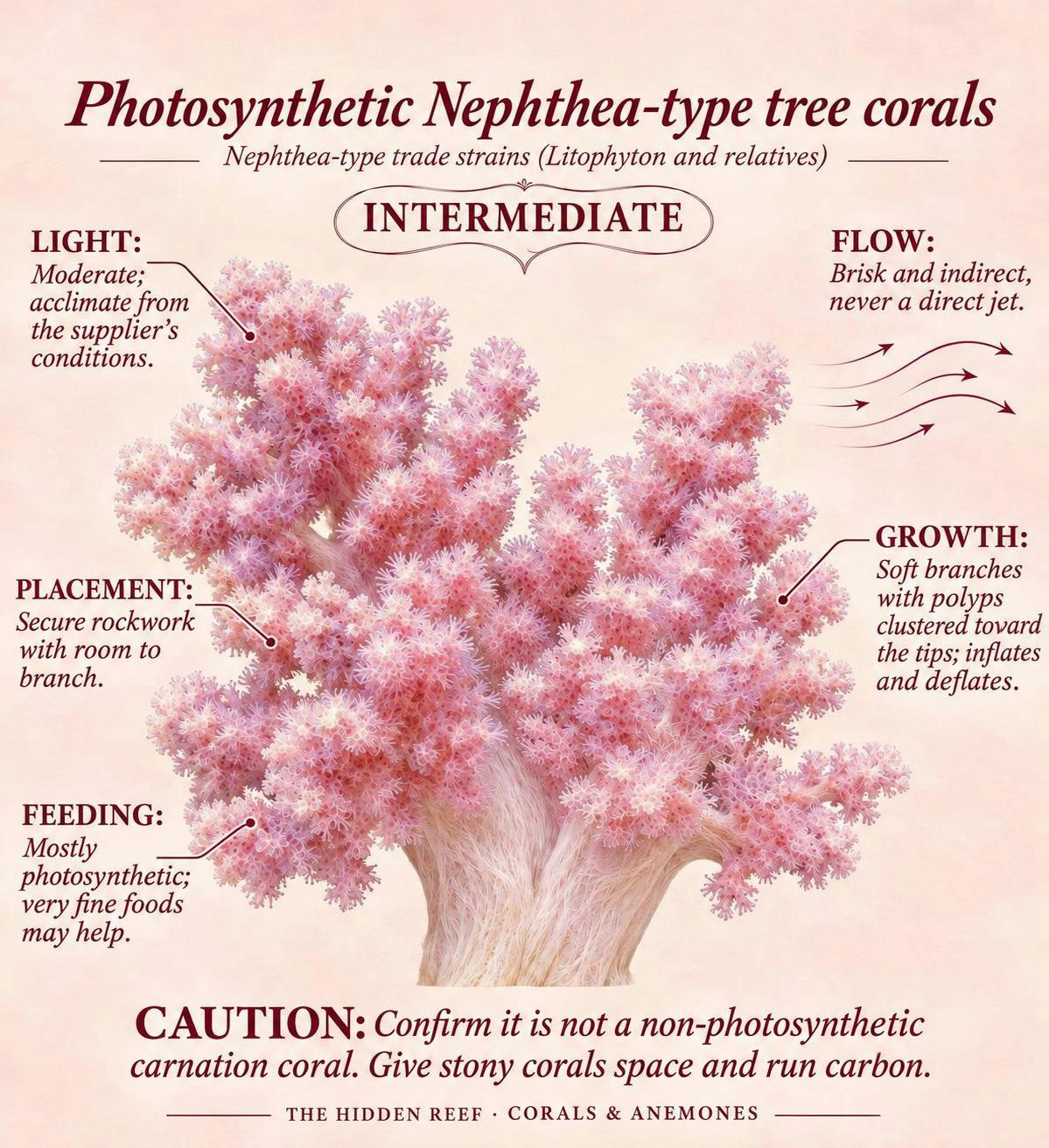
Moderate light, acclimated from the supplier's conditions.
Water flow
Brisk indirect circulation; avoid a jet that flattens the colony.
Placement & space
Secure rockwork with room for an expanded branching colony and some distance from sensitive stony corals.
Feeding
Relies heavily on its symbiotic algae. Very fine foods such as phytoplankton may help; sources disagree on how necessary they are.
Growth & adult form
A fleshy trunk divides into soft branches with polyps clustered toward the tips. Colonies inflate and deflate markedly.
Names you may see in stores
Neon green, pink and spaghetti strains are trade names. The World Register of Marine Species treats Nephthea as a synonym of Litophyton, and tree-shaped soft corals such as Capnella, Lemnalia and Sinularia are often confused with it; a tree outline alone does not prove the genus. A waxy film shed after a short closed spell is normal, but a colony that stays closed or deteriorates needs attention.
A stable reef comes first
Match the seller’s established conditions, acclimate gradually, and monitor temperature, salinity and water chemistry. Light and flow vary with the specimen and aquarium; these labels are starting guidance, not a universal setting.
Sources & review
Care summaries are synthesized from the references below. Difficulty and availability labels are editorial judgments; neither implies current store stock.
- AlgaeBarn — Keeping nephthea corals. Consulted November 15, 2026.
- Tidal Gardens — Nephthea care notes (Koji Wada Pink Nephthea listing). Consulted November 15, 2026.
- World Register of Marine Species — Nephthea (synonym of Litophyton) — taxonomy record. Consulted November 15, 2026.
Biological reference: Tidal Gardens specimen photograph. Independently composed educational illustration; the source photograph is not reproduced. Colors and composition are illustrative, not a specimen for sale.