
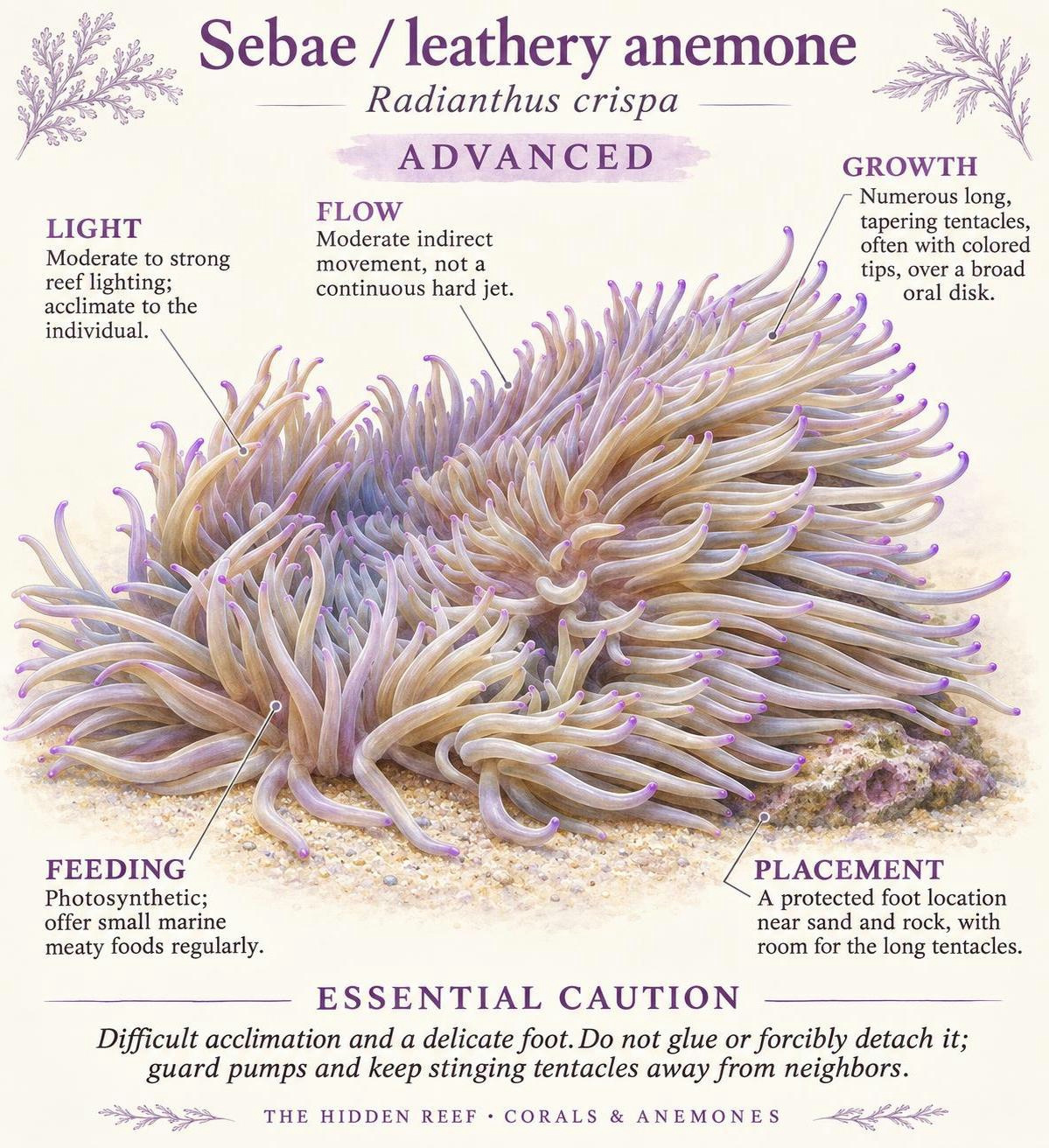
Lighting
Moderate to strong reef lighting; acclimate to the individual.
Water flow
Moderate indirect movement, not a continuous hard jet.
Placement & space
A protected foot location near sand and rock, with room for the long tentacles.
Feeding
Photosynthetic; offer small marine meaty foods regularly.
Growth & adult form
Numerous long, tapering tentacles, often with colored tips, over a broad oral disk.
Names you may see in stores
Sebae is also used for malu. This guide is crispa, commonly sold as Heteractis crispa; WoRMS accepts Radianthus crispa. Photograph color alone cannot establish health or identity.
A stable reef comes first
Match the seller’s established conditions, acclimate gradually, and monitor temperature, salinity and water chemistry. Light and flow vary with the specimen and aquarium; these labels are starting guidance, not a universal setting.
Sources & review
Care summaries are synthesized from the references below. Difficulty and availability labels are editorial judgments; neither implies current store stock.
- LiveAquaria — Sebae anemone. Consulted November 15, 2026.
- reefchasers.com — Sebae anemone care guide. Consulted November 15, 2026.
- www.actiniaria.com — Radianthus_crispa.php. Consulted November 15, 2026.
- World Register of Marine Species — Radianthus crispa — taxonomy record. Consulted November 15, 2026.
Biological reference: Valentina Lifatova, via Actiniaria.com specimen photograph. Independently composed educational illustration; the source photograph is not reproduced. Colors and composition are illustrative, not a specimen for sale.