
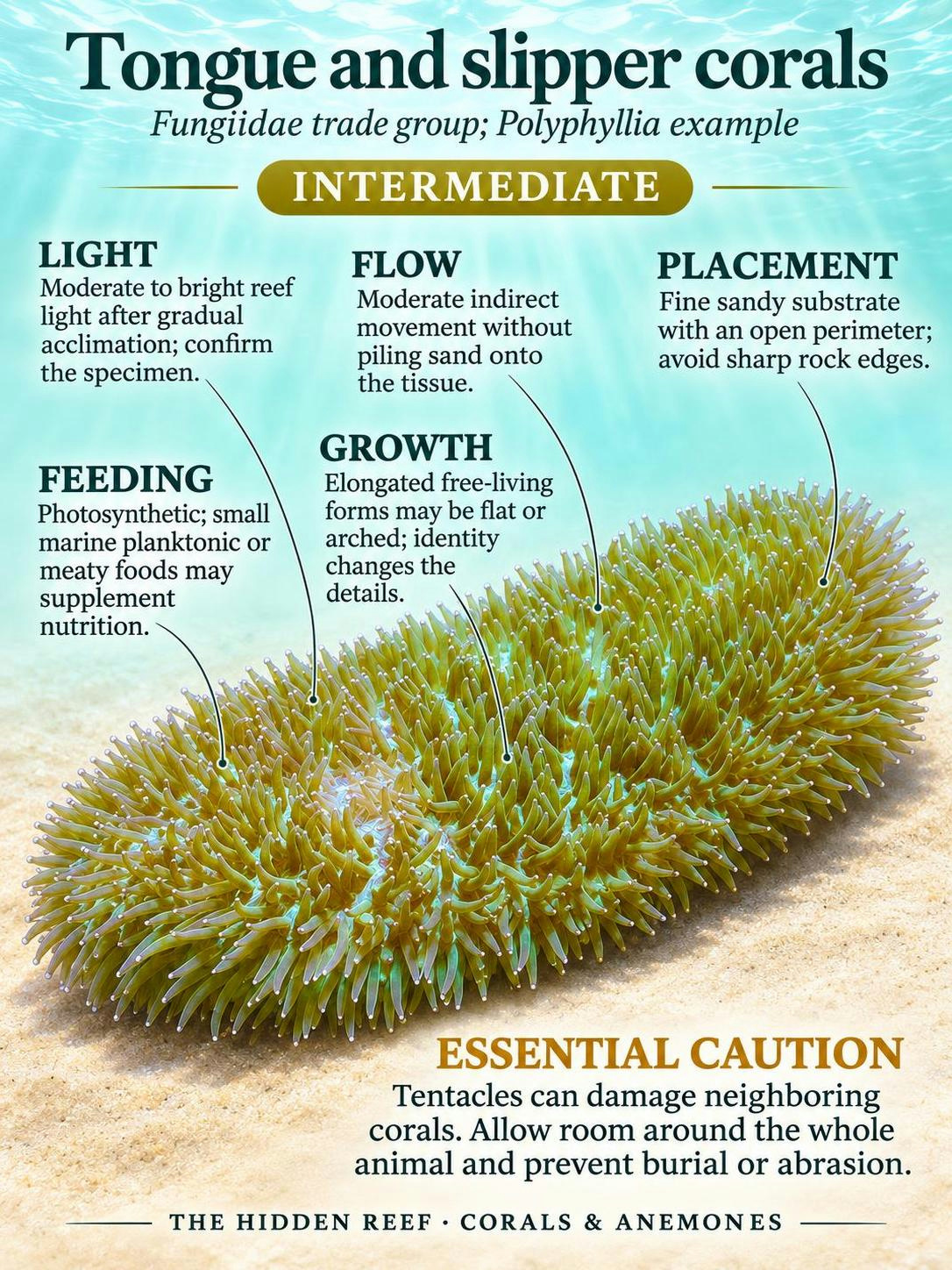
Lighting
Moderate to bright reef light after gradual acclimation; confirm the specimen.
Water flow
Moderate indirect movement without piling sand onto the tissue.
Placement & space
Fine sandy substrate with an open perimeter; avoid sharp rock edges.
Feeding
Photosynthetic; small marine planktonic or meaty foods may supplement nutrition.
Growth & adult form
Elongated free-living forms may be flat or arched; identity changes the details.
Names you may see in stores
Tongue and slipper names cover several fungiids. The photographed Polyphyllia example is not a universal species identification.
A stable reef comes first
Match the seller’s established conditions, acclimate gradually, and monitor temperature, salinity and water chemistry. Light and flow vary with the specimen and aquarium; these labels are starting guidance, not a universal setting.
Sources & review
Care summaries are synthesized from the references below. Difficulty and availability labels are editorial judgments; neither implies current store stock.
- LiveAquaria — Slipper tongue coral. Consulted November 15, 2026.
Biological reference: LiveAquaria specimen photograph. Independently composed educational illustration; the source photograph is not reproduced. Colors and composition are illustrative, not a specimen for sale.