
Lighting
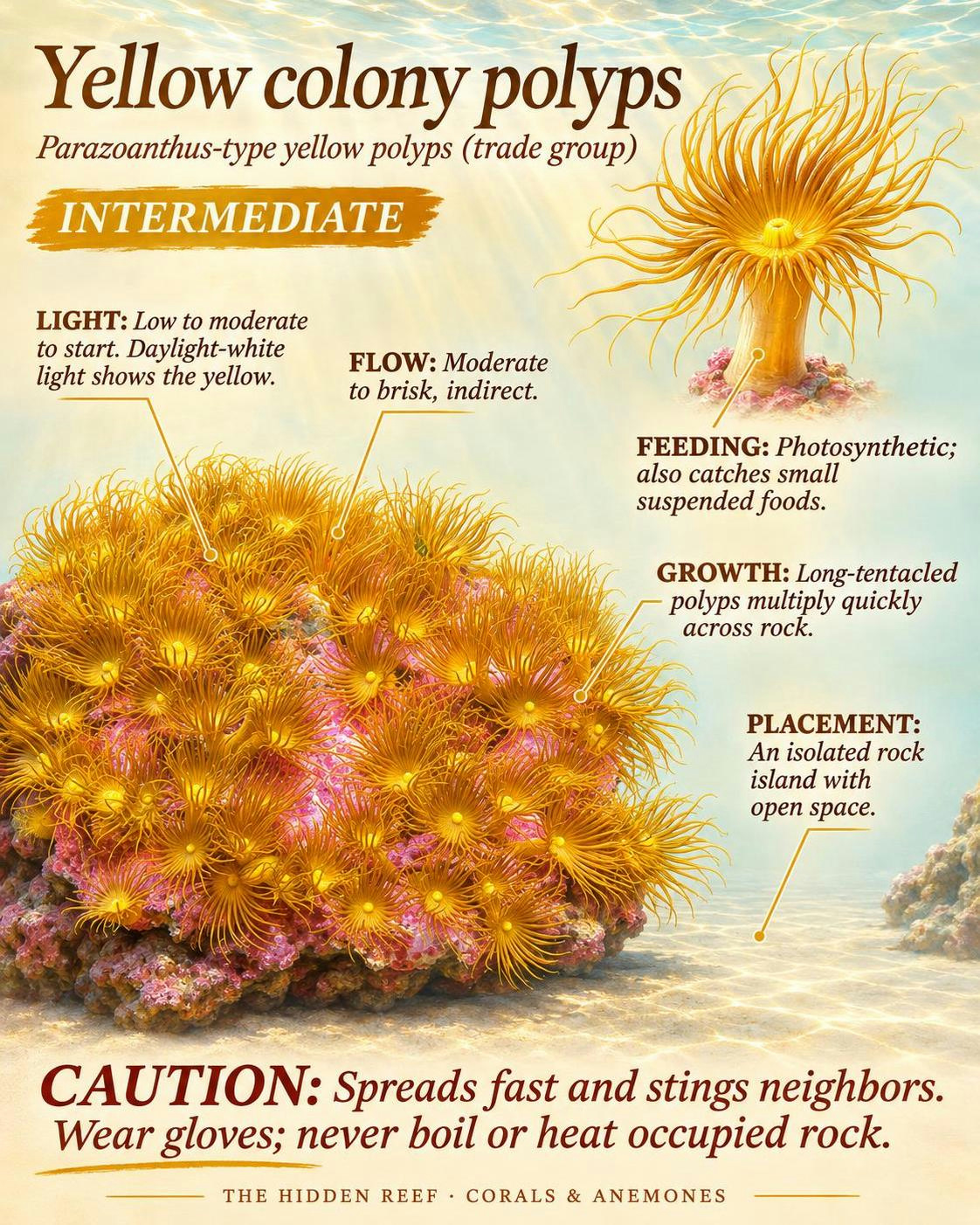
Low to moderate to start, raised gradually. Daylight-white lighting shows the yellow that blue-heavy lighting hides.
Water flow
Moderate to brisk indirect flow, enough to keep debris from settling between the polyps.
Placement & space
An isolated rock island with open space around the spreading colony.
Feeding
Photosynthetic, and an able catcher of small suspended foods. Normal tank feeding is often enough; watch what the polyps capture before adding target feeds.
Growth & adult form
Long-tentacled individual polyps multiply quickly across the rock.
Names you may see in stores
Sold as yellow polyps, yellow colony polyps or Parazoanthus gracilis; the World Register of Marine Species now lists that name under Hydrozoanthus gracilis. Trade pieces are not identified to species here, and a yellow color alone does not establish species or toxin content. Grouped with soft corals for browsing.
A stable reef comes first
Match the seller’s established conditions, acclimate gradually, and monitor temperature, salinity and water chemistry. Light and flow vary with the specimen and aquarium; these labels are starting guidance, not a universal setting.
Sources & review
Care summaries are synthesized from the references below. Difficulty and availability labels are editorial judgments; neither implies current store stock.
- Tidal Gardens — Parazoanthus coral care. Consulted November 15, 2026.
- LiveAquaria — Colony Polyp, Yellow. Consulted November 15, 2026.
- CDC — Suspected palytoxin inhalation exposures associated with zoanthid corals. Consulted November 15, 2026.
- World Register of Marine Species — Parazoanthus gracilis (listed under Hydrozoanthus gracilis) — taxonomy record. Consulted November 15, 2026.
Biological reference: LiveAquaria specimen photograph. Independently composed educational illustration; the source photograph is not reproduced. Colors and composition are illustrative, not a specimen for sale.