
At a glance
- Adult size
- Up to about 11.8 in
- Space
- 6 × 2 × 2 ft, about 180 US gallons
- Social needs
- Peaceful and sociable: keep a group, with monos, archerfish or other scats. Venom glands in the dorsal spines give a very painful sting.
Starting guidance, not a universal minimum. See the care details and sources below.
Adult size
FishBase lists a maximum of 30.0 cm (about 11.8 inches) total length, and Fishkeeping News says all scats can exceed 30 cm. Aquarium Glaser says most are fully grown at 15–20 cm and wild fish are hardly ever larger; TFH expects every scat but one small species to exceed 15 in (38 cm).
Aquarium space
Fishkeeping News says scats are shoaling fish that need a brackish set-up of at least 6 × 2 × 2 ft, which works out to about 180 US gallons (681 litres); TFH likewise gives around 180 US gallons for a school of the larger scats, with plenty of open swimming space.
Water conditions
Needs brackish or marine water. Fishkeeping News advises synthetic sea salt mixed to a specific gravity of 1.010 (seawater is about 1.025) at 25°C (77°F); TFH also aims for an average of 1.010 and says small changes at each water change do no harm. Keep the pH at least 8 with high carbonate hardness, around 20° KH (TFH); Aquarium Glaser says pH must never drop below 8 for long. FishBase gives 22–30°C (72–86°F). Some keep it in fresh water, but TFH says scats are healthier in brackish or marine tanks. These are maintenance ranges, not targets to swing between; avoid abrupt changes.
Natural home
Harbours, estuaries, lagoons and rivers from Somalia and Kenya to South Africa, east to Australia and Papua New Guinea; it forms shoals.
Food and feeding
Omnivore: flake, sticks and pellets, frozen bloodworm, mysis and krill, small crustaceans such as Artemia, plus nori, lettuce and other greens.
Tankmates and behavior
Peaceful and sociable: keep a group, with monos, archerfish or other scats. Venom glands in the dorsal spines give a very painful sting.
Setting up the habitat
A big brackish tank with open swimming room, strong external filters, fine sand or mud, mangrove roots or bogwood; scats eat live plants.
A closer look
Fishkeeping News calls it the least available and most expensive scat; Aquarium Glaser first offered it in 2017. It is Least Concern.
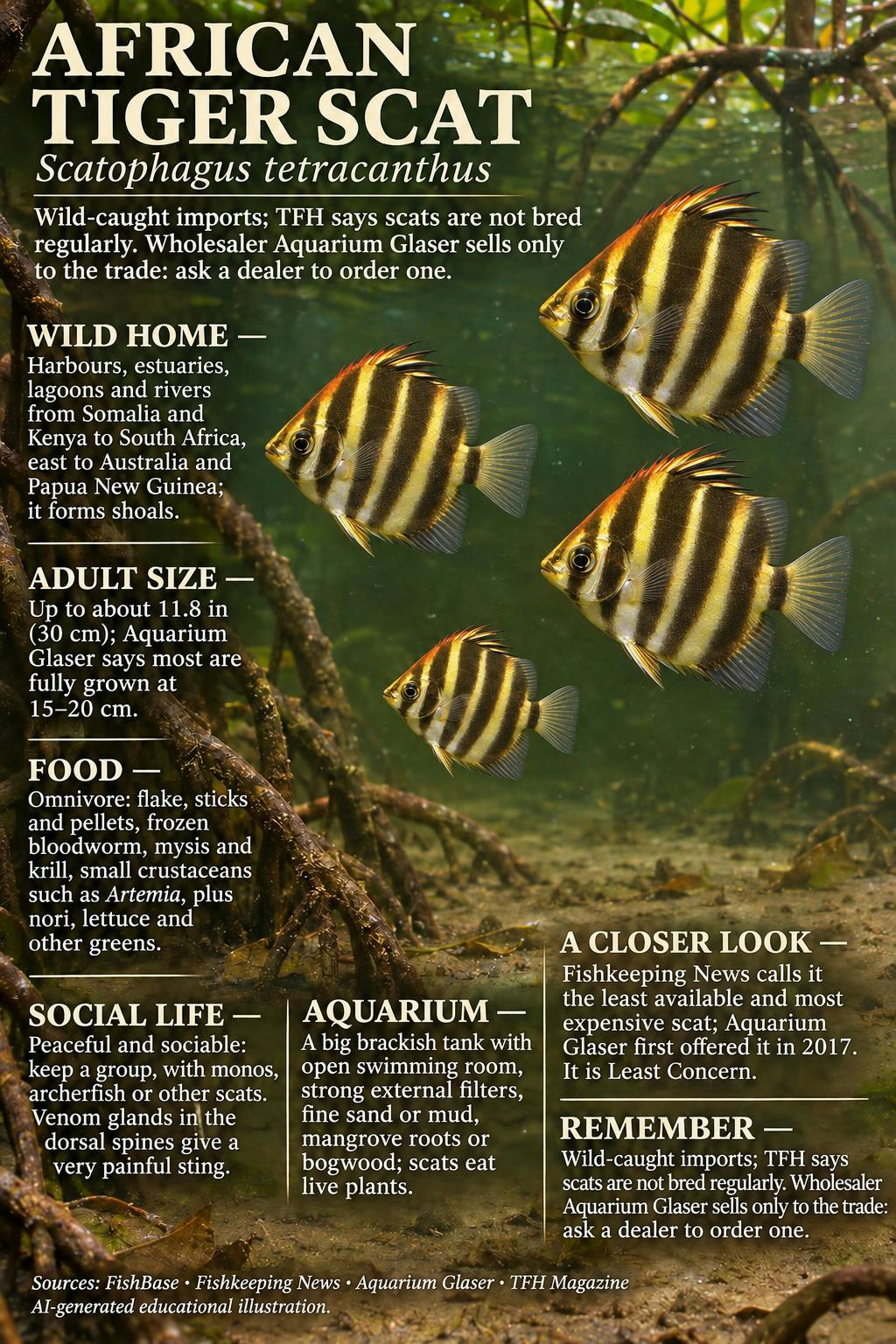
Read the infographic as text
- WILD HOME — Harbours, estuaries, lagoons and rivers from Somalia and Kenya to South Africa, east to Australia and Papua New Guinea; it forms shoals.
- ADULT SIZE — Up to about 11.8 in (30 cm); Aquarium Glaser says most are fully grown at 15–20 cm.
- FOOD — Omnivore: flake, sticks and pellets, frozen bloodworm, mysis and krill, small crustaceans such as Artemia, plus nori, lettuce and other greens.
- SOCIAL LIFE — Peaceful and sociable: keep a group, with monos, archerfish or other scats. Venom glands in the dorsal spines give a very painful sting.
- AQUARIUM — A big brackish tank with open swimming room, strong external filters, fine sand or mud, mangrove roots or bogwood; scats eat live plants.
- A CLOSER LOOK — Fishkeeping News calls it the least available and most expensive scat; Aquarium Glaser first offered it in 2017. It is Least Concern.
- REMEMBER — Wild-caught imports; TFH says scats are not bred regularly. Wholesaler Aquarium Glaser sells only to the trade: ask a dealer to order one.
How to use these figures
Published care ranges and suggested tank sizes are starting points, not guarantees. Tank footprint, group size, filtration, feeding, companions and the individual fish all matter. Standard length excludes the tail fin. Do not abruptly change established water conditions to match a number on a page.
Use a cycled aquarium, monitor water quality and quarantine new arrivals using a suitable species-specific plan. Persistent appetite loss, rapid breathing or weight loss warrants investigation.
Common questions
What should I know before choosing this fish?
Wild-caught imports; TFH says scats are not bred regularly. Wholesaler Aquarium Glaser sells only to the trade: ask a dealer to order one. Peaceful and sociable: keep a group, with monos, archerfish or other scats. Venom glands in the dorsal spines give a very painful sting.
What should I feed it?
Omnivore: flake, sticks and pellets, frozen bloodworm, mysis and krill, small crustaceans such as Artemia, plus nori, lettuce and other greens.
Why is it rare?
Fishkeeping News calls it the least available and most expensive scat; Aquarium Glaser first offered it in 2017. It is Least Concern.
Sources & review
Checked November 12, 2026. Retailer care guidance is not a universal biological minimum.
- FishBase — Scatophagus tetracanthus species account
- Fishkeeping News — African tiger scat article
- Aquarium Glaser — Scatophagus tetracanthus import report — reviewed care reference
- TFH Magazine — Scats and monos for the brackish-water aquarium