
At a glance
- Adult size
- About 1.2 in body length
- Space
- 16 × 8 in base for a group of 4–6
- Social needs
- A poor competitor that larger fish eat: keep 4–6 or more alone or with Boraras, Danionella or Dario. Males spar but do no harm.
Starting guidance, not a universal minimum. See the care details and sources below.
Adult size
Seriously Fish reports a maximum standard length of 30 mm (about 1.2 inches), excluding the tail fin; FishBase also gives 3.0 cm SL.
Aquarium space
Seriously Fish says a base of 16 × 8 in (40 × 20 cm) or more, about 16 litres (4 US gallons), is sufficient. It recommends buying at least 4–6 fish.
Water conditions
Seriously Fish lists 72–81°F (22–27°C), pH 6.5–7.5 and 2–12 dGH, and says it needs a steady pH. FishBase gives 24–28°C, with only lower limits of pH 6.5 and 6 dH. Keep filtration and water flow gentle. These are maintenance ranges, not targets to swing between; avoid abrupt changes.
Natural home
Still or slow, weedy water in Myanmar’s Lake Indawgyi and Ayeyarwady basin; one delta pool held clear water at 29°C and pH 7.1.
Food and feeding
Needs small live foods: Artemia nauplii, Daphnia, microworm. Seriously Fish knows of none taking dried or frozen; most refuse grindal worm.
Tankmates and behavior
A poor competitor that larger fish eat: keep 4–6 or more alone or with Boraras, Danionella or Dario. Males spar but do no harm.
Setting up the habitat
Dense planting, soft sand, roots, floating plants, leaf litter and short plastic pipes as refuges and spawning caves; keep the flow weak.
A closer look
Rarely traded and rare in the hobby (Seriously Fish), yet Least Concern on FishBase; its range is wider than once thought.
Read the infographic as text
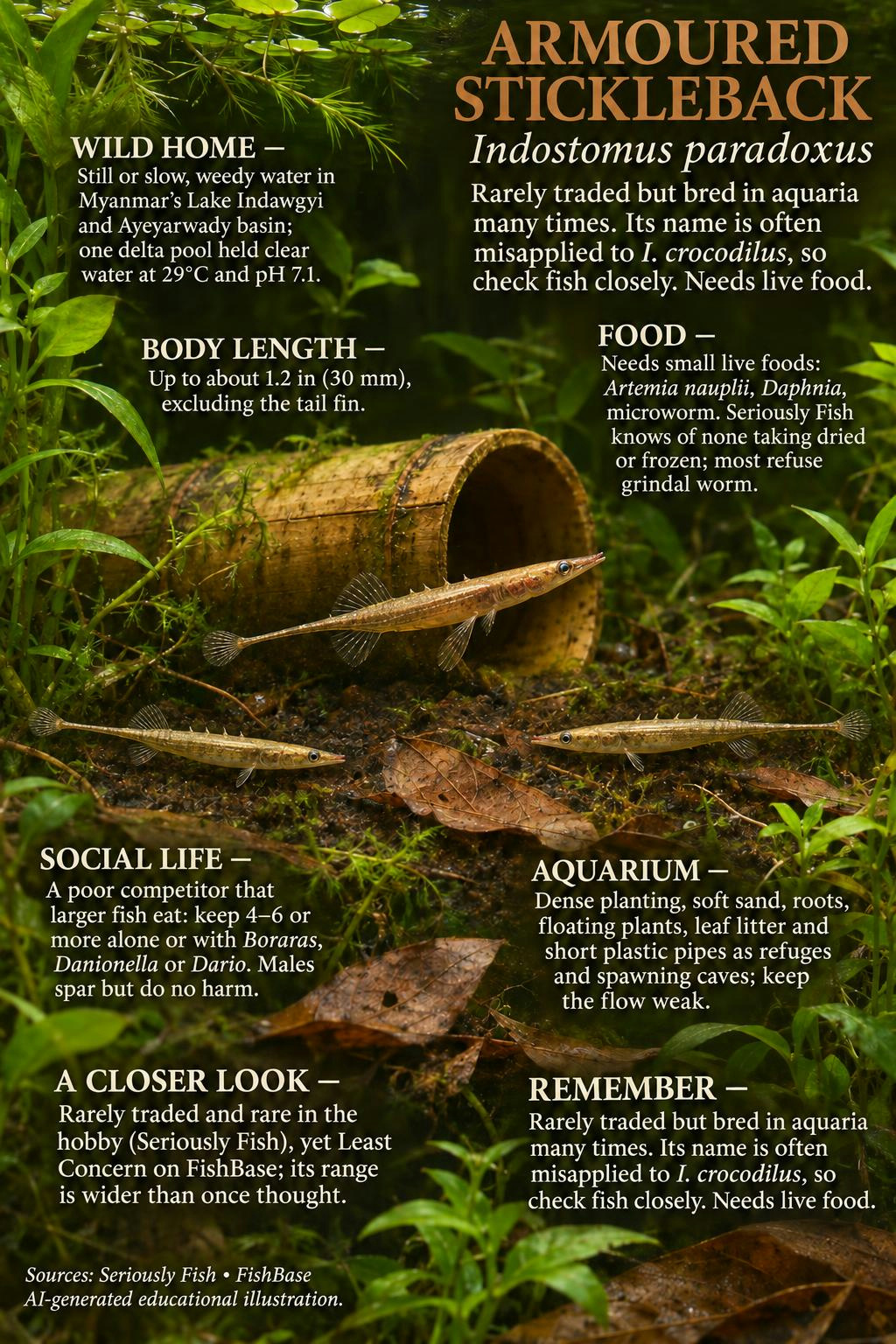
- WILD HOME — Still or slow, weedy water in Myanmar’s Lake Indawgyi and Ayeyarwady basin; one delta pool held clear water at 29°C and pH 7.1.
- BODY LENGTH — Up to about 1.2 in (30 mm), excluding the tail fin.
- FOOD — Needs small live foods: Artemia nauplii, Daphnia, microworm. Seriously Fish knows of none taking dried or frozen; most refuse grindal worm.
- SOCIAL LIFE — A poor competitor that larger fish eat: keep 4–6 or more alone or with Boraras, Danionella or Dario. Males spar but do no harm.
- AQUARIUM — Dense planting, soft sand, roots, floating plants, leaf litter and short plastic pipes as refuges and spawning caves; keep the flow weak.
- A CLOSER LOOK — Rarely traded and rare in the hobby (Seriously Fish), yet Least Concern on FishBase; its range is wider than once thought.
- REMEMBER — Rarely traded but bred in aquaria many times. Its name is often misapplied to I. crocodilus, so check fish closely. Needs live food.
How to use these figures
Published care ranges and suggested tank sizes are starting points, not guarantees. Tank footprint, group size, filtration, feeding, companions and the individual fish all matter. Standard length excludes the tail fin. Do not abruptly change established water conditions to match a number on a page.
Use a cycled aquarium, monitor water quality and quarantine new arrivals using a suitable species-specific plan. Persistent appetite loss, rapid breathing or weight loss warrants investigation.
Common questions
What should I know before choosing this fish?
Rarely traded but bred in aquaria many times. Its name is often misapplied to I. crocodilus, so check fish closely. Needs live food. A poor competitor that larger fish eat: keep 4–6 or more alone or with Boraras, Danionella or Dario. Males spar but do no harm.
What should I feed it?
Needs small live foods: Artemia nauplii, Daphnia, microworm. Seriously Fish knows of none taking dried or frozen; most refuse grindal worm.
Why is it rare?
Rarely traded and rare in the hobby (Seriously Fish), yet Least Concern on FishBase; its range is wider than once thought.
Sources & review
Checked November 12, 2026. Retailer care guidance is not a universal biological minimum.