
At a glance
- Adult size
- About 2 in body length
- Space
- 18 × 12 in base for a pair; see details
- Social needs
- Does not school, and males are aggressively territorial. Keep more females than males, with upper-water Nannostomus or Carnegiella.
Starting guidance, not a universal minimum. See the care details and sources below.
Adult size
Seriously Fish reports a maximum standard length of 50 mm (about 2.0 inches), excluding the tail fin; FishBase gives 4.7 cm SL.
Aquarium space
Seriously Fish says an 18 × 12 in (45 × 30 cm) base, about 41 litres (11 US gallons), suits a pair or one male with several females. For more than one male it advises at least 30 × 30 cm (12 × 12 in) per fish, as fights can badly damage fins.
Water conditions
Seriously Fish lists 70–82°F (21–28°C), pH 3.0–6.5 and 0–5 dGH; FishBase gives 24–28°C, pH 5.2–6.5 and up to 5 dH. Stable water is mandatory, so never add it to an immature tank; for breeding, Seriously Fish suggests pH 4.0–5.0. These are maintenance ranges, not targets to swing between; avoid abrupt changes.
Natural home
Slow, shaded forest streams of the upper Negro, Orinoco and Solimões, with tea-coloured, mineral-poor water, mud or sand and leaf litter.
Food and feeding
Notoriously reluctant to take dried food: new imports need daily live Daphnia, Artemia, grindal worm, microworm or chopped bloodworm.
Tankmates and behavior
Does not school, and males are aggressively territorial. Keep more females than males, with upper-water Nannostomus or Carnegiella.
Setting up the habitat
Soft sand, as it feeds from the bottom; roots, leaf litter and pipes or caves, dim light, gentle air-driven filtration and a mature tank.
A closer look
Rarely exported in numbers; most come mixed into wild cardinal tetra shipments, it ships poorly, and it is seldom bred in captivity.
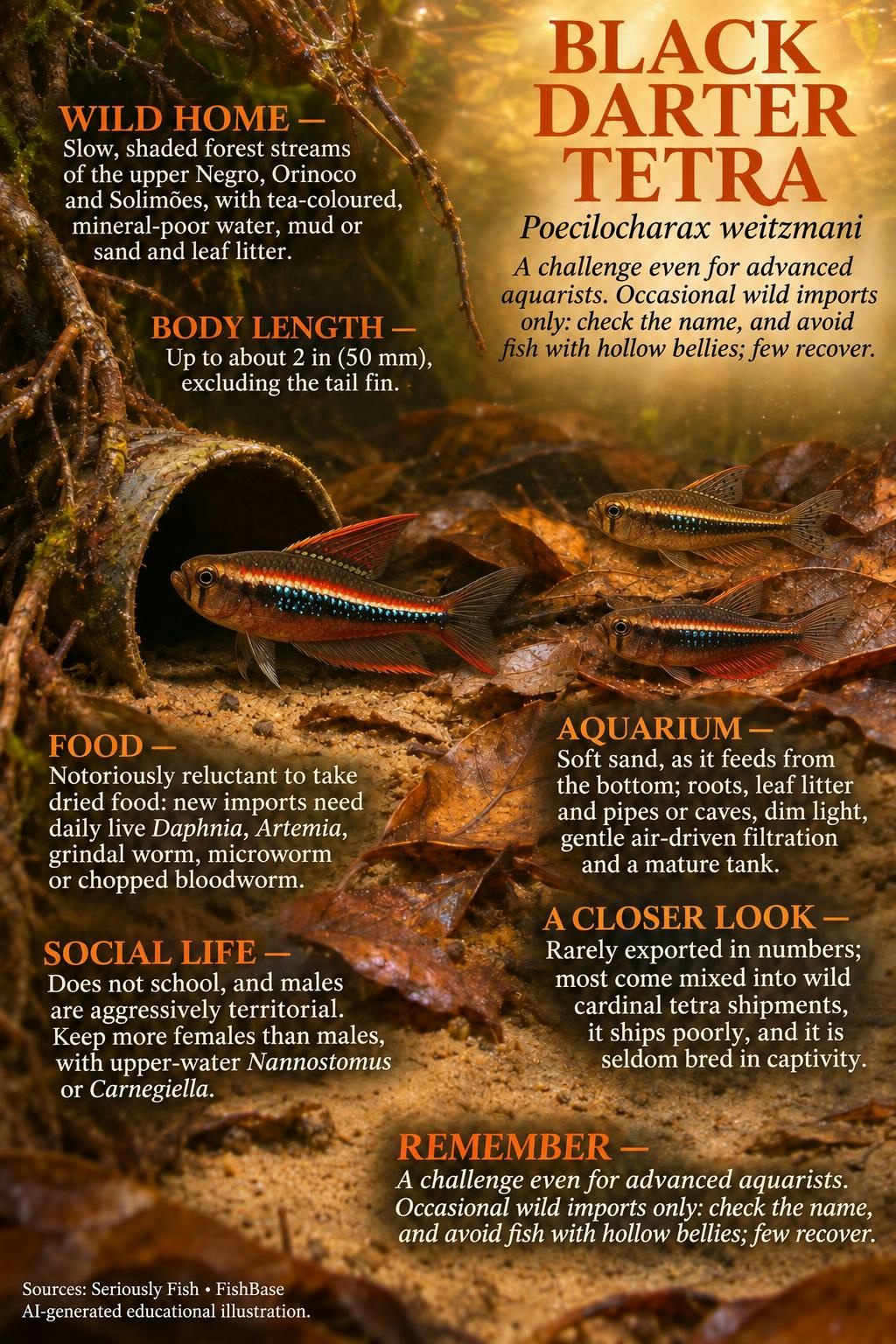
Read the infographic as text
- WILD HOME — Slow, shaded forest streams of the upper Negro, Orinoco and Solimões, with tea-coloured, mineral-poor water, mud or sand and leaf litter.
- BODY LENGTH — Up to about 2 in (50 mm), excluding the tail fin.
- FOOD — Notoriously reluctant to take dried food: new imports need daily live Daphnia, Artemia, grindal worm, microworm or chopped bloodworm.
- SOCIAL LIFE — Does not school, and males are aggressively territorial. Keep more females than males, with upper-water Nannostomus or Carnegiella.
- AQUARIUM — Soft sand, as it feeds from the bottom; roots, leaf litter and pipes or caves, dim light, gentle air-driven filtration and a mature tank.
- A CLOSER LOOK — Rarely exported in numbers; most come mixed into wild cardinal tetra shipments, it ships poorly, and it is seldom bred in captivity.
- REMEMBER — A challenge even for advanced aquarists. Occasional wild imports only: check the name, and avoid fish with hollow bellies; few recover.
How to use these figures
Published care ranges and suggested tank sizes are starting points, not guarantees. Tank footprint, group size, filtration, feeding, companions and the individual fish all matter. Standard length excludes the tail fin. Do not abruptly change established water conditions to match a number on a page.
Use a cycled aquarium, monitor water quality and quarantine new arrivals using a suitable species-specific plan. Persistent appetite loss, rapid breathing or weight loss warrants investigation.
Common questions
What should I know before choosing this fish?
A challenge even for advanced aquarists. Occasional wild imports only: check the name, and avoid fish with hollow bellies; few recover. Does not school, and males are aggressively territorial. Keep more females than males, with upper-water Nannostomus or Carnegiella.
What should I feed it?
Notoriously reluctant to take dried food: new imports need daily live Daphnia, Artemia, grindal worm, microworm or chopped bloodworm.
Why is it rare?
Rarely exported in numbers; most come mixed into wild cardinal tetra shipments, it ships poorly, and it is seldom bred in captivity.
Sources & review
Checked November 12, 2026. Retailer care guidance is not a universal biological minimum.