
At a glance
- Adult size
- 13.4 in (34 cm) TL
- Space
- 250 US gal (946 L) retained guidance; independent adult-care sources support smaller systems
- Social needs
- Keep one grouper. Small fish and ornamental crustaceans can be swallowed; similarly sized groupers may provoke territorial conflict. Potential companions must be too large to eat.
Starting guidance, not a universal minimum. See the care details and sources below.
Adult size
Maximum reported 13.4 inches (34 cm) total length. Plan for the adult, not the juvenile sale size.
Aquarium space
LiveAquaria recommends 250 US gallons (946 L). Independent adult-care support is stronger than that single listing: TFH specifically discusses C. formosa in the 120–135-US-gallon range (454–511 L), and Saltcorner lists 100+ US gallons (379 L). Retain the more conservative 250-US-gallon guidance here, with broad adult turning room, stable caves and high-capacity filtration. De Jong recommends about 660 US gallons (2,500 L); that differing recommendation is not a proven universal minimum. No exact length × width minimum is established here.
Water conditions
72–78°F (22–26°C); pH 8.1–8.4; dKH 8–12; SG 1.020–1.025. Maintain stable conditions rather than swinging between endpoints.
Natural home
Marine; maintain a stable, fully saltwater aquarium.
Food and feeding
Offer varied marine meaty foods, such as shrimp and suitable fish pieces.
Tankmates and behavior
Keep one grouper. Small fish and ornamental crustaceans can be swallowed; similarly sized groupers may provoke territorial conflict. Potential companions must be too large to eat.
Setting up the habitat
Provide broad turning space, stable adult-sized caves and overhangs, efficient filtration, protein skimming and regular waste removal.
A closer look
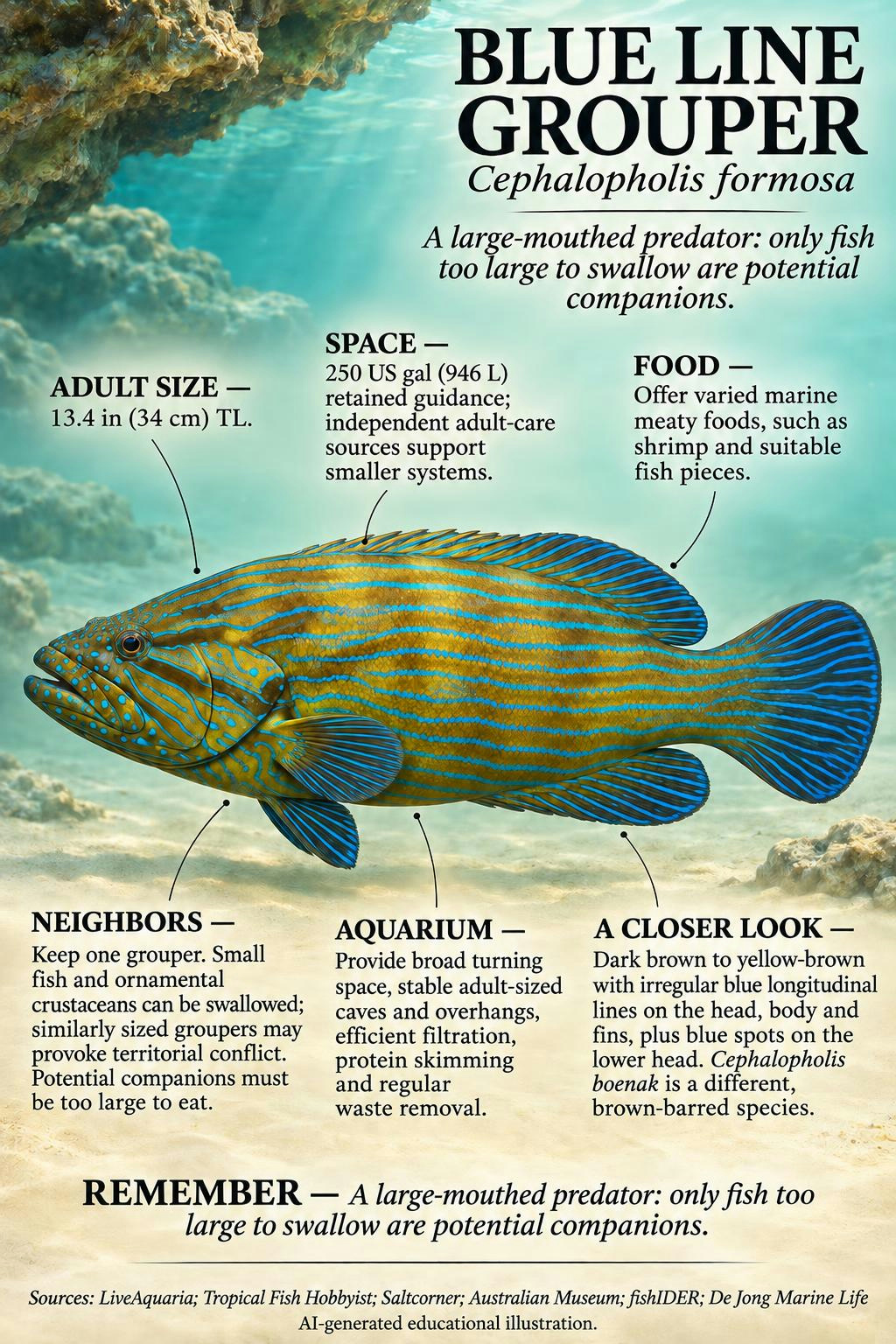
Dark brown to yellow-brown with irregular blue longitudinal lines on the head, body and fins, plus blue spots on the lower head. Cephalopholis boenak is a different, brown-barred species.
Read the infographic as text
- ADULT SIZE — 13.4 in (34 cm) TL.
- SPACE — 250 US gal (946 L) retained guidance; independent adult-care sources support smaller systems.
- FOOD — Offer varied marine meaty foods, such as shrimp and suitable fish pieces.
- NEIGHBORS — Keep one grouper. Small fish and ornamental crustaceans can be swallowed; similarly sized groupers may provoke territorial conflict. Potential companions must be too large to eat.
- AQUARIUM — Provide broad turning space, stable adult-sized caves and overhangs, efficient filtration, protein skimming and regular waste removal.
- A CLOSER LOOK — Dark brown to yellow-brown with irregular blue longitudinal lines on the head, body and fins, plus blue spots on the lower head. Cephalopholis boenak is a different, brown-barred species.
- REMEMBER — A large-mouthed predator: only fish too large to swallow are potential companions.
How to use these figures
Published care ranges and suggested tank sizes are starting points, not guarantees. Tank footprint, group size, filtration, feeding, companions and the individual fish all matter. Standard length excludes the tail fin. Do not abruptly change established water conditions to match a number on a page.
Use a cycled aquarium, monitor water quality and quarantine new arrivals using a suitable species-specific plan. Persistent appetite loss, rapid breathing or weight loss warrants investigation.
Common questions
What should I know before choosing this fish?
A large-mouthed predator: only fish too large to swallow are potential companions. Keep one grouper. Small fish and ornamental crustaceans can be swallowed; similarly sized groupers may provoke territorial conflict. Potential companions must be too large to eat.
What should I feed it?
Offer varied marine meaty foods, such as shrimp and suitable fish pieces.
How much space does an adult need?
LiveAquaria recommends 250 US gallons (946 L). Independent adult-care support is stronger than that single listing: TFH specifically discusses C. formosa in the 120–135-US-gallon range (454–511 L), and Saltcorner lists 100+ US gallons (379 L). Retain the more conservative 250-US-gallon guidance here, with broad adult turning room, stable caves and high-capacity filtration. De Jong recommends about 660 US gallons (2,500 L); that differing recommendation is not a proven universal minimum. No exact length × width minimum is established here.
Sources & review
Checked November 12, 2026. Retailer care guidance is not a universal biological minimum.
- LiveAquaria — Blue line grouper (bluelined hind) — reviewed care reference
- grouper-museum — Cephalopholis formosa
- grouper-fishider — Cephalopholis formosa
- Western Australian Museum — Cephalopholis boenak (distinct comparison species)
- grouper-dejong — Cephalopholis formosa
- grouper-tmc — Cephalopholis formosa
- TFH — Groupers in the Home Aquarium
- Saltcorner — Bluelined Hind