
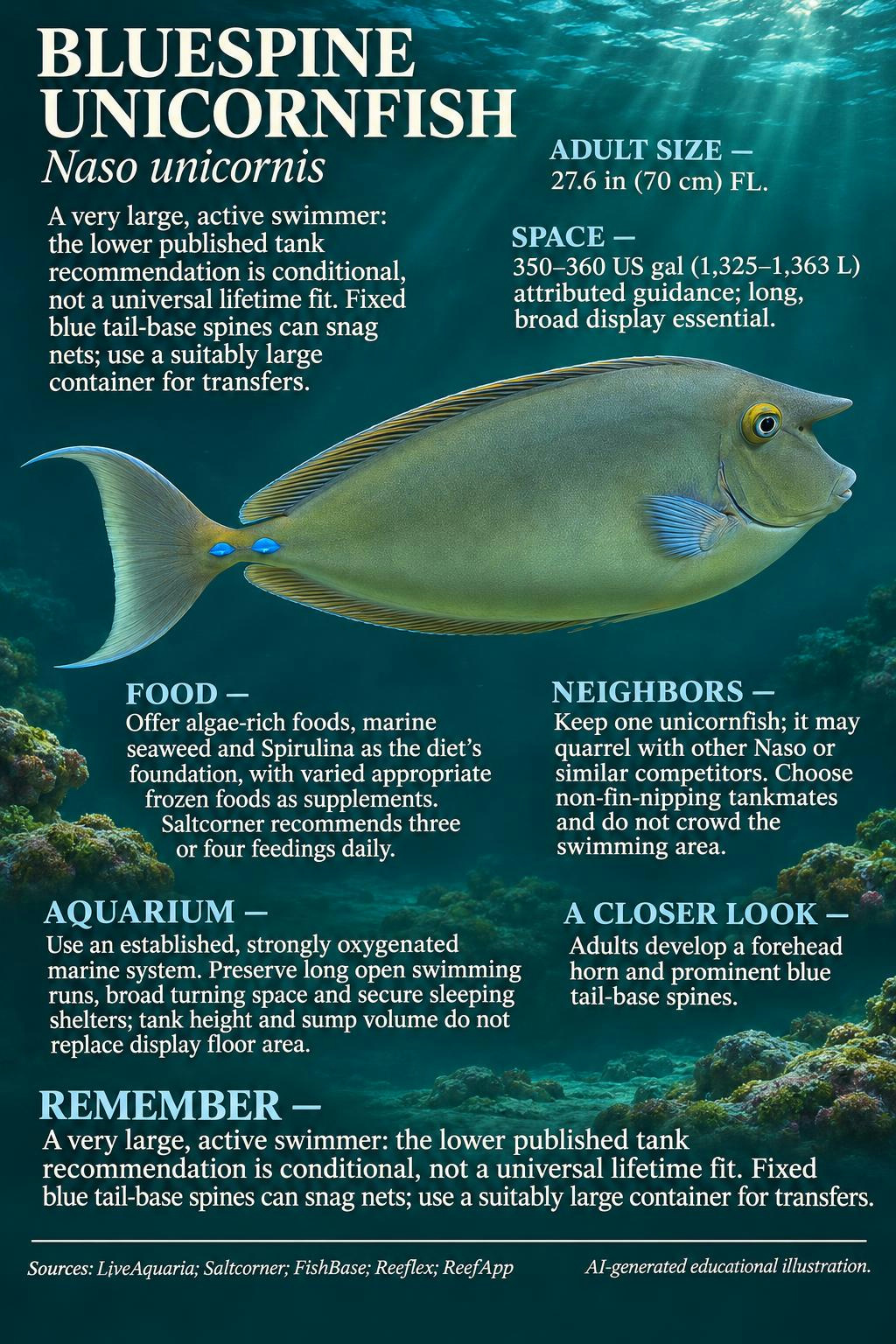
At a glance
- Adult size
- 27.6 in (70 cm) FL
- Space
- 350–360 US gal (1,325–1,363 L) attributed guidance; long, broad display essential
- Social needs
- Keep one unicornfish; it may quarrel with other Naso or similar competitors. Choose non-fin-nipping tankmates and do not crowd the swimming area.
Starting guidance, not a universal minimum. See the care details and sources below.
Adult size
Maximum reported 27.6 inches (70 cm) fork length. Plan for the adult, not the juvenile sale size.
Aquarium space
Saltcorner lists 350 US gallons (1,325 L) alongside a 70 cm fish; LiveAquaria gives 360 US gallons (1,363 L). A single adult is a conditional large-home-aquarium option only with long, wide-open swimming runs and generous turning room after rockwork, not any tank of that volume. Recommendations differ sharply: Reeflex advises 2,642 US gallons (10,000 L), and ReefApp warns that full-grown fish normally exceed home-aquarium provision. No precise minimum length or width is established here.
Water conditions
72–78°F (22–26°C); pH 8.1–8.4; dKH 8–12; SG 1.020–1.025. Maintain stable conditions rather than swinging between endpoints.
Natural home
Marine; maintain a stable, fully saltwater aquarium.
Food and feeding
Offer algae-rich foods, marine seaweed and Spirulina as the diet’s foundation, with varied appropriate frozen foods as supplements. Saltcorner recommends three or four feedings daily.
Tankmates and behavior
Keep one unicornfish; it may quarrel with other Naso or similar competitors. Choose non-fin-nipping tankmates and do not crowd the swimming area.
Setting up the habitat
Use an established, strongly oxygenated marine system. Preserve long open swimming runs, broad turning space and secure sleeping shelters; tank height and sump volume do not replace display floor area.
A closer look
Adults develop a forehead horn and prominent blue tail-base spines.
Read the infographic as text
- ADULT SIZE — 27.6 in (70 cm) FL.
- SPACE — 350–360 US gal (1,325–1,363 L) attributed guidance; long, broad display essential.
- FOOD — Offer algae-rich foods, marine seaweed and Spirulina as the diet’s foundation, with varied appropriate frozen foods as supplements. Saltcorner recommends three or four feedings daily.
- NEIGHBORS — Keep one unicornfish; it may quarrel with other Naso or similar competitors. Choose non-fin-nipping tankmates and do not crowd the swimming area.
- AQUARIUM — Use an established, strongly oxygenated marine system. Preserve long open swimming runs, broad turning space and secure sleeping shelters; tank height and sump volume do not replace display floor area.
- A CLOSER LOOK — Adults develop a forehead horn and prominent blue tail-base spines.
- REMEMBER — A very large, active swimmer: the lower published tank recommendation is conditional, not a universal lifetime fit. Fixed blue tail-base spines can snag nets; use a suitably large container for transfers.
How to use these figures
Published care ranges and suggested tank sizes are starting points, not guarantees. Tank footprint, group size, filtration, feeding, companions and the individual fish all matter. Standard length excludes the tail fin. Do not abruptly change established water conditions to match a number on a page.
Use a cycled aquarium, monitor water quality and quarantine new arrivals using a suitable species-specific plan. Persistent appetite loss, rapid breathing or weight loss warrants investigation.
Common questions
What should I know before choosing this fish?
A very large, active swimmer: the lower published tank recommendation is conditional, not a universal lifetime fit. Fixed blue tail-base spines can snag nets; use a suitably large container for transfers. Keep one unicornfish; it may quarrel with other Naso or similar competitors. Choose non-fin-nipping tankmates and do not crowd the swimming area.
What should I feed it?
Offer algae-rich foods, marine seaweed and Spirulina as the diet’s foundation, with varied appropriate frozen foods as supplements. Saltcorner recommends three or four feedings daily.
How much space does an adult need?
Saltcorner lists 350 US gallons (1,325 L) alongside a 70 cm fish; LiveAquaria gives 360 US gallons (1,363 L). A single adult is a conditional large-home-aquarium option only with long, wide-open swimming runs and generous turning room after rockwork, not any tank of that volume. Recommendations differ sharply: Reeflex advises 2,642 US gallons (10,000 L), and ReefApp warns that full-grown fish normally exceed home-aquarium provision. No precise minimum length or width is established here.
Sources & review
Checked November 12, 2026. Retailer care guidance is not a universal biological minimum.