
At a glance
- Adult size
- About 1.7 in body length
- Space
- 20+ US gallons (CLS); GWG 150+ litres
- Social needs
- Not for novices. Territorial: both sexes spar and a dominant fish harasses the rest. Keep six or more, never a pair; adults eat fry.
Starting guidance, not a universal minimum. See the care details and sources below.
Adult size
FishBase gives a maximum standard length of 4.3 cm (about 1.7 inches), excluding the tail fin; the GWG’s maximum is slightly larger. The Chicago Livebearer Society gives 1.5 in for males and 2.0 in for females.
Aquarium space
The Chicago Livebearer Society says adults need 20 US gallons (76 litres) or more and calls ten-gallon tanks unsuitable for them. The GWG recommends at least 150 litres (about 40 US gallons); a tank with a generous base and little height is better.
Water conditions
The Chicago Livebearer Society keeps it cool, 68–74°F (20–23°C), in hard water, and says it does very well at room temperature; its breeder’s tank was unheated. No source gives a pH or hardness figure. The GWG warns that constant temperatures above 24°C (75°F) make the fish sick and age it too fast, so give a winter rest below 20°C (68°F) for 2 or 3 months, when breeding stops. Spawning restarts at 20 or 21°C and stops again when it gets too warm, at 25°C (77°F). It asks for moderate to swift flow, a high oxygen level and 60–80% water changes every week. These are maintenance ranges, not targets to swing between; make the seasonal change slowly and avoid abrupt changes.
Natural home
Spring-fed ponds and small creeks with little or no flow above the El Saltito falls, Durango, Mexico, over sand, gravel and silty mud.
Food and feeding
Takes flake. The GWG suggests bloodworms, water fleas, mysids and boiled peas; the CLS prefers vegetable flake, warning against high protein.
Tankmates and behavior
Not for novices. Territorial: both sexes spar and a dominant fish harasses the rest. Keep six or more, never a pair; adults eat fry.
Setting up the habitat
Treat it like a territorial cichlid: rock piles, caves and plants to break sight lines, plus roots or wood and moderate to swift flow.
A closer look
Endangered (IUCN): pumping dries its springs, and introduced tilapia, bass and sunfish invade them. Few fish are left at El Toboso.
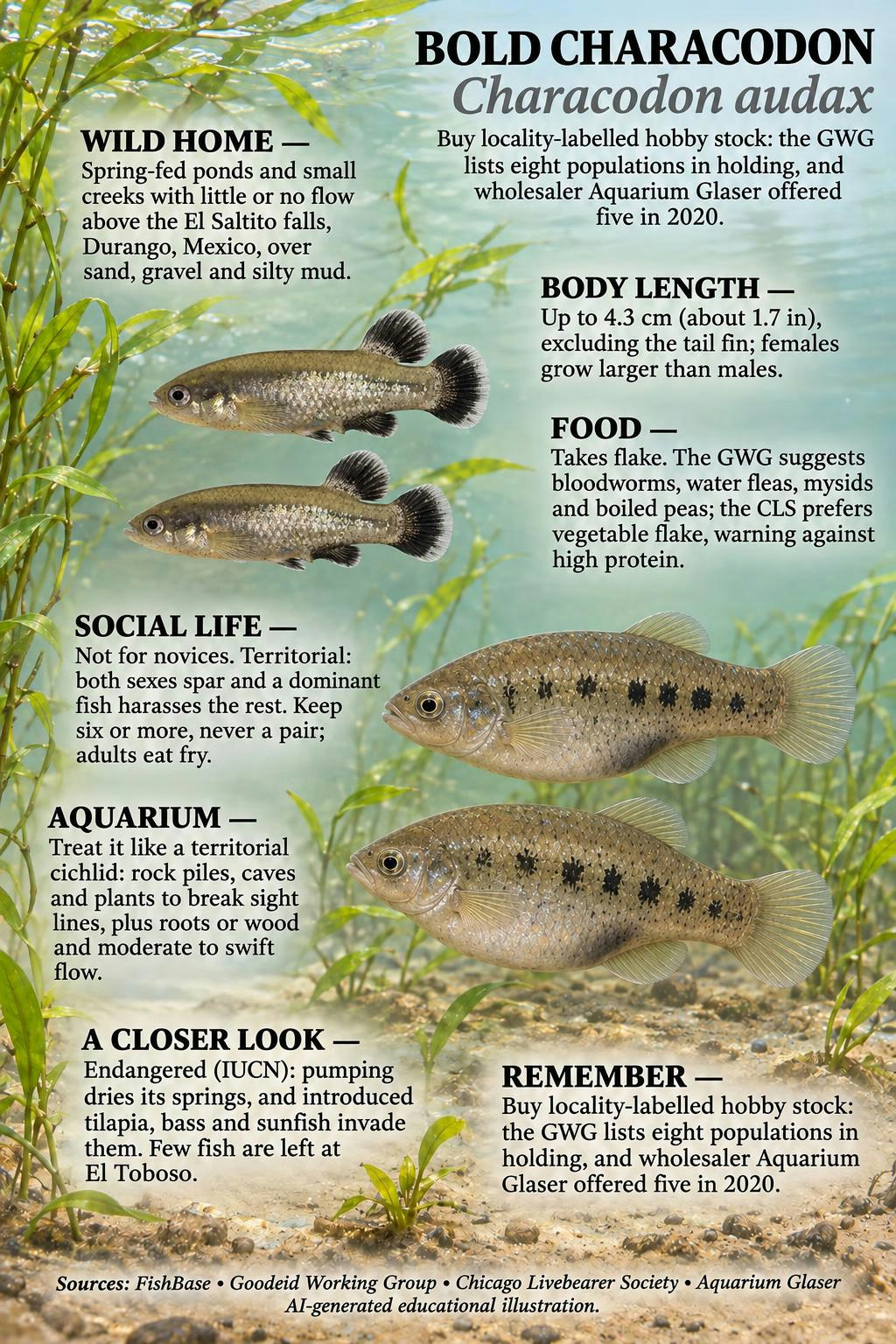
Read the infographic as text
- WILD HOME — Spring-fed ponds and small creeks with little or no flow above the El Saltito falls, Durango, Mexico, over sand, gravel and silty mud.
- BODY LENGTH — Up to 4.3 cm (about 1.7 in), excluding the tail fin; females grow larger than males.
- FOOD — Takes flake. The GWG suggests bloodworms, water fleas, mysids and boiled peas; the CLS prefers vegetable flake, warning against high protein.
- SOCIAL LIFE — Not for novices. Territorial: both sexes spar and a dominant fish harasses the rest. Keep six or more, never a pair; adults eat fry.
- AQUARIUM — Treat it like a territorial cichlid: rock piles, caves and plants to break sight lines, plus roots or wood and moderate to swift flow.
- A CLOSER LOOK — Endangered (IUCN): pumping dries its springs, and introduced tilapia, bass and sunfish invade them. Few fish are left at El Toboso.
- REMEMBER — Buy locality-labelled hobby stock: the GWG lists eight populations in holding, and wholesaler Aquarium Glaser offered five in 2020.
How to use these figures
Published care ranges and suggested tank sizes are starting points, not guarantees. Tank footprint, group size, filtration, feeding, companions and the individual fish all matter. Standard length excludes the tail fin. Do not abruptly change established water conditions to match a number on a page.
Use a cycled aquarium, monitor water quality and quarantine new arrivals using a suitable species-specific plan. Persistent appetite loss, rapid breathing or weight loss warrants investigation.
Common questions
What should I know before choosing this fish?
Buy locality-labelled hobby stock: the GWG lists eight populations in holding, and wholesaler Aquarium Glaser offered five in 2020. Not for novices. Territorial: both sexes spar and a dominant fish harasses the rest. Keep six or more, never a pair; adults eat fry.
What should I feed it?
Takes flake. The GWG suggests bloodworms, water fleas, mysids and boiled peas; the CLS prefers vegetable flake, warning against high protein.
Why is it rare?
Endangered (IUCN): pumping dries its springs, and introduced tilapia, bass and sunfish invade them. Few fish are left at El Toboso.
Sources & review
Checked November 12, 2026. Retailer care guidance is not a universal biological minimum.
- FishBase — Characodon audax species account
- Goodeid Working Group — Characodon lateralis (bold characodon) species account
- Chicago Livebearer Society — Characodon audax “El Toboso” fish profile
- Aquarium Glaser — Characodon audax Puente Pino Suarez and Guadalupe Aguilera stock note — reviewed care reference