
At a glance
- Adult size
- LiveAquaria lists 6 in; FishBase records 15 cm SL
- Space
- 130+ US gallons
- Social needs
- Rated semi-aggressive. Juveniles usually get along, but adults quarrel with one another.
Starting guidance, not a universal minimum. See the care details and sources below.
Adult size
FishBase reports a maximum recorded standard length of 15 cm (5.9 inches), excluding the tail. A recorded maximum is not a promise of typical aquarium size. LiveAquaria lists a maximum of 6 inches.
Aquarium space
LiveAquaria’s quick-facts panel lists a minimum of 130 US gallons (492 litres); its care text calls for a large, established reef aquarium, the deeper the better.
Water conditions
LiveAquaria’s quick-facts panel lists 72–78°F (22–26°C), pH 8.1–8.4, dKH 8–12 and specific gravity 1.020–1.025. These are maintenance ranges, not targets to swing between; avoid abrupt changes.
Natural home
Deep water from South Africa to Palau, Japan and Indonesia, 92–300 m down and usually 200–300 m; males are seen near coelacanth caves.
Food and feeding
Enriched frozen mysis and brine shrimp, and in time quality flake in small amounts through the day; a refugium adds live copepods.
Tankmates and behavior
Rated semi-aggressive. Juveniles usually get along, but adults quarrel with one another.
Setting up the habitat
130 gallons or more, with live rock caves and crevices, open areas and low to moderate light; it keeps to the lower tank.
A closer look
Collecting it deeper than 200 feet takes much work and danger, so it commands a hefty price, and supply is sporadic.
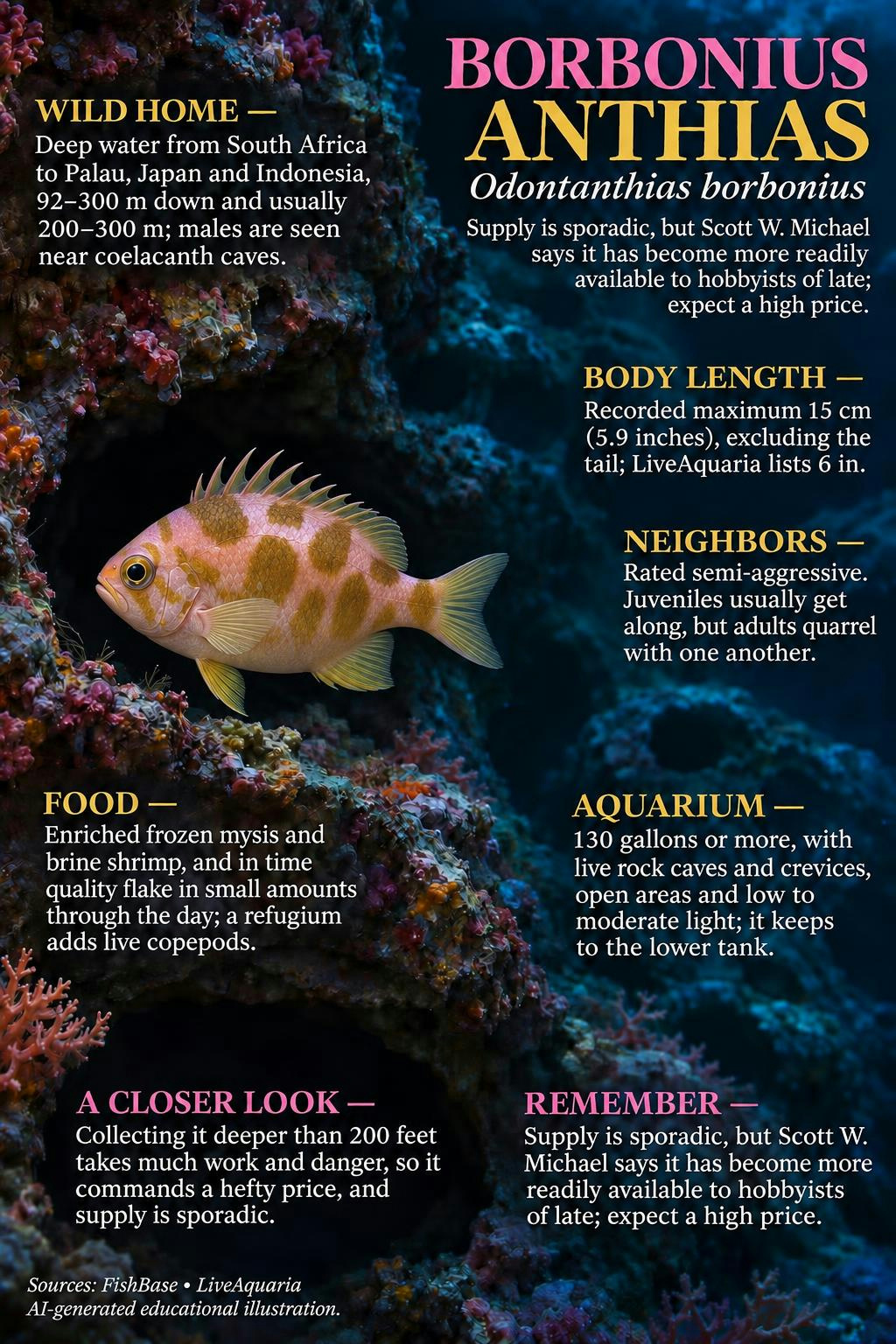
Read the infographic as text
- WILD HOME — Deep water from South Africa to Palau, Japan and Indonesia, 92–300 m down and usually 200–300 m; males are seen near coelacanth caves.
- BODY LENGTH — Recorded maximum 15 cm (5.9 inches), excluding the tail; LiveAquaria lists 6 in.
- FOOD — Enriched frozen mysis and brine shrimp, and in time quality flake in small amounts through the day; a refugium adds live copepods.
- NEIGHBORS — Rated semi-aggressive. Juveniles usually get along, but adults quarrel with one another.
- AQUARIUM — 130 gallons or more, with live rock caves and crevices, open areas and low to moderate light; it keeps to the lower tank.
- A CLOSER LOOK — Collecting it deeper than 200 feet takes much work and danger, so it commands a hefty price, and supply is sporadic.
- REMEMBER — Supply is sporadic, but Scott W. Michael says it has become more readily available to hobbyists of late; expect a high price.
How to use these figures
Published care ranges and suggested tank sizes are starting points, not guarantees. Tank footprint, group size, filtration, feeding, companions and the individual fish all matter. Standard length excludes the tail fin. Do not abruptly change established water conditions to match a number on a page.
Use a cycled aquarium, monitor water quality and quarantine new arrivals using a suitable species-specific plan. Persistent appetite loss, rapid breathing or weight loss warrants investigation.
Common questions
What should I know before choosing this fish?
Supply is sporadic, but Scott W. Michael says it has become more readily available to hobbyists of late; expect a high price. Rated semi-aggressive. Juveniles usually get along, but adults quarrel with one another.
What should I feed it?
Enriched frozen mysis and brine shrimp, and in time quality flake in small amounts through the day; a refugium adds live copepods.
Why is it rare?
Collecting it deeper than 200 feet takes much work and danger, so it commands a hefty price, and supply is sporadic.
Sources & review
Checked November 12, 2026. Retailer care guidance is not a universal biological minimum.
- FishBase — Odontanthias borbonius species account
- LiveAquaria — Blotched Anthias care profile — reviewed care reference