
At a glance
- Adult size
- Recorded maximum 3.9 in; see length definition
- Space
- 30+ US gallons
- Social needs
- Semi-aggressive: one per tank unless a breeding pair. If attacked, it bites the inside of the attacker’s mouth.
Starting guidance, not a universal minimum. See the care details and sources below.
Adult size
FishBase reports a maximum recorded length of 10 cm (3.9 inches), excluding the tail. A recorded maximum is not a promise of typical aquarium size. LiveAquaria lists a maximum of 5 inches.
Aquarium space
LiveAquaria says it needs a minimum tank of 30 US gallons (114 litres), with live rock for hunting and grazing.
Water conditions
LiveAquaria lists 72–78°F (22–26°C), pH 8.1–8.4, dKH 8–12 and specific gravity 1.020–1.025. These are retailer fish-care ranges, not a universal prescription for every coral or invertebrate; match the whole system and keep conditions stable.
Natural home
Reefs of Fiji, the only place FishBase records it; the eggs are stuck to the bottom by an adhesive pad.
Food and feeding
Finely chopped crustacean flesh, mysis and vitamin-enriched brine shrimp, and frozen herbivore preparations.
Tankmates and behavior
Semi-aggressive: one per tank unless a breeding pair. If attacked, it bites the inside of the attacker’s mouth.
Setting up the habitat
30 gallons or more with live rock for hunting and grazing; rated reef compatible.
A closer look
Solid bright yellow; males are generally larger, and pass through a succession of colors when breeding.
Read the infographic as text
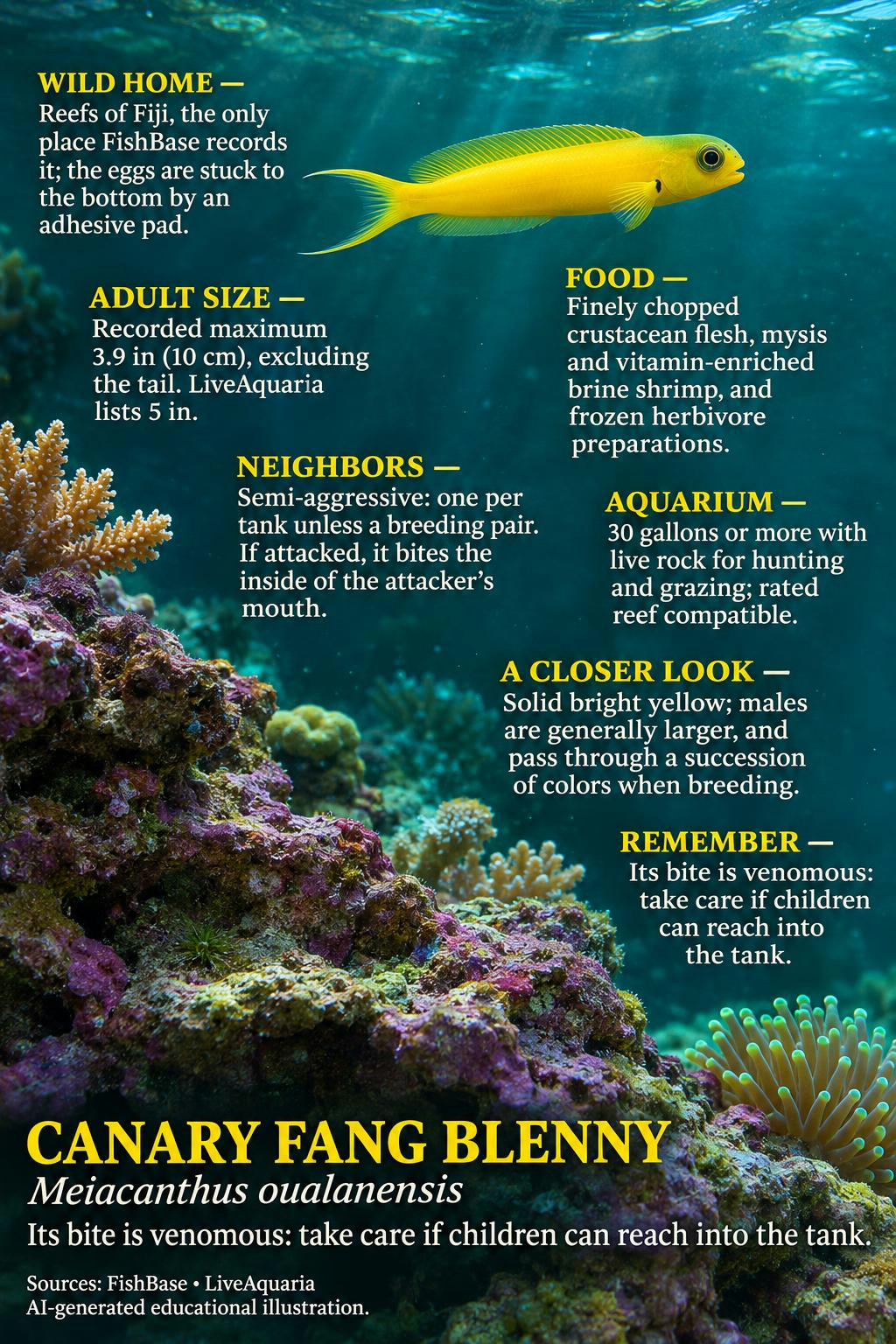
- WILD HOME — Reefs of Fiji, the only place FishBase records it; the eggs are stuck to the bottom by an adhesive pad.
- ADULT SIZE — Recorded maximum 3.9 in (10 cm), excluding the tail. LiveAquaria lists 5 in.
- FOOD — Finely chopped crustacean flesh, mysis and vitamin-enriched brine shrimp, and frozen herbivore preparations.
- NEIGHBORS — Semi-aggressive: one per tank unless a breeding pair. If attacked, it bites the inside of the attacker’s mouth.
- AQUARIUM — 30 gallons or more with live rock for hunting and grazing; rated reef compatible.
- A CLOSER LOOK — Solid bright yellow; males are generally larger, and pass through a succession of colors when breeding.
- REMEMBER — Its bite is venomous: take care if children can reach into the tank.
How to use these figures
Published care ranges and suggested tank sizes are starting points, not guarantees. Tank footprint, group size, filtration, feeding, companions and the individual fish all matter. Standard length excludes the tail fin. Do not abruptly change established water conditions to match a number on a page.
Use a cycled aquarium, monitor water quality and quarantine new arrivals using a suitable species-specific plan. Persistent appetite loss, rapid breathing or weight loss warrants investigation.
Common questions
What is the main consideration before buying?
Its bite is venomous: take care if children can reach into the tank. Semi-aggressive: one per tank unless a breeding pair. If attacked, it bites the inside of the attacker’s mouth.
What should this fish eat?
Finely chopped crustacean flesh, mysis and vitamin-enriched brine shrimp, and frozen herbivore preparations.
Sources & review
Checked November 12, 2026. Retailer care guidance is not a universal biological minimum.
- FishBase — Meiacanthus oualanensis species account
- LiveAquaria — Canary Blenny care profile — reviewed care reference