
At a glance
- Adult size
- About 9–10 in
- Space
- 150+ US gallons
- Social needs
- Rarely bothers unrelated fish and holds its own once settled; one per tank, no other Chaetodontoplus. Nips corals and clams.
Starting guidance, not a universal minimum. See the care details and sources below.
Adult size
Saltcorner gives 10 inches (25 cm), and CORAL Magazine says adults reach 9–10 inches (25 cm). FishBase lists only 10.0 cm (about 3.9 inches) total length, which conflicts with both.
Aquarium space
Saltcorner and CORAL Magazine both give a minimum of 150 US gallons (568 litres) for an adult; CORAL says it settles in well at that size or larger. Keep one per tank unless the tank is large and you can get a pair.
Water conditions
Saltcorner lists 66–75°F (19–24°C), specific gravity 1.020–1.026 and pH 8.0–8.5, a cool range; FishBase calls its climate zone temperate. These are maintenance ranges, not targets to swing between; avoid abrupt changes.
Natural home
Deep coral reefs, 1–40 m, from the southern Great Barrier Reef and New Caledonia to Lord Howe Island, feeding on sponges and tunicates.
Food and feeding
Offer mysis, clams, brine shrimp and angelfish foods with sponge, plus some algae, in three or more small meals a day.
Tankmates and behavior
Rarely bothers unrelated fish and holds its own once settled; one per tank, no other Chaetodontoplus. Nips corals and clams.
Setting up the habitat
150 gallons or more in a quiet room: large and well established, with live rock, caves and boltholes to hide in, and calm tankmates.
A closer look
Rarely exported from its range off eastern Australia, New Caledonia and Lord Howe Island, and wild adults often fail to thrive.
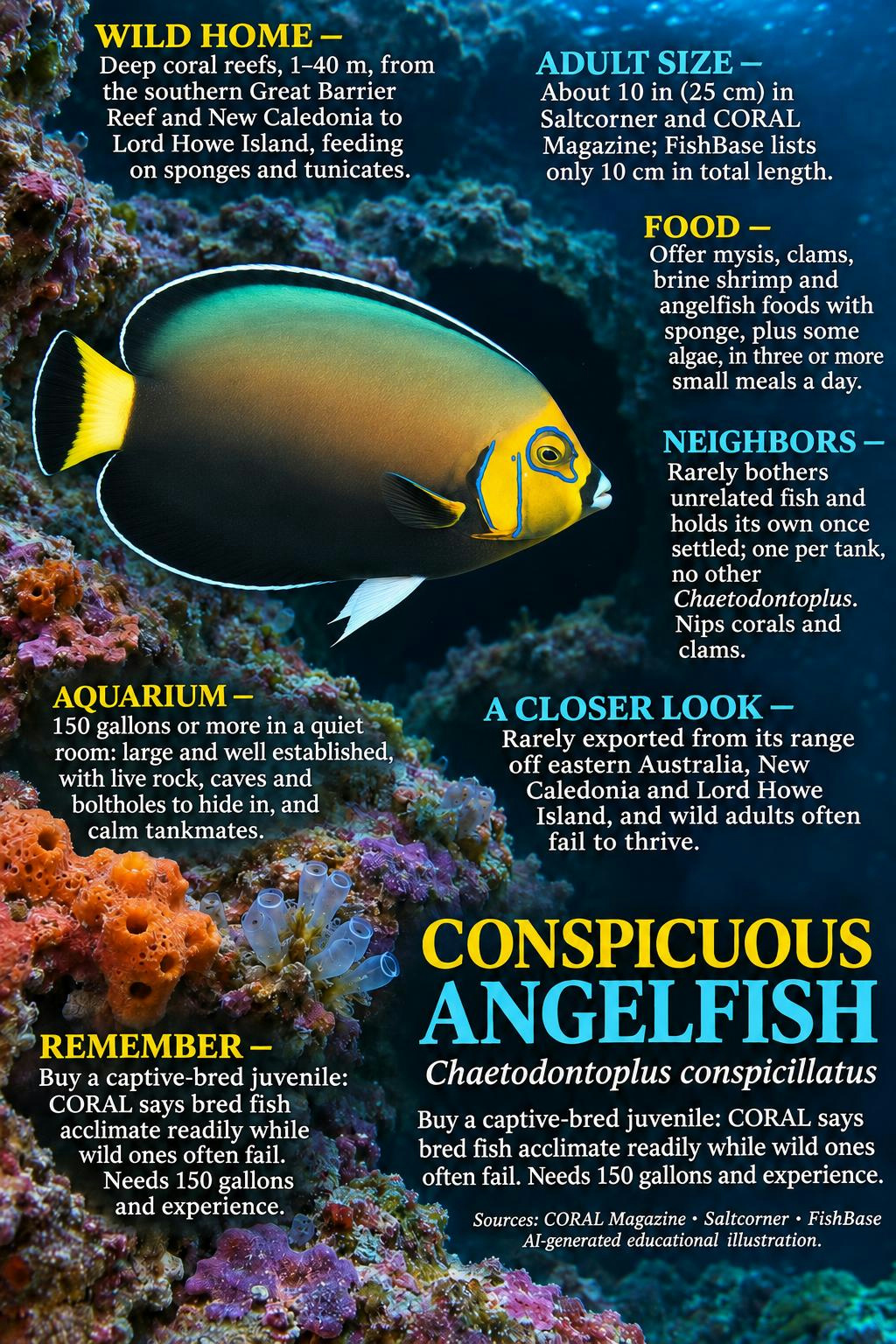
Read the infographic as text
- WILD HOME — Deep coral reefs, 1–40 m, from the southern Great Barrier Reef and New Caledonia to Lord Howe Island, feeding on sponges and tunicates.
- ADULT SIZE — About 10 in (25 cm) in Saltcorner and CORAL Magazine; FishBase lists only 10 cm in total length.
- FOOD — Offer mysis, clams, brine shrimp and angelfish foods with sponge, plus some algae, in three or more small meals a day.
- NEIGHBORS — Rarely bothers unrelated fish and holds its own once settled; one per tank, no other Chaetodontoplus. Nips corals and clams.
- AQUARIUM — 150 gallons or more in a quiet room: large and well established, with live rock, caves and boltholes to hide in, and calm tankmates.
- A CLOSER LOOK — Rarely exported from its range off eastern Australia, New Caledonia and Lord Howe Island, and wild adults often fail to thrive.
- REMEMBER — Buy a captive-bred juvenile: CORAL says bred fish acclimate readily while wild ones often fail. Needs 150 gallons and experience.
How to use these figures
Published care ranges and suggested tank sizes are starting points, not guarantees. Tank footprint, group size, filtration, feeding, companions and the individual fish all matter. Standard length excludes the tail fin. Do not abruptly change established water conditions to match a number on a page.
Use a cycled aquarium, monitor water quality and quarantine new arrivals using a suitable species-specific plan. Persistent appetite loss, rapid breathing or weight loss warrants investigation.
Common questions
What should I know before choosing this fish?
Buy a captive-bred juvenile: CORAL says bred fish acclimate readily while wild ones often fail. Needs 150 gallons and experience. Rarely bothers unrelated fish and holds its own once settled; one per tank, no other Chaetodontoplus. Nips corals and clams.
What should I feed it?
Offer mysis, clams, brine shrimp and angelfish foods with sponge, plus some algae, in three or more small meals a day.
Why is it rare?
Rarely exported from its range off eastern Australia, New Caledonia and Lord Howe Island, and wild adults often fail to thrive.
Sources & review
Checked November 12, 2026. Retailer care guidance is not a universal biological minimum.