
At a glance
- Adult size
- About 9.8 in body length
- Space
- 120 × 60 cm (47 × 24 in) base; 250+ litres for one or a pair
- Social needs
- Aggressive to its own kind: keep one or a self-chosen pair. It can share a large tank with H. bartoni, never with H. carpintis.
Starting guidance, not a universal minimum. See the care details and sources below.
Adult size
FishBase gives a maximum standard length of 25.0 cm (about 9.8 inches), excluding the tail fin. Cichlid Amérique gives males 25 cm and females 20 cm total length in one part, and males about 20 cm in another; the Nordiska Ciklidsällskapet register gives 35 cm (about 13.8 inches). Males are slightly larger than females.
Aquarium space
Cichlid Amérique keeps it alone or as a pair in at least 250 litres (about 66 US gallons); a self-chosen pair or a group needs at least 120 cm (about 47.2 inches) long by 60 cm wide, and mixing with other robust cichlids 650 litres (about 172 US gallons) or more. The Nordiska Ciklidsällskapet register gives 200 cm (about 78.7 inches) and 720 litres (about 190 US gallons).
Water conditions
Cichlid Amérique wants moderate to hard water with a steady pH of 7.0–8.5 and 24–28°C (75–82°F). It tolerates 18°C (64°F), but then stops breeding and eats less, so do not keep it cool for long. FishBase gives 22–30°C (72–86°F) and pH 7.0–8.5; the register gives 22–28°C (72–82°F). It falls ill if the water is unsuitable even briefly, so filter strongly and change water every week. These are maintenance ranges, not targets to swing between; avoid abrupt changes.
Natural home
The Pánuco basin of Mexico, notably the warm karst spring of Media Luna, where it sifts sand and detritus for snails.
Food and feeding
A snail specialist in the wild. Takes flake, pellets, frozen foods, cooked vegetables and small snails; avoid bloodworm.
Tankmates and behavior
Aggressive to its own kind: keep one or a self-chosen pair. It can share a large tank with H. bartoni, never with H. carpintis.
Setting up the habitat
Sand to dig in, rock caves, open swimming space and gentle flow; shield the heater, as it moves equipment. Plants do not last.
A closer look
Endangered: its Media Luna spring once fed the Río Viejo, now blocked and diverted for farming; an introduced cichlid shares it.
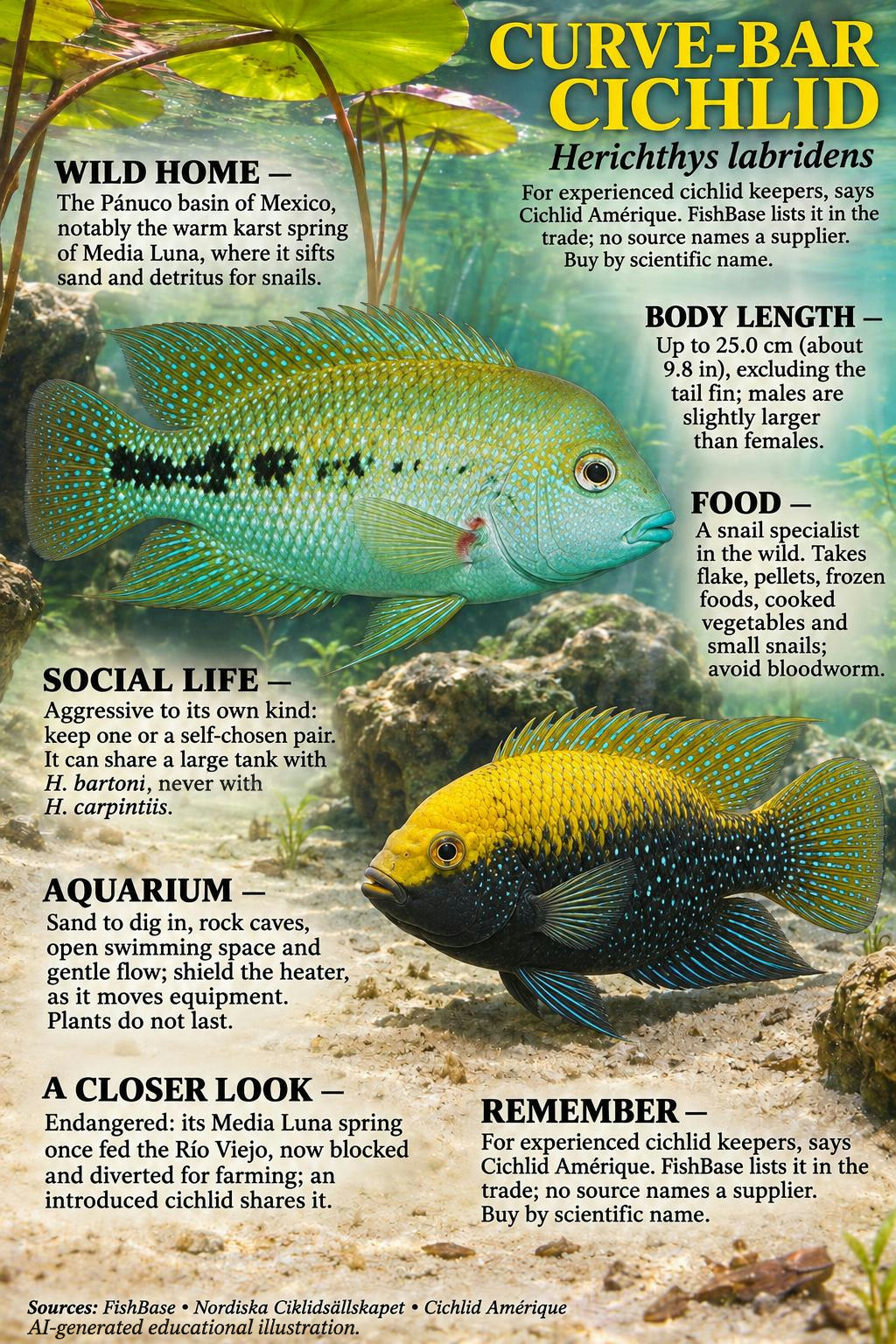
Read the infographic as text
- WILD HOME — The Pánuco basin of Mexico, notably the warm karst spring of Media Luna, where it sifts sand and detritus for snails.
- BODY LENGTH — Up to 25.0 cm (about 9.8 in), excluding the tail fin; males are slightly larger than females.
- FOOD — A snail specialist in the wild. Takes flake, pellets, frozen foods, cooked vegetables and small snails; avoid bloodworm.
- SOCIAL LIFE — Aggressive to its own kind: keep one or a self-chosen pair. It can share a large tank with H. bartoni, never with H. carpintis.
- AQUARIUM — Sand to dig in, rock caves, open swimming space and gentle flow; shield the heater, as it moves equipment. Plants do not last.
- A CLOSER LOOK — Endangered: its Media Luna spring once fed the Río Viejo, now blocked and diverted for farming; an introduced cichlid shares it.
- REMEMBER — For experienced cichlid keepers, says Cichlid Amérique. FishBase lists it in the trade; no source names a supplier. Buy by scientific name.
How to use these figures
Published care ranges and suggested tank sizes are starting points, not guarantees. Tank footprint, group size, filtration, feeding, companions and the individual fish all matter. Standard length excludes the tail fin. Do not abruptly change established water conditions to match a number on a page.
Use a cycled aquarium, monitor water quality and quarantine new arrivals using a suitable species-specific plan. Persistent appetite loss, rapid breathing or weight loss warrants investigation.
Common questions
What should I know before choosing this fish?
For experienced cichlid keepers, says Cichlid Amérique. FishBase lists it in the trade; no source names a supplier. Buy by scientific name. Aggressive to its own kind: keep one or a self-chosen pair. It can share a large tank with H. bartoni, never with H. carpintis.
What should I feed it?
A snail specialist in the wild. Takes flake, pellets, frozen foods, cooked vegetables and small snails; avoid bloodworm.
Why is it rare?
Endangered: its Media Luna spring once fed the Río Viejo, now blocked and diverted for farming; an introduced cichlid shares it.
Sources & review
Checked November 12, 2026. Retailer care guidance is not a universal biological minimum.