
At a glance
- Adult size
- FishBase records 23 cm TL; Scott Michael gives 7.5 in
- Space
- 30+ US gallons for an adult (genus advice)
- Social needs
- Best alone in a species tank. One ate an anemonefish thought too deep-bodied for it, and a smaller frogfish fatally attacked another.
Starting guidance, not a universal minimum. See the care details and sources below.
Adult size
FishBase reports a maximum recorded length of 23 cm (9.1 inches), including the tail. A recorded maximum is not a promise of typical aquarium size. Scott Michael gives a smaller maximum of 7.5 inches.
Aquarium space
No source gives a tank size for this species alone. Writing about the whole genus, Scott Michael suggests at least 20 US gallons (76 litres) for a small fish and a standard 30 US gallons (114 litres) for an adult, as these fish are inactive.
Water conditions
No source gives a temperature, pH, alkalinity or salinity range for this species; FishBase lists it only as tropical. Keep conditions steady and avoid abrupt changes.
Natural home
Coral reefs, rubble and open sand 18–55 m deep, recorded from Mauritius and Sri Lanka to Indonesia, the Philippines and Papua New Guinea.
Food and feeding
Needs live food at first, such as gut-loaded ghost shrimp or mollies, and many never take anything else. Train it to a feeding stick.
Tankmates and behavior
Best alone in a species tank. One ate an anemonefish thought too deep-bodied for it, and a smaller frogfish fatally attacked another.
Setting up the habitat
Open sand or rubble with light décor, as it sits in the open. Scott Michael says Rhinopias spines are venomous: handle with care.
A closer look
Scott Michael says no Rhinopias is common. Experts still debate whether it is a species apart from R. frondosa or a variant of it.
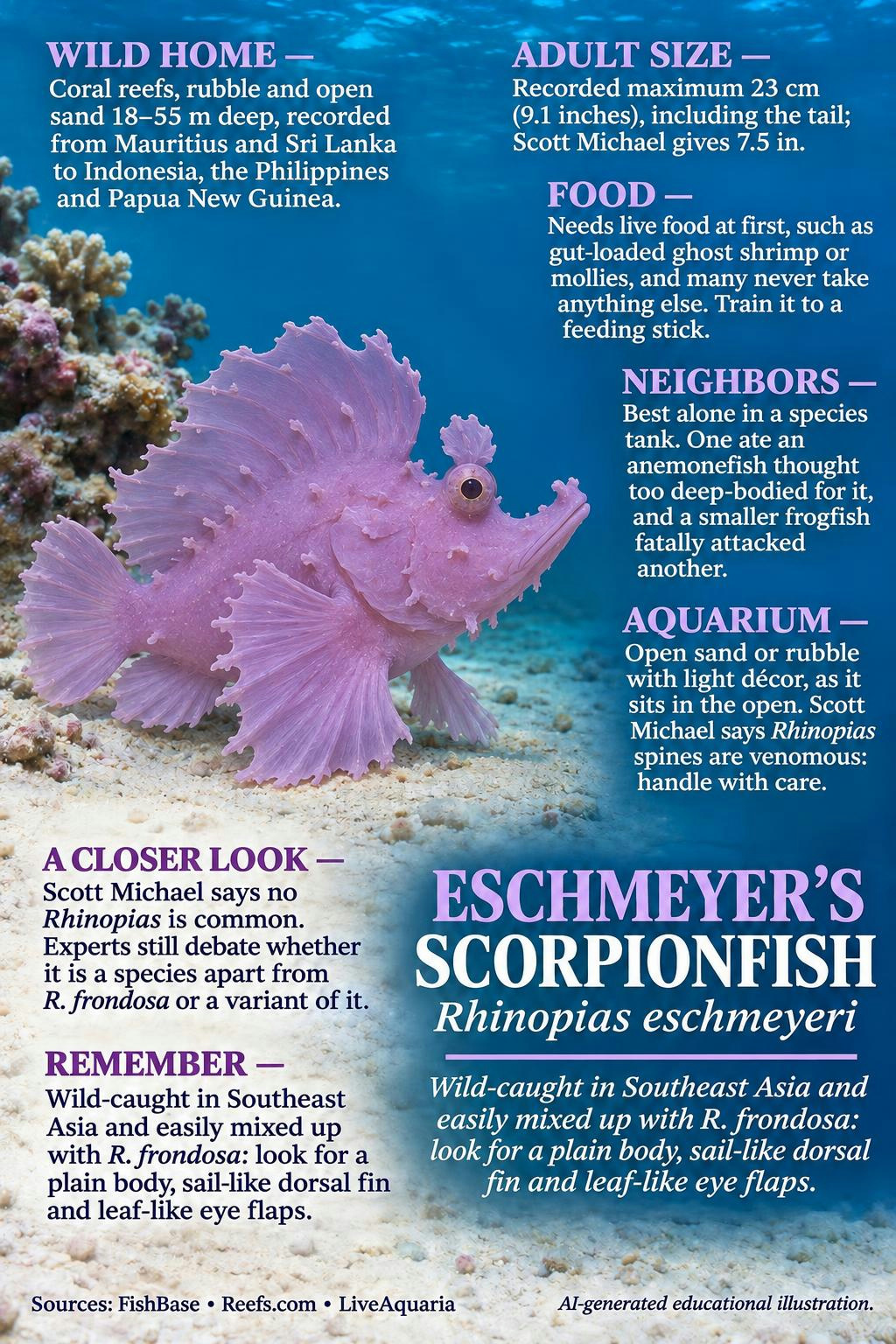
Read the infographic as text
- WILD HOME — Coral reefs, rubble and open sand 18–55 m deep, recorded from Mauritius and Sri Lanka to Indonesia, the Philippines and Papua New Guinea.
- ADULT SIZE — Recorded maximum 23 cm (9.1 inches), including the tail; Scott Michael gives 7.5 in.
- FOOD — Needs live food at first, such as gut-loaded ghost shrimp or mollies, and many never take anything else. Train it to a feeding stick.
- NEIGHBORS — Best alone in a species tank. One ate an anemonefish thought too deep-bodied for it, and a smaller frogfish fatally attacked another.
- AQUARIUM — Open sand or rubble with light décor, as it sits in the open. Scott Michael says Rhinopias spines are venomous: handle with care.
- A CLOSER LOOK — Scott Michael says no Rhinopias is common. Experts still debate whether it is a species apart from R. frondosa or a variant of it.
- REMEMBER — Wild-caught in Southeast Asia and easily mixed up with R. frondosa: look for a plain body, sail-like dorsal fin and leaf-like eye flaps.
How to use these figures
Published care ranges and suggested tank sizes are starting points, not guarantees. Tank footprint, group size, filtration, feeding, companions and the individual fish all matter. Standard length excludes the tail fin. Do not abruptly change established water conditions to match a number on a page.
Use a cycled aquarium, monitor water quality and quarantine new arrivals using a suitable species-specific plan. Persistent appetite loss, rapid breathing or weight loss warrants investigation.
Common questions
What should I know before choosing this fish?
Wild-caught in Southeast Asia and easily mixed up with R. frondosa: look for a plain body, sail-like dorsal fin and leaf-like eye flaps. Best alone in a species tank. One ate an anemonefish thought too deep-bodied for it, and a smaller frogfish fatally attacked another.
What should I feed it?
Needs live food at first, such as gut-loaded ghost shrimp or mollies, and many never take anything else. Train it to a feeding stick.
Why is it rare?
Scott Michael says no Rhinopias is common. Experts still debate whether it is a species apart from R. frondosa or a variant of it.
Sources & review
Checked November 12, 2026. Retailer care guidance is not a universal biological minimum.
- FishBase — Rhinopias eschmeyeri species account
- Reefs.com — Scott Michael, The Rhinopias spp.: the ultimate scorpionfishes
- LiveAquaria — Rhinopias Scorpionfish (R. frondosa) care profile, cited only for its use of the Eschmeyer’s name — reviewed care reference