
At a glance
- Adult size
- About 4.5 cm (1.8 in) total length
- Space
- 29+ US gallons
- Social needs
- Not particularly aggressive, but it may get feisty with similar fish such as dottybacks. Captive-bred fish are less shy at mealtimes.
Starting guidance, not a universal minimum. See the care details and sources below.
Adult size
FishBase records a maximum of 4.5 cm (about 1.8 inches) total length, including the tail. Kenneth Wingerter’s care article says it is about two and a half inches long, even smaller than the royal gramma.
Aquarium space
Kenneth Wingerter’s care article says it needs no more than a 29-gallon tank, 29 US gallons (110 litres). No other source gives a tank size.
Water conditions
No source gives a temperature, pH, alkalinity or salinity range; FishBase lists only a tropical reef habitat 5–30 m deep. Keep conditions steady and avoid abrupt changes.
Natural home
Shallow reef walls 5–30 m deep, almost entirely off Cuba; a single specimen has been collected in the Cayman Islands.
Food and feeding
Almost any small, meaty food: brine shrimp, mysis and other small crustaceans, with a good frozen or flake food added.
Tankmates and behavior
Not particularly aggressive, but it may get feisty with similar fish such as dottybacks. Captive-bred fish are less shy at mealtimes.
Setting up the habitat
Rocky aquascaping with many deep, dark crevices. It may hide a lot at first; basslets can be shy, especially under bright light.
A closer look
A tiny Cuban range and legal limits on collection made it a waiting-list fish; legal barriers keep wild Cuban fish from US buyers.
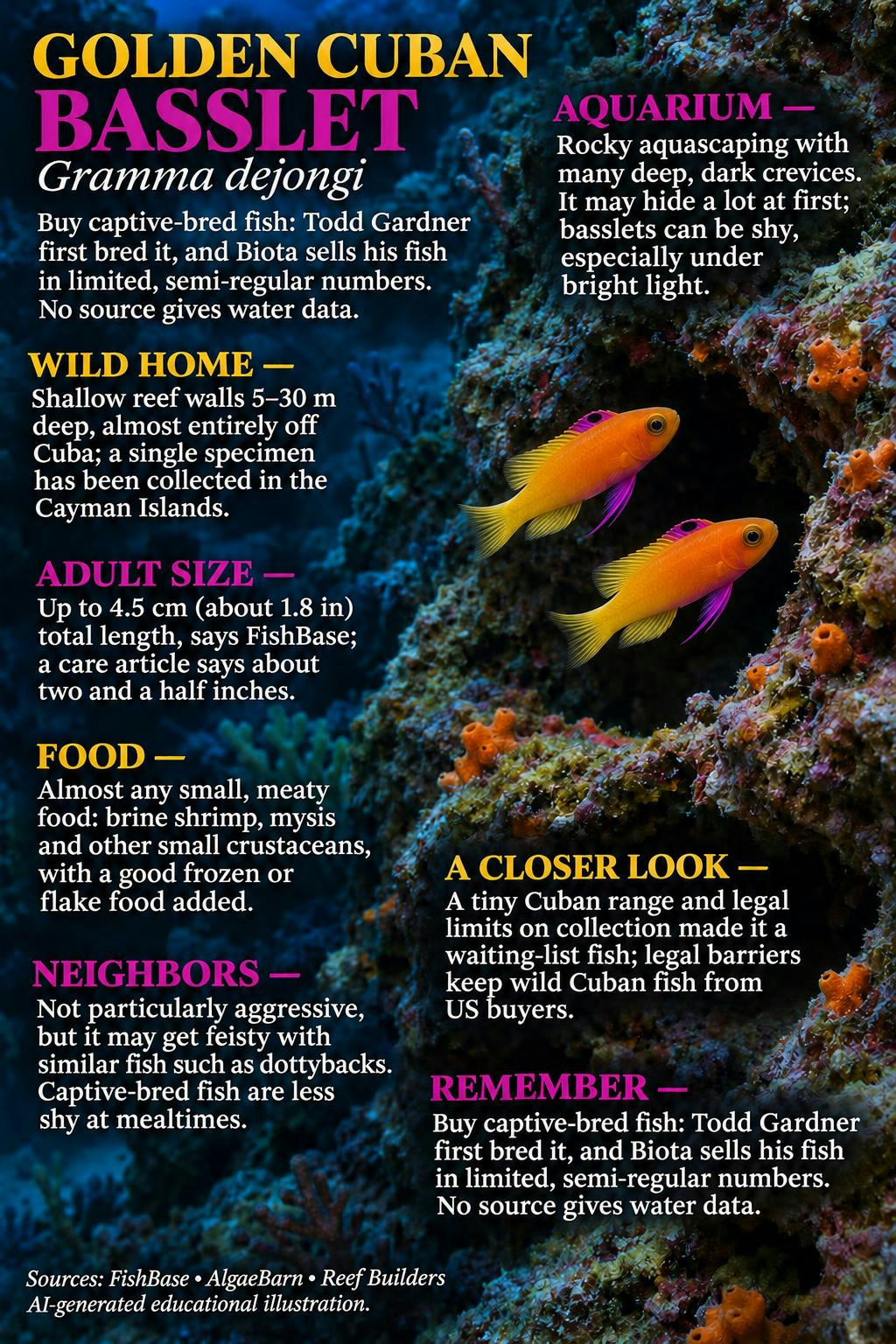
Read the infographic as text
- WILD HOME — Shallow reef walls 5–30 m deep, almost entirely off Cuba; a single specimen has been collected in the Cayman Islands.
- ADULT SIZE — Up to 4.5 cm (about 1.8 in) total length, says FishBase; a care article says about two and a half inches.
- FOOD — Almost any small, meaty food: brine shrimp, mysis and other small crustaceans, with a good frozen or flake food added.
- NEIGHBORS — Not particularly aggressive, but it may get feisty with similar fish such as dottybacks. Captive-bred fish are less shy at mealtimes.
- AQUARIUM — Rocky aquascaping with many deep, dark crevices. It may hide a lot at first; basslets can be shy, especially under bright light.
- A CLOSER LOOK — A tiny Cuban range and legal limits on collection made it a waiting-list fish; legal barriers keep wild Cuban fish from US buyers.
- REMEMBER — Buy captive-bred fish: Todd Gardner first bred it, and Biota sells his fish in limited, semi-regular numbers. No source gives water data.
How to use these figures
Published care ranges and suggested tank sizes are starting points, not guarantees. Tank footprint, group size, filtration, feeding, companions and the individual fish all matter. Standard length excludes the tail fin. Do not abruptly change established water conditions to match a number on a page.
Use a cycled aquarium, monitor water quality and quarantine new arrivals using a suitable species-specific plan. Persistent appetite loss, rapid breathing or weight loss warrants investigation.
Common questions
What should I know before choosing this fish?
Buy captive-bred fish: Todd Gardner first bred it, and Biota sells his fish in limited, semi-regular numbers. No source gives water data. Not particularly aggressive, but it may get feisty with similar fish such as dottybacks. Captive-bred fish are less shy at mealtimes.
What should I feed it?
Almost any small, meaty food: brine shrimp, mysis and other small crustaceans, with a good frozen or flake food added.
Why is it rare?
A tiny Cuban range and legal limits on collection made it a waiting-list fish; legal barriers keep wild Cuban fish from US buyers.
Sources & review
Checked November 12, 2026. Retailer care guidance is not a universal biological minimum.
- FishBase — Gramma dejongi species account
- Kenneth Wingerter — Keeping the Golden Cuban Basslet (AlgaeBarn care article) — reviewed care reference
- Reef Builders — Captive Bred Gramma dejongi now Available from Biota