
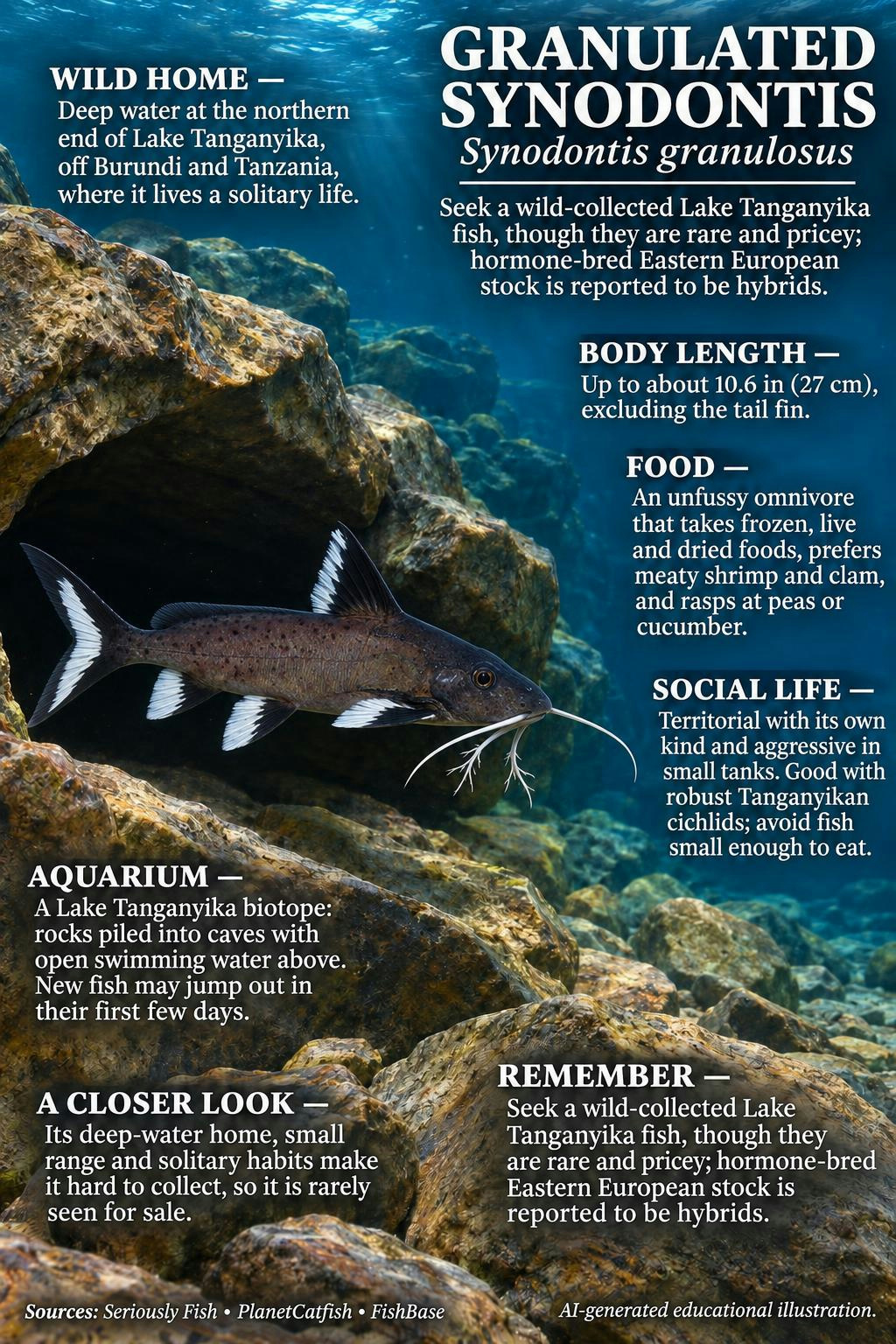
At a glance
- Adult size
- About 10.6 in body length
- Space
- 60 × 24 in base, about 143 US gallons; see details
- Social needs
- Territorial with its own kind and aggressive in small tanks. Good with robust Tanganyikan cichlids; avoid fish small enough to eat.
Starting guidance, not a universal minimum. See the care details and sources below.
Adult size
Seriously Fish and PlanetCatfish give a maximum standard length of 27 cm (about 10.6 inches), excluding the tail fin; FishBase gives 27 cm total length.
Aquarium space
Seriously Fish lists 60 × 24 × 24 inches (150 × 60 × 60 cm), about 540 litres (143 US gallons). PlanetCatfish advises at least 500 litres (about 132 US gallons) and warns it may turn reclusive and aggressive below 250 litres (about 66 US gallons).
Water conditions
Seriously Fish lists 75–82°F (24–28°C), pH 7.8–8.5 and 8–35 dGH; PlanetCatfish gives pH 7.8–8.4 at 24–28°C, and FishBase 22–26°C. It needs alkaline water and a steady temperature. These are maintenance ranges, not targets to swing between; avoid abrupt changes.
Natural home
Deep water at the northern end of Lake Tanganyika, off Burundi and Tanzania, where it lives a solitary life.
Food and feeding
An unfussy omnivore that takes frozen, live and dried foods, prefers meaty shrimp and clam, and rasps at peas or cucumber.
Tankmates and behavior
Territorial with its own kind and aggressive in small tanks. Good with robust Tanganyikan cichlids; avoid fish small enough to eat.
Setting up the habitat
A Lake Tanganyika biotope: rocks piled into caves with open swimming water above. New fish may jump out in their first few days.
A closer look
Its deep-water home, small range and solitary habits make it hard to collect, so it is rarely seen for sale.
Read the infographic as text
- WILD HOME — Deep water at the northern end of Lake Tanganyika, off Burundi and Tanzania, where it lives a solitary life.
- BODY LENGTH — Up to about 10.6 in (27 cm), excluding the tail fin.
- FOOD — An unfussy omnivore that takes frozen, live and dried foods, prefers meaty shrimp and clam, and rasps at peas or cucumber.
- SOCIAL LIFE — Territorial with its own kind and aggressive in small tanks. Good with robust Tanganyikan cichlids; avoid fish small enough to eat.
- AQUARIUM — A Lake Tanganyika biotope: rocks piled into caves with open swimming water above. New fish may jump out in their first few days.
- A CLOSER LOOK — Its deep-water home, small range and solitary habits make it hard to collect, so it is rarely seen for sale.
- REMEMBER — Seek a wild-collected Lake Tanganyika fish, though they are rare and pricey; hormone-bred Eastern European stock is reported to be hybrids.
How to use these figures
Published care ranges and suggested tank sizes are starting points, not guarantees. Tank footprint, group size, filtration, feeding, companions and the individual fish all matter. Standard length excludes the tail fin. Do not abruptly change established water conditions to match a number on a page.
Use a cycled aquarium, monitor water quality and quarantine new arrivals using a suitable species-specific plan. Persistent appetite loss, rapid breathing or weight loss warrants investigation.
Common questions
What should I know before choosing this fish?
Seek a wild-collected Lake Tanganyika fish, though they are rare and pricey; hormone-bred Eastern European stock is reported to be hybrids. Territorial with its own kind and aggressive in small tanks. Good with robust Tanganyikan cichlids; avoid fish small enough to eat.
What should I feed it?
An unfussy omnivore that takes frozen, live and dried foods, prefers meaty shrimp and clam, and rasps at peas or cucumber.
Why is it rare?
Its deep-water home, small range and solitary habits make it hard to collect, so it is rarely seen for sale.
Sources & review
Checked November 12, 2026. Retailer care guidance is not a universal biological minimum.