
At a glance
- Adult size
- Recorded maximum 3.9 in; see length definition
- Space
- Adult swimming and feeding space; see details
- Social needs
- A shoaling fish; plan a spacious established system and monitor individuals rather than assuming a group will stay harmonious.
Starting guidance, not a universal minimum. See the care details and sources below.
Adult size
FishBase reports a maximum recorded length of 10 cm (3.9 inches), including the tail. A recorded maximum is not a promise of typical aquarium size.
Aquarium space
Plan a spacious, established aquarium for a group with open swimming space and numerous retreats. The reviewed care text does not supply a numerical minimum; group size and feeding access matter.
Water conditions
Maintain stable, well-oxygenated marine water. Match temperature and salinity to the whole aquarium and the stock’s acclimation needs; the reviewed care text does not establish a species-specific numerical target. Check salinity with a suitable calibrated instrument and avoid abrupt changes.
Natural home
Indo-Pacific lagoons and shallow reefs, often above branching corals.
Food and feeding
Several small varied marine meals through the day, with portions available to all fish.
Tankmates and behavior
A shoaling fish; plan a spacious established system and monitor individuals rather than assuming a group will stay harmonious.
Setting up the habitat
Open hovering space above sheltered rockwork and branching structures.
A closer look
The blue-green sheen changes with viewing angle and light.
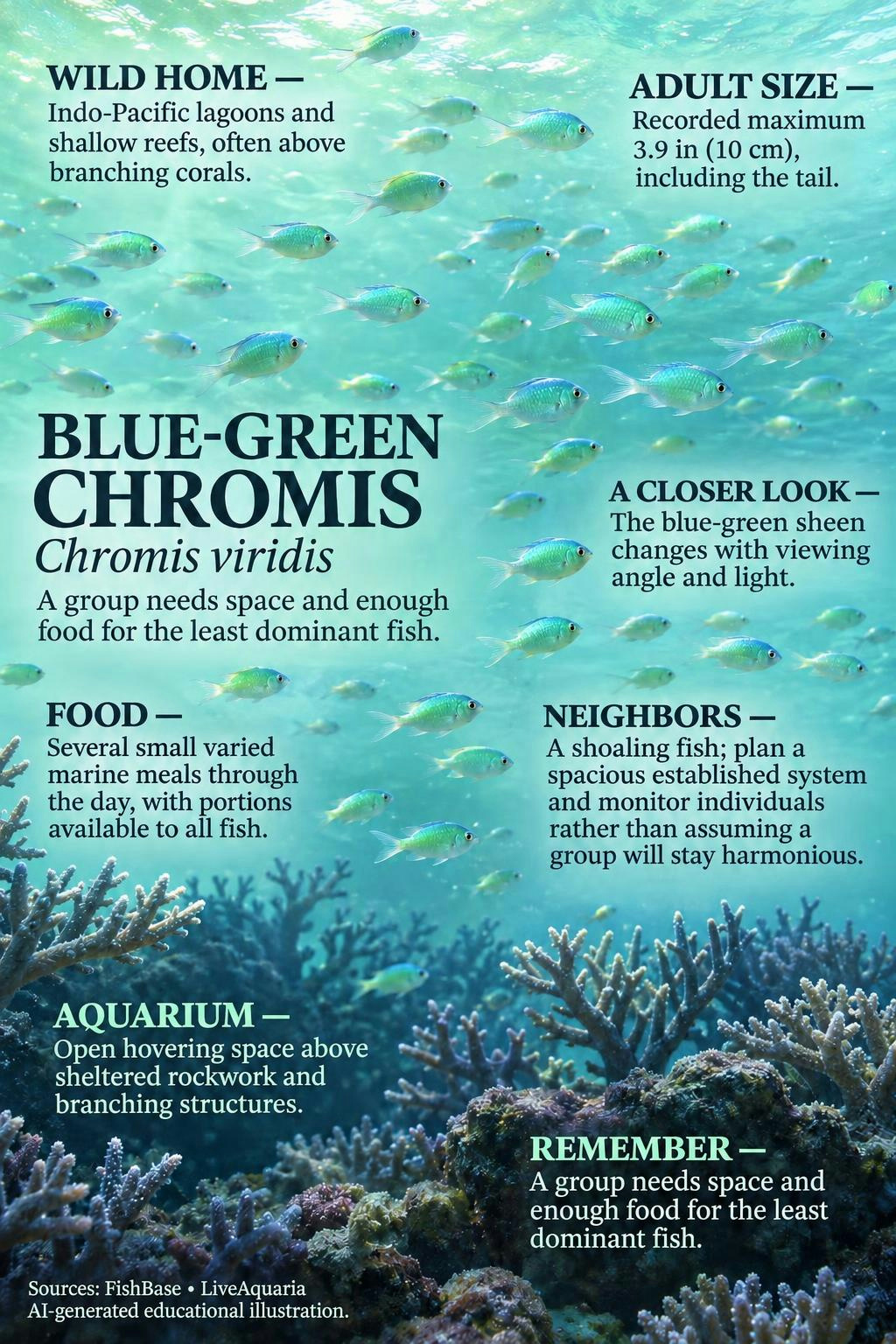
Read the infographic as text
- WILD HOME — Indo-Pacific lagoons and shallow reefs, often above branching corals.
- ADULT SIZE — Recorded maximum 3.9 in (10 cm), including the tail.
- FOOD — Several small varied marine meals through the day, with portions available to all fish.
- NEIGHBORS — A shoaling fish; plan a spacious established system and monitor individuals rather than assuming a group will stay harmonious.
- AQUARIUM — Open hovering space above sheltered rockwork and branching structures.
- A CLOSER LOOK — The blue-green sheen changes with viewing angle and light.
- REMEMBER — A group needs space and enough food for the least dominant fish.
How to use these figures
Published care ranges and suggested tank sizes are starting points, not guarantees. Tank footprint, group size, filtration, feeding, companions and the individual fish all matter. Standard length excludes the tail fin. Do not abruptly change established water conditions to match a number on a page.
Use a cycled aquarium, monitor water quality and quarantine new arrivals using a suitable species-specific plan. Persistent appetite loss, rapid breathing or weight loss warrants investigation.
Common questions
What is the main consideration before buying?
A group needs space and enough food for the least dominant fish. A shoaling fish; plan a spacious established system and monitor individuals rather than assuming a group will stay harmonious.
What should this fish eat?
Several small varied marine meals through the day, with portions available to all fish.
Sources & review
Checked November 12, 2026. Retailer care guidance is not a universal biological minimum.
- FishBase — Chromis viridis species account
- LiveAquaria — Blue-green chromis care profile — reviewed care reference