
At a glance
- Adult size
- Quality Marine gives 6 in; FishBase records 15 cm TL
- Space
- 70+ US gallons
- Social needs
- Wild fish live in pairs. It may be territorial toward similar angels, though dwarf angels added together to a big tank can get along.
Starting guidance, not a universal minimum. See the care details and sources below.
Adult size
FishBase reports a maximum recorded length of 15 cm (5.9 inches), including the tail. A recorded maximum is not a promise of typical aquarium size. Quality Marine and Frank Baensch both say it reaches 6 inches.
Aquarium space
Quality Marine recommends a minimum aquarium of 70 US gallons (265 litres) or larger.
Water conditions
Quality Marine lists 72–78°F (22–26°C), pH 8.1–8.4, 8–12 dKH and salinity 1.020–1.025. Frank Baensch found his wild adults needed cooler water, 74–80°F (23–27°C), while his first captive-bred young did well up to 82°F (28°C). These are maintenance ranges, not targets to swing between; avoid abrupt changes.
Natural home
Rocky and coral reefs 12–60 m deep in southern and central Japan, and at Midway and Kure in the northwestern Hawaiian Islands.
Food and feeding
Meaty, angelfish and algae foods several times a day; Baensch says it thrives on gel food, small pellets, flake and frozen brine shrimp.
Tankmates and behavior
Wild fish live in pairs. It may be territorial toward similar angels, though dwarf angels added together to a big tank can get along.
Setting up the habitat
70 gallons or more, well established, with plenty of rock, caves and crevices for grazing and hiding. It may pick at invertebrates.
A closer look
Quality Marine and Frank Baensch call it rare in the trade; it lives mainly on Japan’s southern coast, especially the Izu Peninsula.
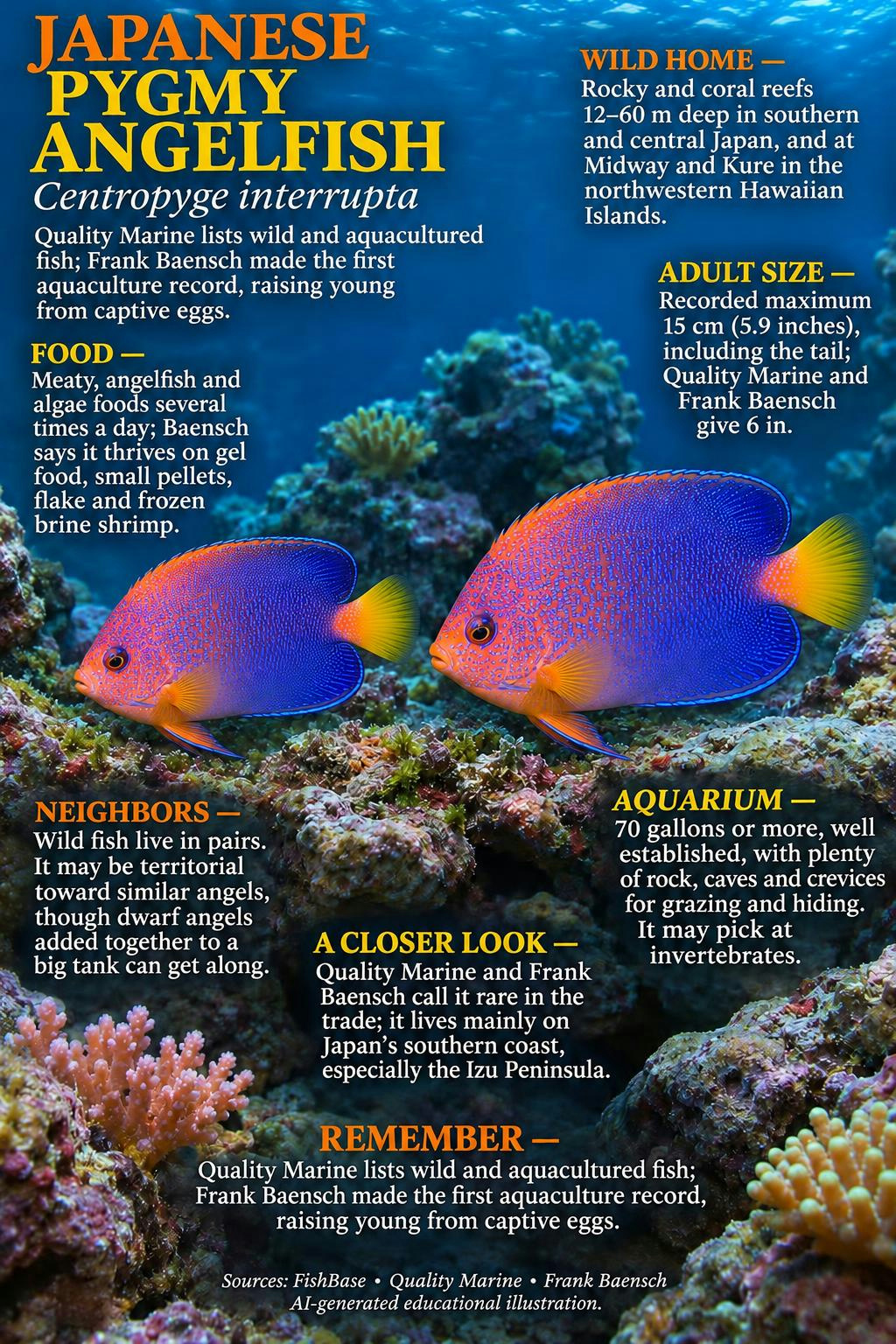
Read the infographic as text
- WILD HOME — Rocky and coral reefs 12–60 m deep in southern and central Japan, and at Midway and Kure in the northwestern Hawaiian Islands.
- ADULT SIZE — Recorded maximum 15 cm (5.9 inches), including the tail; Quality Marine and Frank Baensch give 6 in.
- FOOD — Meaty, angelfish and algae foods several times a day; Baensch says it thrives on gel food, small pellets, flake and frozen brine shrimp.
- NEIGHBORS — Wild fish live in pairs. It may be territorial toward similar angels, though dwarf angels added together to a big tank can get along.
- AQUARIUM — 70 gallons or more, well established, with plenty of rock, caves and crevices for grazing and hiding. It may pick at invertebrates.
- A CLOSER LOOK — Quality Marine and Frank Baensch call it rare in the trade; it lives mainly on Japan’s southern coast, especially the Izu Peninsula.
- REMEMBER — Quality Marine lists wild and aquacultured fish; Frank Baensch made the first aquaculture record, raising young from captive eggs.
How to use these figures
Published care ranges and suggested tank sizes are starting points, not guarantees. Tank footprint, group size, filtration, feeding, companions and the individual fish all matter. Standard length excludes the tail fin. Do not abruptly change established water conditions to match a number on a page.
Use a cycled aquarium, monitor water quality and quarantine new arrivals using a suitable species-specific plan. Persistent appetite loss, rapid breathing or weight loss warrants investigation.
Common questions
What should I know before choosing this fish?
Quality Marine lists wild and aquacultured fish; Frank Baensch made the first aquaculture record, raising young from captive eggs. Wild fish live in pairs. It may be territorial toward similar angels, though dwarf angels added together to a big tank can get along.
What should I feed it?
Meaty, angelfish and algae foods several times a day; Baensch says it thrives on gel food, small pellets, flake and frozen brine shrimp.
Why is it rare?
Quality Marine and Frank Baensch call it rare in the trade; it lives mainly on Japan’s southern coast, especially the Izu Peninsula.
Sources & review
Checked November 12, 2026. Retailer care guidance is not a universal biological minimum.
- FishBase — Centropyge interrupta species account
- Quality Marine — Japanese Angelfish care profile — reviewed care reference
- Frank Baensch — Japanese Pygmy Angelfish culture report