
At a glance
- Adult size
- About 3.9 in body length (males)
- Space
- 36 × 12 in base or larger; see details
- Social needs
- Very peaceful but skittish: keep a shoal of at least 6–8 with similar-sized rainbowfish, characins, danios, barbs or hardy Corydoras.
Starting guidance, not a universal minimum. See the care details and sources below.
Adult size
Seriously Fish reports a maximum standard length of 100 mm (about 3.9 inches), excluding the tail fin; FishBase gives 9.0 cm SL. ANGFA says males reach 10 cm while females usually stay under 8 cm.
Aquarium space
Seriously Fish lists 36 × 12 × 12 inches (90 × 30 × 30 cm), about 81 litres (21 US gallons), and notes that a very large group needs a suitably larger tank.
Water conditions
Seriously Fish lists 77–86°F (25–30°C), pH 7.0–8.0 and 10–20 dGH, and says it will not do well in soft, acidic water; weekly partial water changes keep quality high. ANGFA records 28°C and pH 7.0–7.8 in the lake; FishBase gives 26–30°C. These are maintenance ranges, not targets to swing between; avoid abrupt changes.
Natural home
Shallow, clear, sunlit water among lilies, reeds, logs and shoreline plants in Lake Wanam, a small lake near Lae, Papua New Guinea.
Food and feeding
Unfussy: takes most dried, frozen and live foods, and regular live foods bring out the best colours.
Tankmates and behavior
Very peaceful but skittish: keep a shoal of at least 6–8 with similar-sized rainbowfish, characins, danios, barbs or hardy Corydoras.
Setting up the habitat
A planted tank with dense plant areas and open swimming space, gentle water movement and clean, hard, alkaline water.
A closer look
Endemic to Lake Wanam; introduced tilapia, Gambusia and carp and more people nearby likely made it Critically Endangered.
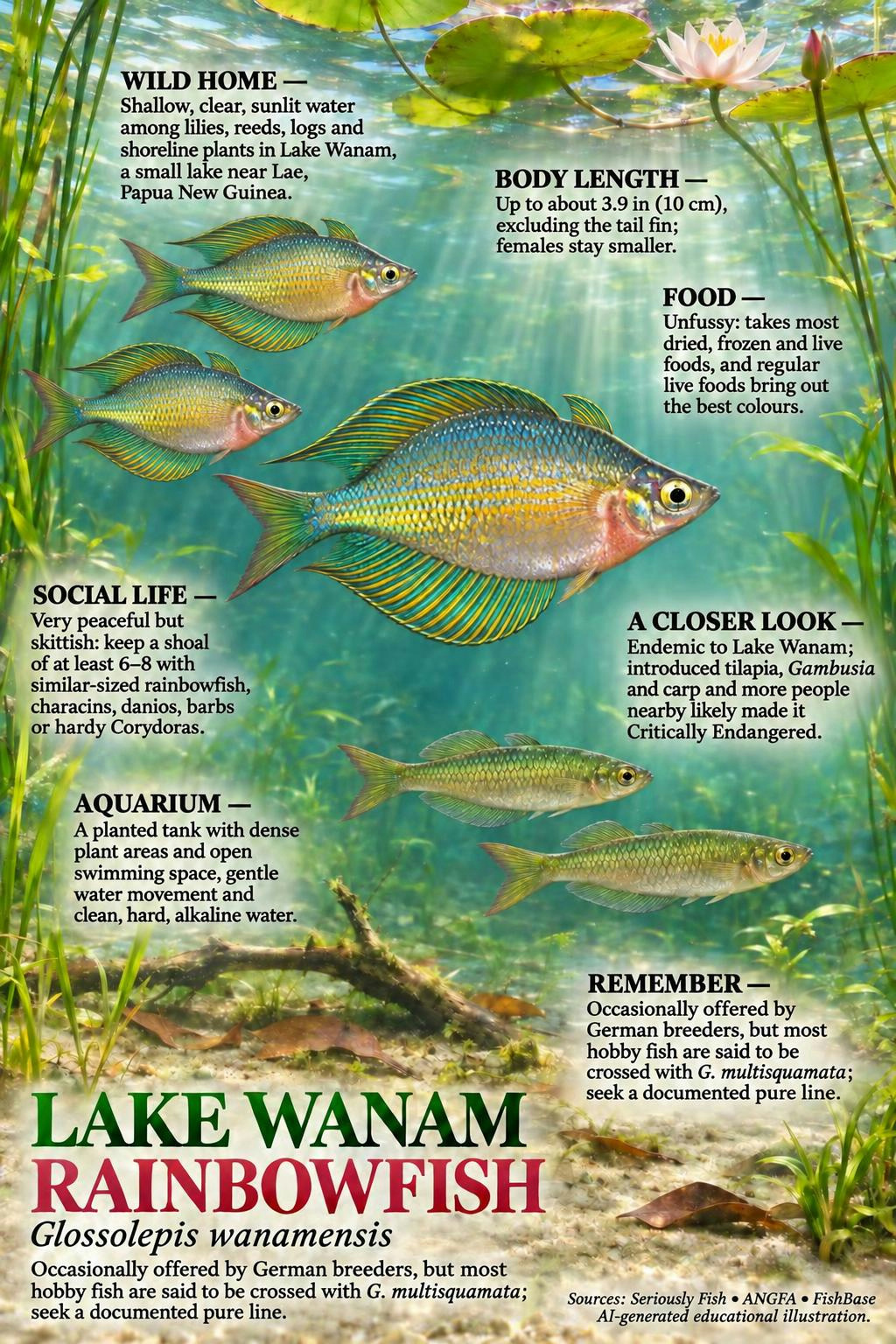
Read the infographic as text
- WILD HOME — Shallow, clear, sunlit water among lilies, reeds, logs and shoreline plants in Lake Wanam, a small lake near Lae, Papua New Guinea.
- BODY LENGTH — Up to about 3.9 in (10 cm), excluding the tail fin; females stay smaller.
- FOOD — Unfussy: takes most dried, frozen and live foods, and regular live foods bring out the best colours.
- SOCIAL LIFE — Very peaceful but skittish: keep a shoal of at least 6–8 with similar-sized rainbowfish, characins, danios, barbs or hardy Corydoras.
- AQUARIUM — A planted tank with dense plant areas and open swimming space, gentle water movement and clean, hard, alkaline water.
- A CLOSER LOOK — Endemic to Lake Wanam; introduced tilapia, Gambusia and carp and more people nearby likely made it Critically Endangered.
- REMEMBER — Occasionally offered by German breeders, but most hobby fish are said to be crossed with G. multisquamata; seek a documented pure line.
How to use these figures
Published care ranges and suggested tank sizes are starting points, not guarantees. Tank footprint, group size, filtration, feeding, companions and the individual fish all matter. Standard length excludes the tail fin. Do not abruptly change established water conditions to match a number on a page.
Use a cycled aquarium, monitor water quality and quarantine new arrivals using a suitable species-specific plan. Persistent appetite loss, rapid breathing or weight loss warrants investigation.
Common questions
What should I know before choosing this fish?
Occasionally offered by German breeders, but most hobby fish are said to be crossed with G. multisquamata; seek a documented pure line. Very peaceful but skittish: keep a shoal of at least 6–8 with similar-sized rainbowfish, characins, danios, barbs or hardy Corydoras.
What should I feed it?
Unfussy: takes most dried, frozen and live foods, and regular live foods bring out the best colours.
Why is it rare?
Endemic to Lake Wanam; introduced tilapia, Gambusia and carp and more people nearby likely made it Critically Endangered.
Sources & review
Checked November 12, 2026. Retailer care guidance is not a universal biological minimum.