
At a glance
- Adult size
- About 1.2 inches (3 cm) standard length, excluding the tail fin
- Aquarium space
- At least a 24 × 12 inch (60 × 30 cm) base.
- Feeding
- Fine, varied foods small enough for every fish.
- Compatibility
- At least 8–10; peaceful companions, no predators.
Starting guidance, not a universal minimum. See the care details and sources below.
Adult size
About 1.2 inches (3 cm) standard length, excluding the tail fin
Aquarium space
At least a 24 × 12 inch (60 × 30 cm) base, following Seriously Fish, with enough usable volume and filtration for the whole group and any companions.
Water conditions
70–77°F (21–25°C), pH 4.0–7.5 and 1–12 dGH are the species-profile ranges. Captive-bred stock may be accustomed to different water than wild fish. Do not force a stocked tank rapidly toward the acidic endpoint.
Natural home
Amazon-basin forest streams and small tributaries, with roots, branches and leaf litter; both dark-stained and clearer habitats occur.
Food and feeding
Offer fine foods small enough for its mouth, with varied small live or frozen foods. Observe the whole group at feeding time rather than assuming every fish gets a share.
Tankmates and behavior
Keep at least 8–10 of its own species with peaceful, similarly sized companions. Avoid fish large enough to swallow them, and match temperature preferences rather than treating all tetras alike.
Setting up the habitat
Plant or furnish the edges, leave open swimming space, and provide shaded areas. Choose healthy stock and introduce it to a stable, cycled aquarium.
A closer look
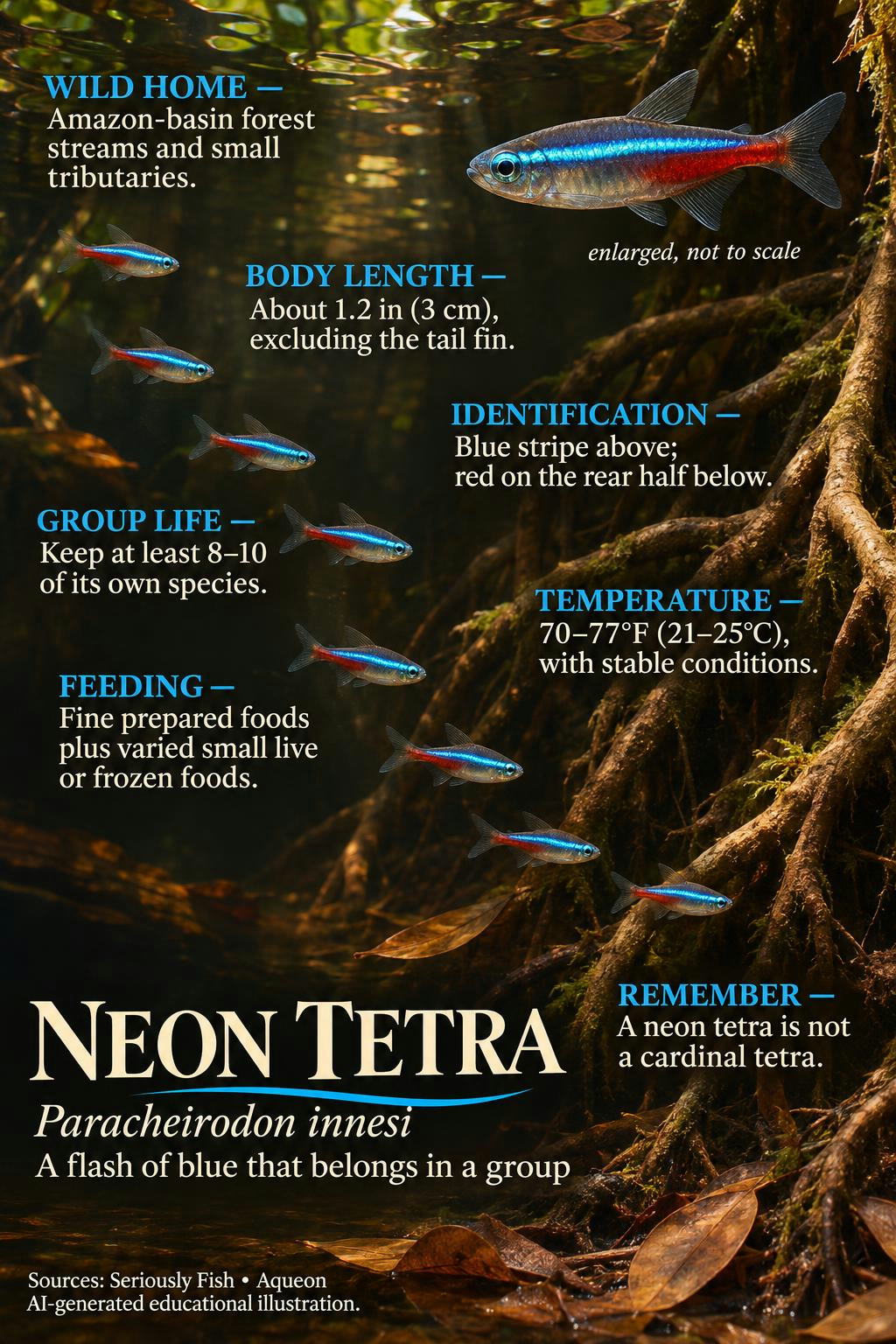
The familiar blue stripe contrasts with a red stripe on the rear half of the lower body. A cardinal tetra’s red extends much farther forward.
Read the infographic as text
- WILD HOME — Amazon-basin forest streams and small tributaries.
- BODY LENGTH — About 1.2 in (3 cm), excluding the tail fin.
- IDENTIFICATION — Blue stripe above; red on the rear half below.
- GROUP LIFE — Keep at least 8–10 of its own species.
- FEEDING — Fine prepared foods plus varied small live or frozen foods.
- TEMPERATURE — 70–77°F (21–25°C), with stable conditions.
- REMEMBER — A neon tetra is not a cardinal tetra.
How to use these figures
Published care ranges and suggested tank sizes are starting points, not guarantees. Tank footprint, group size, filtration, feeding, companions and the individual fish all matter. Standard length excludes the tail fin. Do not abruptly change established water conditions to match a number on a page.
Use a cycled aquarium, monitor water quality and quarantine new arrivals using a suitable species-specific plan. Persistent appetite loss, rapid breathing or weight loss warrants investigation.
Common questions
How many neon tetras should I keep?
Keep at least 8–10 of its own species with peaceful, similarly sized companions. Avoid fish large enough to swallow them, and match temperature preferences rather than treating all tetras alike.
How does a neon tetra differ from a cardinal tetra?
The familiar blue stripe contrasts with a red stripe on the rear half of the lower body. A cardinal tetra’s red extends much farther forward.
Sources & review
Checked November 12, 2026. Retailer care guidance is not a universal biological minimum.