
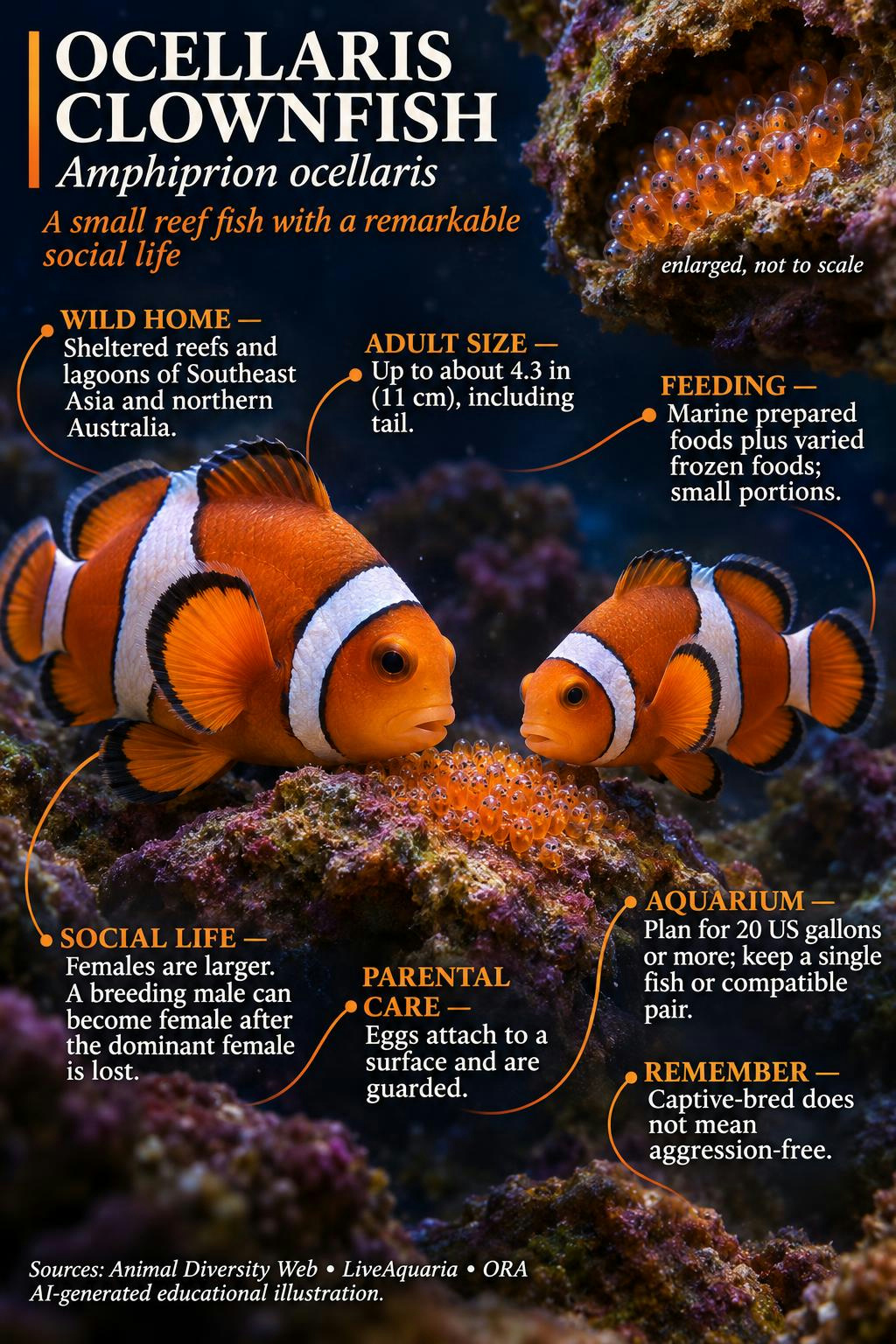
At a glance
- Adult size
- Up to about 4.3 inches (11 cm), including tail
- Aquarium space
- 20 US gallons or more; community tanks need extra space.
- Feeding
- Varied marine foods; confirm both fish eat.
- Compatibility
- Single fish or an established compatible pair.
Starting guidance, not a universal minimum. See the care details and sources below.
Adult size
Up to about 4.3 inches (11 cm), including tail
Aquarium space
20 US gallons or larger is LiveAquaria’s starting recommendation. Allow more space for a community and plan around the adult fish, not the purchase size.
Water conditions
Stable tropical marine conditions. ORA recommends 75–80°F (24–27°C) for its aquacultured fish. Confirm salinity with the breeder and the requirements of any invertebrates; fish-only holding salinity is not a universal reef target.
Natural home
Sheltered reefs and lagoons in Southeast Asia and northern Australia; wild fish associate with host anemones.
Food and feeding
An omnivore. Offer appropriately sized marine pellets or flakes plus varied frozen marine foods. Check that each fish actually eats, especially when establishing a pair.
Tankmates and behavior
Keep a single fish or an established compatible pair. They defend their territory, particularly around eggs. Do not assume two adults or a mixture of clownfish species will get along.
Setting up the habitat
Provide stable rockwork and sheltered places, with room away from a defended territory. A cycled aquarium and consistent maintenance matter even for a relatively hardy captive-bred fish.
A closer look
Females are larger than males. In their social system a breeding male can become female after the dominant female is lost. Eggs are laid on a surface and guarded.
Read the infographic as text
- WILD HOME — Sheltered reefs and lagoons of Southeast Asia and northern Australia.
- ADULT SIZE — Up to about 4.3 in (11 cm), including tail.
- FEEDING — Marine prepared foods plus varied frozen foods; small portions.
- SOCIAL LIFE — Females are larger. A breeding male can become female after the dominant female is lost.
- PARENTAL CARE — Eggs attach to a surface and are guarded.
- AQUARIUM — Plan for 20 US gallons or more; keep a single fish or compatible pair.
- REMEMBER — Captive-bred does not mean aggression-free.
How to use these figures
Published care ranges and suggested tank sizes are starting points, not guarantees. Tank footprint, group size, filtration, feeding, companions and the individual fish all matter. Standard length excludes the tail fin. Do not abruptly change established water conditions to match a number on a page.
Use a cycled aquarium, monitor water quality and quarantine new arrivals using a suitable species-specific plan. Persistent appetite loss, rapid breathing or weight loss warrants investigation.
Common questions
Can two adult clownfish automatically become a pair?
Keep a single fish or an established compatible pair. They defend their territory, particularly around eggs. Do not assume two adults or a mixture of clownfish species will get along.
Can a male clownfish become female?
Females are larger than males. In their social system a breeding male can become female after the dominant female is lost. Eggs are laid on a surface and guarded.
Sources & review
Checked November 12, 2026. Retailer care guidance is not a universal biological minimum.
- Amphiprion ocellaris (Clown anemonefish) | INFORMATION
- Saltwater Aquarium Fish – LiveAquaria — reviewed care reference
- Clownfish Care: Finding Nemo...In Your Home — reviewed care reference
- FAQ | ORA | Oceans, Reefs & Aquariums