
At a glance
- Adult size
- About 15 cm (5.9 in)
- Space
- 75–211 US gallons; see details
- Social needs
- Somewhat territorial but leaves other species alone. If dying or badly threatened, it can release a toxin that can kill other fish.
Starting guidance, not a universal minimum. See the care details and sources below.
Adult size
FishBase and Reef Life Survey give a maximum of 15 cm (about 5.9 inches) total length; AquaInfo gives 13–15 cm.
Aquarium space
Reefs.com gives a minimum of 75 US gallons (284 litres); AquaInfo asks for at least 800 litres (about 211 US gallons), a little more for a pair. It swims slowly, so keep the current gentle.
Water conditions
A cool-water fish. Reefs.com says it does better at 55–70°F (13–21°C); AquaInfo gives 20–24°C (68–75°F); Reef Life Survey records wild sea temperatures of 11–22.2°C. No source gives pH or salinity. These are maintenance ranges, not targets to swing between; avoid abrupt changes.
Natural home
Temperate reefs along Australia’s southern coast, 5–60 m deep, but mostly shallower than 20 m.
Food and feeding
Shrimps, crabs, starfish, sea urchins and fish, and possibly other frozen foods. Not reef safe: it eats coral and sharpens its teeth on it.
Tankmates and behavior
Somewhat territorial but leaves other species alone. If dying or badly threatened, it can release a toxin that can kill other fish.
Setting up the habitat
A fish-only tank with no corals, gentle flow for a slow swimmer, and cool water. Reefs.com rates it for experts only.
A closer look
A temperate fish of southern Australia: Reef Life Survey divers find it at only 5.7% of reef sites, about 2 per transect where seen.
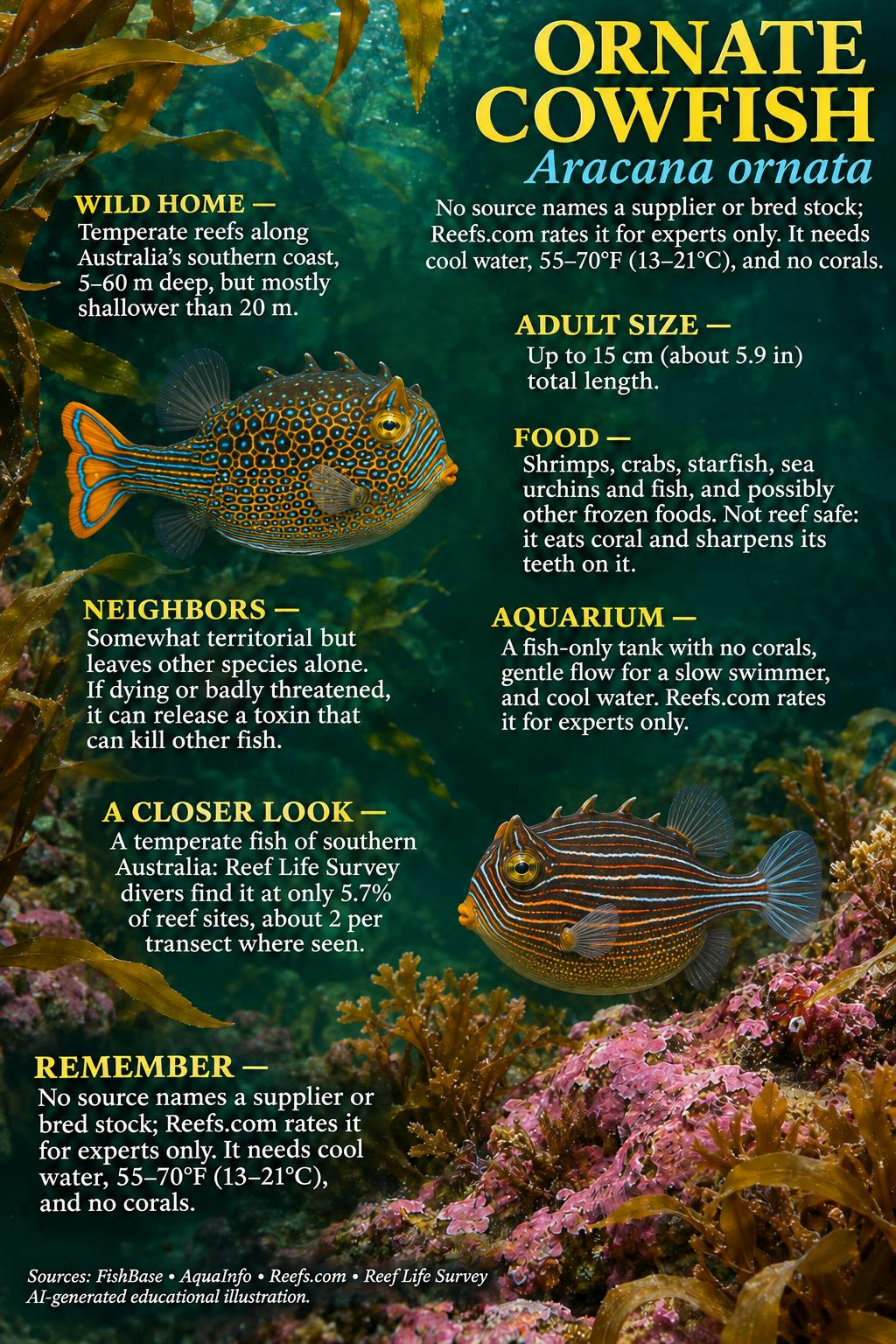
Read the infographic as text
- WILD HOME — Temperate reefs along Australia’s southern coast, 5–60 m deep, but mostly shallower than 20 m.
- ADULT SIZE — Up to 15 cm (about 5.9 in) total length.
- FOOD — Shrimps, crabs, starfish, sea urchins and fish, and possibly other frozen foods. Not reef safe: it eats coral and sharpens its teeth on it.
- NEIGHBORS — Somewhat territorial but leaves other species alone. If dying or badly threatened, it can release a toxin that can kill other fish.
- AQUARIUM — A fish-only tank with no corals, gentle flow for a slow swimmer, and cool water. Reefs.com rates it for experts only.
- A CLOSER LOOK — A temperate fish of southern Australia: Reef Life Survey divers find it at only 5.7% of reef sites, about 2 per transect where seen.
- REMEMBER — No source names a supplier or bred stock; Reefs.com rates it for experts only. It needs cool water, 55–70°F (13–21°C), and no corals.
How to use these figures
Published care ranges and suggested tank sizes are starting points, not guarantees. Tank footprint, group size, filtration, feeding, companions and the individual fish all matter. Standard length excludes the tail fin. Do not abruptly change established water conditions to match a number on a page.
Use a cycled aquarium, monitor water quality and quarantine new arrivals using a suitable species-specific plan. Persistent appetite loss, rapid breathing or weight loss warrants investigation.
Common questions
What should I know before choosing this fish?
No source names a supplier or bred stock; Reefs.com rates it for experts only. It needs cool water, 55–70°F (13–21°C), and no corals. Somewhat territorial but leaves other species alone. If dying or badly threatened, it can release a toxin that can kill other fish.
What should I feed it?
Shrimps, crabs, starfish, sea urchins and fish, and possibly other frozen foods. Not reef safe: it eats coral and sharpens its teeth on it.
Why is it rare?
A temperate fish of southern Australia: Reef Life Survey divers find it at only 5.7% of reef sites, about 2 per transect where seen.
Sources & review
Checked November 12, 2026. Retailer care guidance is not a universal biological minimum.