
At a glance
- Adult size
- Recorded maximum 9.1 in; see length definition
- Space
- 125–130 US gallons or more; see details
- Social needs
- Keep only one per tank: similar-shaped tangs can be very aggressive toward each other.
Starting guidance, not a universal minimum. See the care details and sources below.
Adult size
FishBase reports a maximum recorded length of 23 cm (9.1 inches), including the tail. A recorded maximum is not a promise of typical aquarium size. LiveAquaria lists a maximum of 8 inches.
Aquarium space
LiveAquaria’s quick-facts panel lists a minimum of 130 US gallons (492 litres); its care text says a 125 gallon (473 litre) or larger aquarium is necessary to provide plenty of swimming room.
Water conditions
LiveAquaria lists 72–78°F (22–26°C), pH 8.1–8.4, dKH 8–12 and specific gravity 1.020–1.025. These are retailer fish-care ranges, not a universal prescription for every coral or invertebrate; match the whole system and keep conditions stable. FishBase gives 24–28°C (75–82°F) for the species in the wild.
Natural home
Clear lagoon and seaward reefs, usually in shallow exposed areas, from Sulawesi to the Philippines and Ryukyu Islands.
Food and feeding
Plenty of marine seaweed and algae, on a clip or tied to a rock, at least three times a week, besides meaty foods.
Tankmates and behavior
Keep only one per tank: similar-shaped tangs can be very aggressive toward each other.
Setting up the habitat
125 gallons or more with plenty of swimming room; rated reef compatible.
A closer look
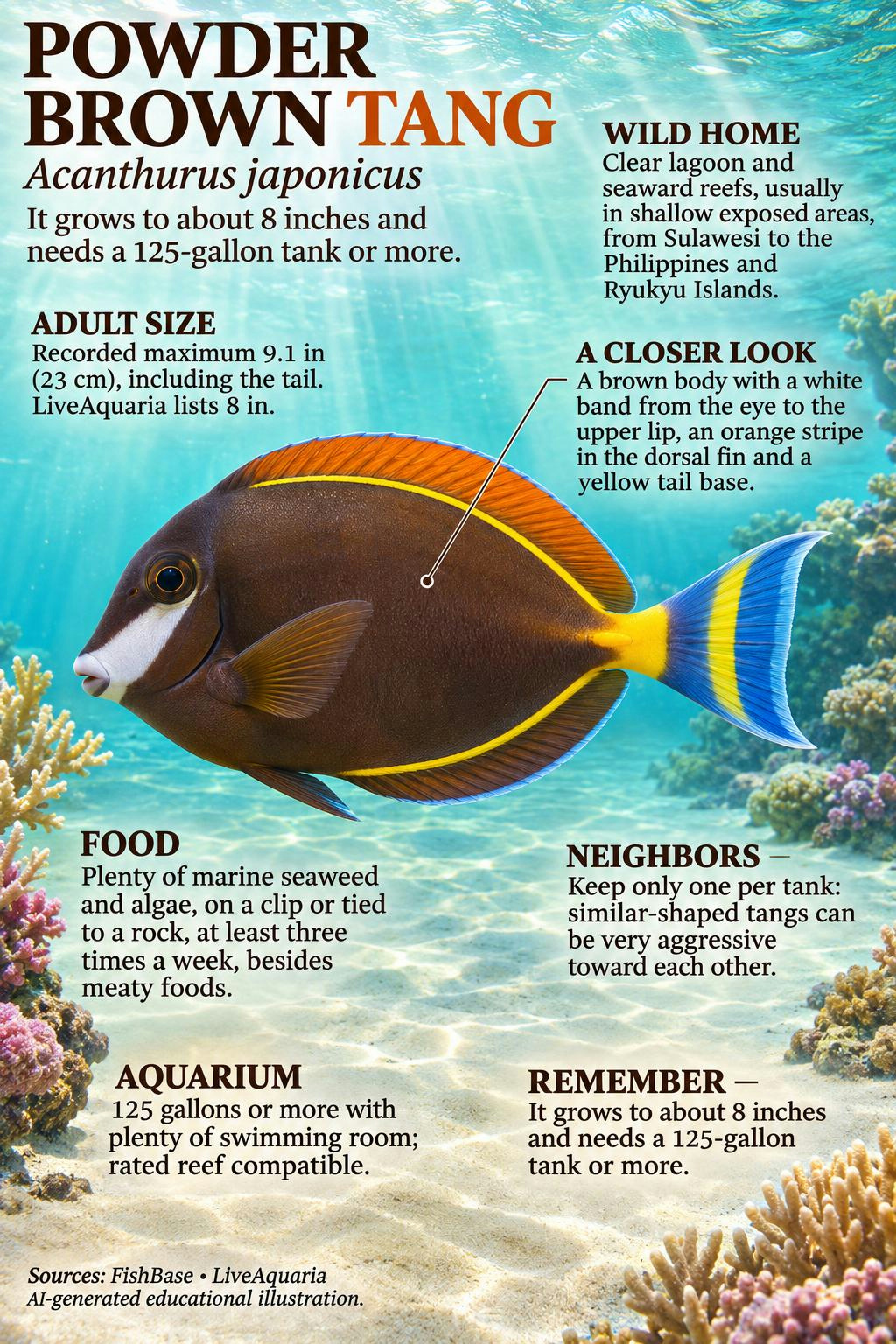
A brown body with a white band from the eye to the upper lip, an orange stripe in the dorsal fin and a yellow tail base.
Read the infographic as text
- WILD HOME — Clear lagoon and seaward reefs, usually in shallow exposed areas, from Sulawesi to the Philippines and Ryukyu Islands.
- ADULT SIZE — Recorded maximum 9.1 in (23 cm), including the tail. LiveAquaria lists 8 in.
- FOOD — Plenty of marine seaweed and algae, on a clip or tied to a rock, at least three times a week, besides meaty foods.
- NEIGHBORS — Keep only one per tank: similar-shaped tangs can be very aggressive toward each other.
- AQUARIUM — 125 gallons or more with plenty of swimming room; rated reef compatible.
- A CLOSER LOOK — A brown body with a white band from the eye to the upper lip, an orange stripe in the dorsal fin and a yellow tail base.
- REMEMBER — It grows to about 8 inches and needs a 125-gallon tank or more.
How to use these figures
Published care ranges and suggested tank sizes are starting points, not guarantees. Tank footprint, group size, filtration, feeding, companions and the individual fish all matter. Standard length excludes the tail fin. Do not abruptly change established water conditions to match a number on a page.
Use a cycled aquarium, monitor water quality and quarantine new arrivals using a suitable species-specific plan. Persistent appetite loss, rapid breathing or weight loss warrants investigation.
Common questions
What is the main consideration before buying?
It grows to about 8 inches and needs a 125-gallon tank or more. Keep only one per tank: similar-shaped tangs can be very aggressive toward each other.
What should this fish eat?
Plenty of marine seaweed and algae, on a clip or tied to a rock, at least three times a week, besides meaty foods.
Sources & review
Checked November 12, 2026. Retailer care guidance is not a universal biological minimum.
- FishBase — Acanthurus japonicus species account
- LiveAquaria — Powder Brown Tang care profile — reviewed care reference