
At a glance
- Adult size
- About 1.4 in body length
- Space
- 18 × 12 in base for a pair or small group
- Social needs
- Not for a community tank; breeding comes first. Reports differ: some keep harems, others see sustained bullying and keep single pairs.
Starting guidance, not a universal minimum. See the care details and sources below.
Adult size
Seriously Fish reports a maximum standard length of 36 mm (about 1.4 inches), excluding the tail fin; FishBase agrees at 3.6 cm SL.
Aquarium space
Seriously Fish says an 18 × 12 in (45 × 30 cm) base, about 41 litres (11 US gallons), is the minimum and suits a pair or small group. Fit the tightest cover you can: fry need warm, humid air to develop.
Water conditions
Seriously Fish lists 72–81°F (22–27°C), pH 3.0–6.0 and 1–5 dGH, with negligible carbonate hardness, so reverse osmosis water may be needed; the type locality measured pH 3.5–3.7 in 1991. FishBase gives no water figures. Change small amounts of water regularly. These are maintenance ranges, not targets to swing between; avoid abrupt changes.
Natural home
Shaded, shallow peat swamp blackwater in northern Selangor, Malaysia, often under 1 m deep over leaf litter; many pools are temporary.
Food and feeding
Takes dried foods once it learns them, but offer plenty of small live or frozen Daphnia, Artemia or bloodworm; do not overfeed.
Tankmates and behavior
Not for a community tank; breeding comes first. Reports differ: some keep harems, others see sustained bullying and keep single pairs.
Setting up the habitat
Bubble-nester; the male tends the nest alone. Dim light, roots, leaf litter, floating plants, nest tubes, a gentle filter, a tight lid.
A closer look
Much of its range is now oil palm or rubber; FishBase lists it as Endangered. One site, Tg Malim, is an officially protected zone.
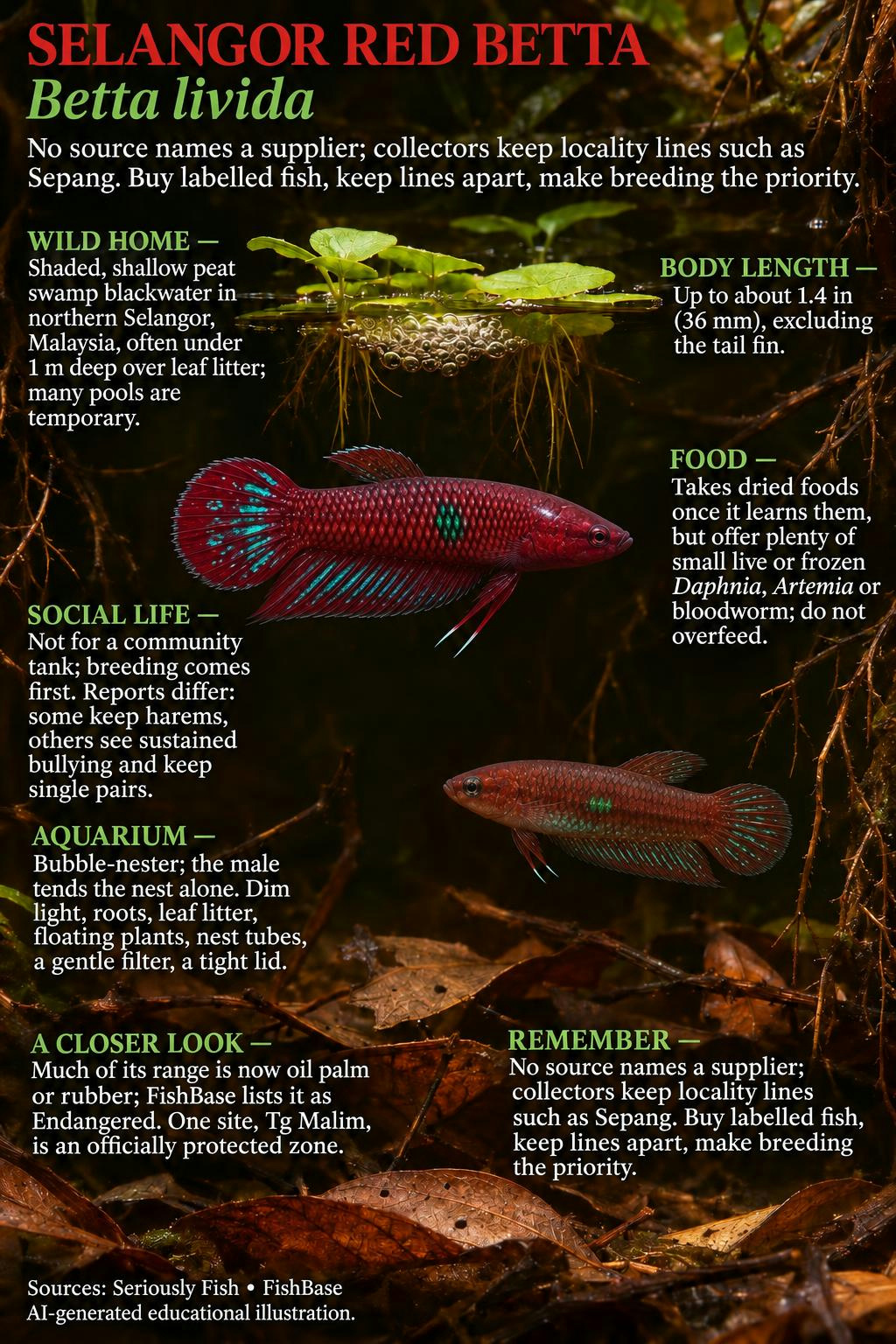
Read the infographic as text
- WILD HOME — Shaded, shallow peat swamp blackwater in northern Selangor, Malaysia, often under 1 m deep over leaf litter; many pools are temporary.
- BODY LENGTH — Up to about 1.4 in (36 mm), excluding the tail fin.
- FOOD — Takes dried foods once it learns them, but offer plenty of small live or frozen Daphnia, Artemia or bloodworm; do not overfeed.
- SOCIAL LIFE — Not for a community tank; breeding comes first. Reports differ: some keep harems, others see sustained bullying and keep single pairs.
- AQUARIUM — Bubble-nester; the male tends the nest alone. Dim light, roots, leaf litter, floating plants, nest tubes, a gentle filter, a tight lid.
- A CLOSER LOOK — Much of its range is now oil palm or rubber; FishBase lists it as Endangered. One site, Tg Malim, is an officially protected zone.
- REMEMBER — No source names a supplier; collectors keep locality lines such as Sepang. Buy labelled fish, keep lines apart, make breeding the priority.
How to use these figures
Published care ranges and suggested tank sizes are starting points, not guarantees. Tank footprint, group size, filtration, feeding, companions and the individual fish all matter. Standard length excludes the tail fin. Do not abruptly change established water conditions to match a number on a page.
Use a cycled aquarium, monitor water quality and quarantine new arrivals using a suitable species-specific plan. Persistent appetite loss, rapid breathing or weight loss warrants investigation.
Common questions
What should I know before choosing this fish?
No source names a supplier; collectors keep locality lines such as Sepang. Buy labelled fish, keep lines apart, make breeding the priority. Not for a community tank; breeding comes first. Reports differ: some keep harems, others see sustained bullying and keep single pairs.
What should I feed it?
Takes dried foods once it learns them, but offer plenty of small live or frozen Daphnia, Artemia or bloodworm; do not overfeed.
Why is it rare?
Much of its range is now oil palm or rubber; FishBase lists it as Endangered. One site, Tg Malim, is an officially protected zone.
Sources & review
Checked November 12, 2026. Retailer care guidance is not a universal biological minimum.