
At a glance
- Adult size
- Up to 10 cm SL (FishBase); males to 12 cm (ANGFA)
- Space
- 300 litres (about 79 US gallons) or more
- Social needs
- Peaceful, in a small group. Never keep it with other Chilatherina: all rainbowfish can hybridise, and the females look alike.
Starting guidance, not a universal minimum. See the care details and sources below.
Adult size
FishBase records a maximum standard length of 10.0 cm (about 3.9 inches), excluding the tail fin. ANGFA says males may reach 12 cm while females are usually under 10 cm; the Biotope Aquarium Project gives a standard length of 12 cm.
Aquarium space
No source gives tank dimensions. The Biotope Aquarium Project gives a minimum aquarium volume of 300 litres (about 79 US gallons) for a small group.
Water conditions
The ForAquarist breeder keeps it at 22–26°C (72–79°F), calling 26°C the upper limit for raising young, with pH above 7 and hardness up to 10°dH. The Biotope Aquarium Project gives 22–27°C (72–81°F) and pH 6.2–7.0; FishBase gives 24–28°C (75–82°F). These are maintenance ranges, not targets to swing between; avoid abrupt changes.
Natural home
Lake Sentani and its feeder streams in West Papua, Indonesia, gathering around submerged plants and fallen branches along the margins.
Food and feeding
Omnivorous: up to 70% flake or pellet food plus live bloodworms, brine shrimp and daphnia; ForAquarist says insect larvae suit it best.
Tankmates and behavior
Peaceful, in a small group. Never keep it with other Chilatherina: all rainbowfish can hybridise, and the females look alike.
Setting up the habitat
At least 300 litres, with clear, slow-moving water and plants; java moss or a spawning mop takes the eggs.
A closer look
Perhaps gone from the lake itself; its one known creek is mining-polluted and re-collection has failed. Critically Endangered.
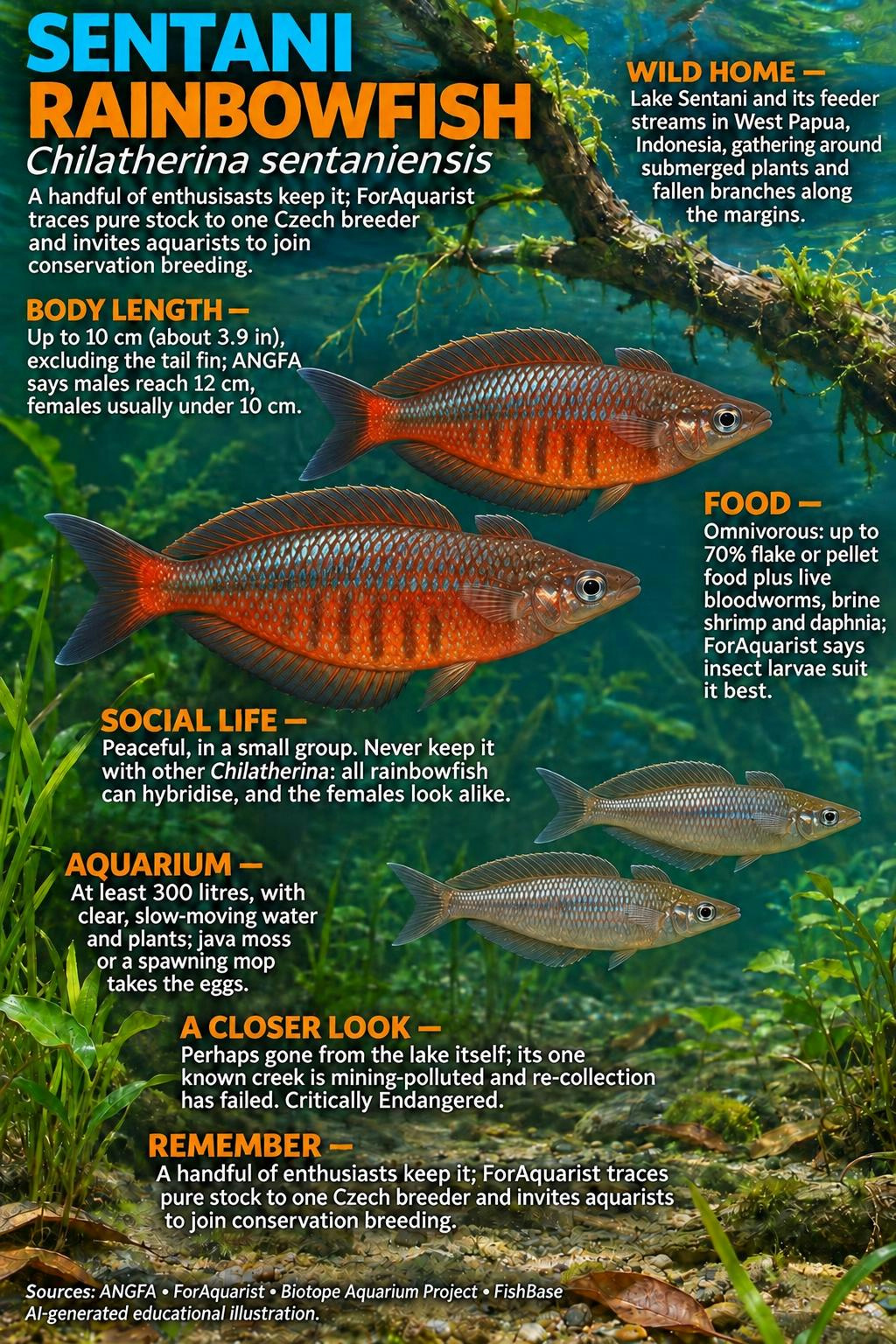
Read the infographic as text
- WILD HOME — Lake Sentani and its feeder streams in West Papua, Indonesia, gathering around submerged plants and fallen branches along the margins.
- BODY LENGTH — Up to 10 cm (about 3.9 in), excluding the tail fin; ANGFA says males reach 12 cm, females usually under 10 cm.
- FOOD — Omnivorous: up to 70% flake or pellet food plus live bloodworms, brine shrimp and daphnia; ForAquarist says insect larvae suit it best.
- SOCIAL LIFE — Peaceful, in a small group. Never keep it with other Chilatherina: all rainbowfish can hybridise, and the females look alike.
- AQUARIUM — At least 300 litres, with clear, slow-moving water and plants; java moss or a spawning mop takes the eggs.
- A CLOSER LOOK — Perhaps gone from the lake itself; its one known creek is mining-polluted and re-collection has failed. Critically Endangered.
- REMEMBER — A handful of enthusiasts keep it; ForAquarist traces pure stock to one Czech breeder and invites aquarists to join conservation breeding.
How to use these figures
Published care ranges and suggested tank sizes are starting points, not guarantees. Tank footprint, group size, filtration, feeding, companions and the individual fish all matter. Standard length excludes the tail fin. Do not abruptly change established water conditions to match a number on a page.
Use a cycled aquarium, monitor water quality and quarantine new arrivals using a suitable species-specific plan. Persistent appetite loss, rapid breathing or weight loss warrants investigation.
Common questions
What should I know before choosing this fish?
A handful of enthusiasts keep it; ForAquarist traces pure stock to one Czech breeder and invites aquarists to join conservation breeding. Peaceful, in a small group. Never keep it with other Chilatherina: all rainbowfish can hybridise, and the females look alike.
What should I feed it?
Omnivorous: up to 70% flake or pellet food plus live bloodworms, brine shrimp and daphnia; ForAquarist says insect larvae suit it best.
Why is it rare?
Perhaps gone from the lake itself; its one known creek is mining-polluted and re-collection has failed. Critically Endangered.
Sources & review
Checked November 12, 2026. Retailer care guidance is not a universal biological minimum.