
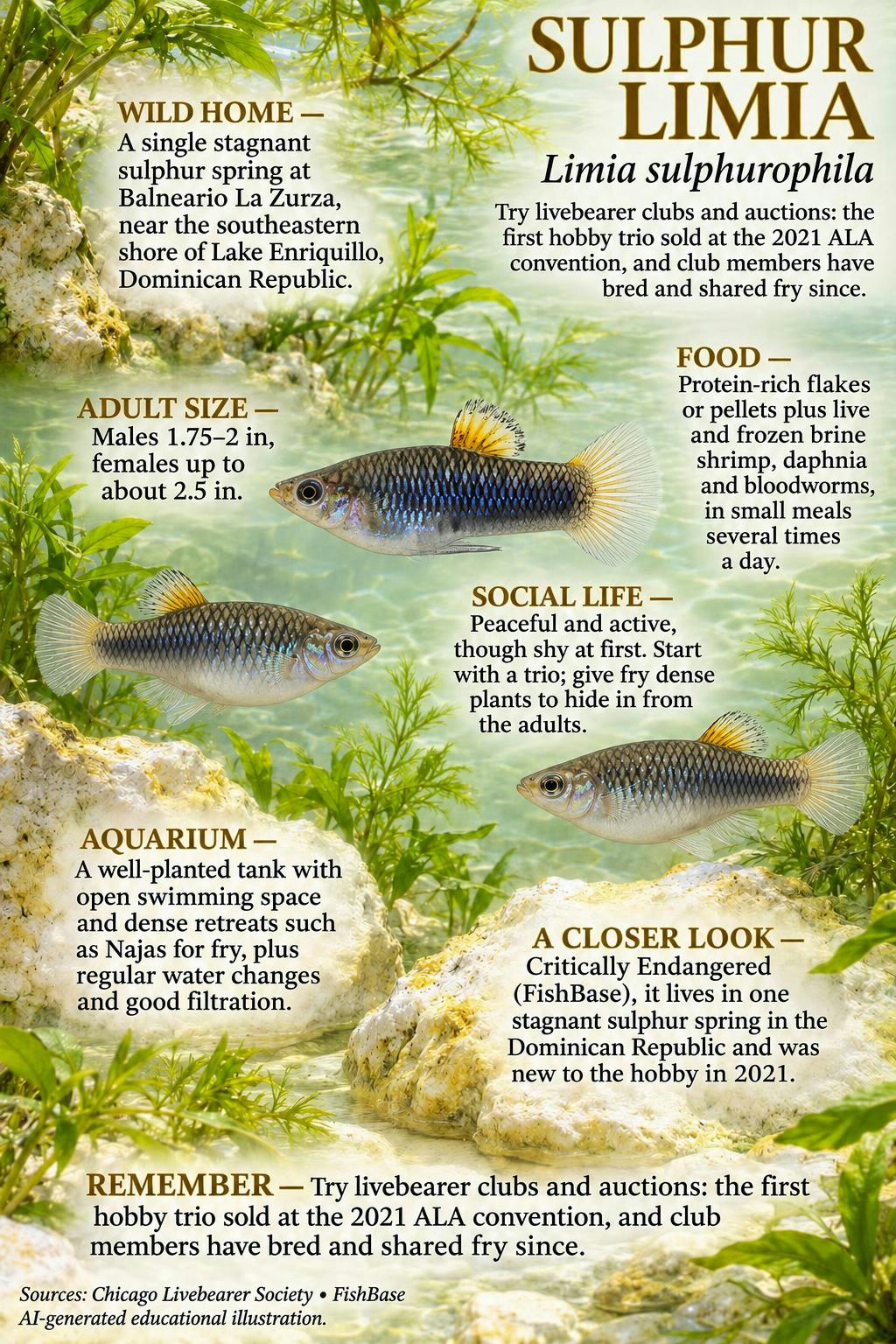
At a glance
- Adult size
- Males 1.75–2 in; females 2.5 in
- Space
- 10 US gallons (38 litres) or more
- Social needs
- Peaceful and active, though shy at first. Start with a trio; give fry dense plants to hide in from the adults.
Starting guidance, not a universal minimum. See the care details and sources below.
Adult size
The Chicago Livebearer Society gives males 1.75–2 in and females 2.5 in; FishBase gives maximum standard lengths of 3.9 cm (about 1.5 inches) for males and 4.3 cm (about 1.7 inches) for females.
Aquarium space
The Chicago Livebearer Society, the only care account found, says 10 US gallons (38 litres) or more; the author bred a trio in a heavily planted 10-gallon tank.
Water conditions
The Chicago Livebearer Society recommends 75–80°F (24–27°C) and pH 6.5–7.5, though it is not picky and the author kept it in very hard well water. FishBase gives 23–28°C, pH 7.0–7.7 and 10–30 dH. These are maintenance ranges, not targets to swing between; avoid abrupt changes.
Natural home
A single stagnant sulphur spring at Balneario La Zurza, near the southeastern shore of Lake Enriquillo, Dominican Republic.
Food and feeding
Protein-rich flakes or pellets plus live and frozen brine shrimp, daphnia and bloodworms, in small meals several times a day.
Tankmates and behavior
Peaceful and active, though shy at first. Start with a trio; give fry dense plants to hide in from the adults.
Setting up the habitat
A well-planted tank with open swimming space and dense retreats such as Najas for fry, plus regular water changes and good filtration.
A closer look
Critically Endangered (FishBase), it lives in one stagnant sulphur spring in the Dominican Republic and was new to the hobby in 2021.
Read the infographic as text
- WILD HOME — A single stagnant sulphur spring at Balneario La Zurza, near the southeastern shore of Lake Enriquillo, Dominican Republic.
- ADULT SIZE — Males 1.75–2 in, females up to about 2.5 in.
- FOOD — Protein-rich flakes or pellets plus live and frozen brine shrimp, daphnia and bloodworms, in small meals several times a day.
- SOCIAL LIFE — Peaceful and active, though shy at first. Start with a trio; give fry dense plants to hide in from the adults.
- AQUARIUM — A well-planted tank with open swimming space and dense retreats such as Najas for fry, plus regular water changes and good filtration.
- A CLOSER LOOK — Critically Endangered (FishBase), it lives in one stagnant sulphur spring in the Dominican Republic and was new to the hobby in 2021.
- REMEMBER — Try livebearer clubs and auctions: the first hobby trio sold at the 2021 ALA convention, and club members have bred and shared fry since.
How to use these figures
Published care ranges and suggested tank sizes are starting points, not guarantees. Tank footprint, group size, filtration, feeding, companions and the individual fish all matter. Standard length excludes the tail fin. Do not abruptly change established water conditions to match a number on a page.
Use a cycled aquarium, monitor water quality and quarantine new arrivals using a suitable species-specific plan. Persistent appetite loss, rapid breathing or weight loss warrants investigation.
Common questions
What should I know before choosing this fish?
Try livebearer clubs and auctions: the first hobby trio sold at the 2021 ALA convention, and club members have bred and shared fry since. Peaceful and active, though shy at first. Start with a trio; give fry dense plants to hide in from the adults.
What should I feed it?
Protein-rich flakes or pellets plus live and frozen brine shrimp, daphnia and bloodworms, in small meals several times a day.
Why is it rare?
Critically Endangered (FishBase), it lives in one stagnant sulphur spring in the Dominican Republic and was new to the hobby in 2021.
Sources & review
Checked November 12, 2026. Retailer care guidance is not a universal biological minimum.