
At a glance
- Adult size
- About 7.1 in total length
- Space
- About 150 cm long; 500 litres (about 132 US gallons)
- Social needs
- Territorial, strongly so when breeding, and pushy at feeding time; it ignores livebearers, tetras and minnows kept with it.
Starting guidance, not a universal minimum. See the care details and sources below.
Adult size
FishBase gives a maximum total length of 18.0 cm (about 7.1 inches), including the tail fin; Cichlid Amérique gives males about 18 cm and females about 12–15 cm, and the Nordiska Ciklidsällskapet register gives 18 cm. Males are larger and grow a forehead hump in the spawning season.
Aquarium space
Cichlid Amérique asks for at least 500 litres (about 132 US gallons), ideally about 150 cm (about 59.1 inches) long, though it also cites 300–400 litres as a minimum; two pairs need at least 150 × 50 × 50 cm. Too small a tank or too-small tankmates raise aggression. The Nordiska Ciklidsällskapet register gives 160 cm (about 63.0 inches) and 540 litres (about 143 US gallons).
Water conditions
Cichlid Amérique wants very hard, alkaline water: pH 7.8–8.3, 15–25 dGH and 20–28°C (68–82°F), avoiding anything above 28°C; below that range breeding stops and growth stalls. It needs well-oxygenated water and a weekly water change. FishBase gives pH 7.8–8.3; the register gives 23–27°C (73–81°F). These are maintenance ranges, not targets to swing between; avoid abrupt changes.
Natural home
Clear, hard, mineral-rich water over rock, often below waterfalls, in the Río Tamasopo, a Pánuco tributary in Mexico.
Food and feeding
Grazes algae and detritus in the wild. Give plant-rich foods such as peas, green beans and zucchini; avoid protein-rich diets.
Tankmates and behavior
Territorial, strongly so when breeding, and pushy at feeding time; it ignores livebearers, tetras and minnows kept with it.
Setting up the habitat
Sand or fine gravel, many flat stones and rock caves, few roots and open swimming space; any plants must tolerate hard water.
A closer look
Vulnerable: its few rivers in the Tamasopo area are polluted by sugar-mill waste and by sugar-cane pesticides and fertilisers.
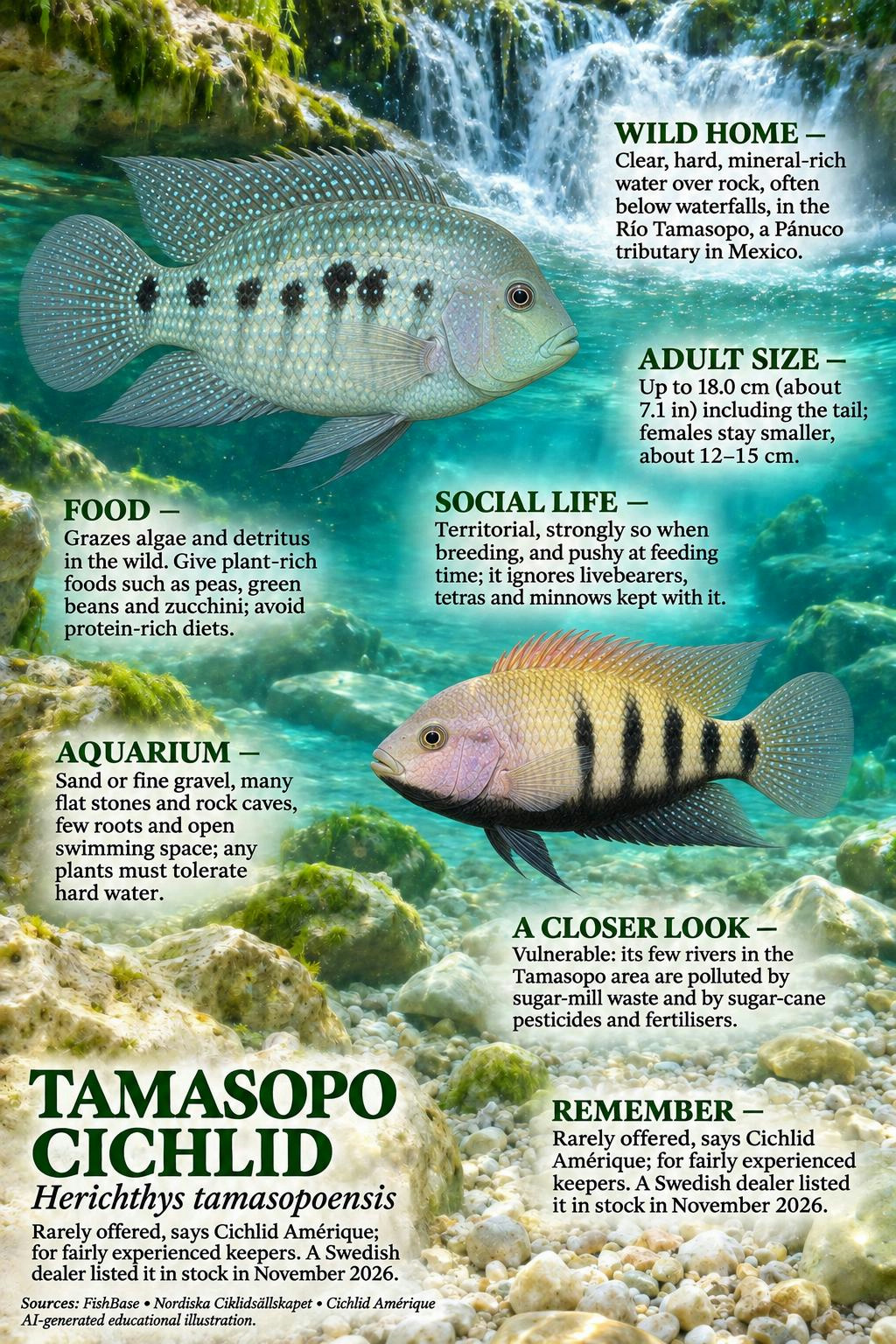
Read the infographic as text
- WILD HOME — Clear, hard, mineral-rich water over rock, often below waterfalls, in the Río Tamasopo, a Pánuco tributary in Mexico.
- ADULT SIZE — Up to 18.0 cm (about 7.1 in) including the tail; females stay smaller, about 12–15 cm.
- FOOD — Grazes algae and detritus in the wild. Give plant-rich foods such as peas, green beans and zucchini; avoid protein-rich diets.
- SOCIAL LIFE — Territorial, strongly so when breeding, and pushy at feeding time; it ignores livebearers, tetras and minnows kept with it.
- AQUARIUM — Sand or fine gravel, many flat stones and rock caves, few roots and open swimming space; any plants must tolerate hard water.
- A CLOSER LOOK — Vulnerable: its few rivers in the Tamasopo area are polluted by sugar-mill waste and by sugar-cane pesticides and fertilisers.
- REMEMBER — Rarely offered, says Cichlid Amérique; for fairly experienced keepers. A Swedish dealer listed it in stock in November 2026.
How to use these figures
Published care ranges and suggested tank sizes are starting points, not guarantees. Tank footprint, group size, filtration, feeding, companions and the individual fish all matter. Standard length excludes the tail fin. Do not abruptly change established water conditions to match a number on a page.
Use a cycled aquarium, monitor water quality and quarantine new arrivals using a suitable species-specific plan. Persistent appetite loss, rapid breathing or weight loss warrants investigation.
Common questions
What should I know before choosing this fish?
Rarely offered, says Cichlid Amérique; for fairly experienced keepers. A Swedish dealer listed it in stock in November 2026. Territorial, strongly so when breeding, and pushy at feeding time; it ignores livebearers, tetras and minnows kept with it.
What should I feed it?
Grazes algae and detritus in the wild. Give plant-rich foods such as peas, green beans and zucchini; avoid protein-rich diets.
Why is it rare?
Vulnerable: its few rivers in the Tamasopo area are polluted by sugar-mill waste and by sugar-cane pesticides and fertilisers.
Sources & review
Checked November 12, 2026. Retailer care guidance is not a universal biological minimum.