
At a glance
- Adult size
- 118.1 in (300 cm) TL reported maximum; captive accounts 5–6 ft (152–183 cm)
- Space
- 500 US gal (1,893 L), 96 × 48 × 25 in specialist plan; one eel only
- Social needs
- Keep alone in the conditional 500-US-gallon (1,893-L) specialist plan. Even large fish and other morays can be attacked; a tankmate being too large to swallow is not a guarantee of safety.
Starting guidance, not a universal minimum. See the care details and sources below.
Adult size
FishBase reports a maximum of 118.1 inches (300 cm) total length; specialist aquarium accounts discuss adults around 5–6 feet (152–183 cm). A usual captive size is not a species maximum.
Aquarium space
WetWebMedia explicitly endorses one eel for life in a dedicated 96 × 48 × 25-inch tank (244 × 122 × 64 cm), nominally 500 US gallons (1,893 L), provided it has enough caves, excellent filtration and NO tankmates. This is the qualifying specialist plan, not any tank labelled 500 gallons. The same specialist prefers 600–750 US gallons (2,271–2,839 L); De Jong recommends about 1,321 US gallons (5,000 L). Retain the reported 300 cm species maximum: this plan is not a guarantee for an exceptionally large individual.
Water conditions
72–78°F (22–26°C); pH 8.1–8.4; dKH 8–12; SG 1.020–1.025, from LiveAquaria’s marine care panel. Provide strong aeration, effective filtration and stable water quality.
Natural home
Marine; maintain a stable, fully saltwater aquarium.
Food and feeding
Offer varied suitably sized marine meaty foods rather than a single food item.
Tankmates and behavior
Keep alone in the conditional 500-US-gallon (1,893-L) specialist plan. Even large fish and other morays can be attacked; a tankmate being too large to swallow is not a guarantee of safety.
Setting up the habitat
Preserve the source’s 8 × 4-foot floor area (244 × 122 cm), with secured caves large enough for the adult body, excellent filtration and oxygenation, and an escape-proof cover over every opening. Use a dedicated single-eel system.
A closer look
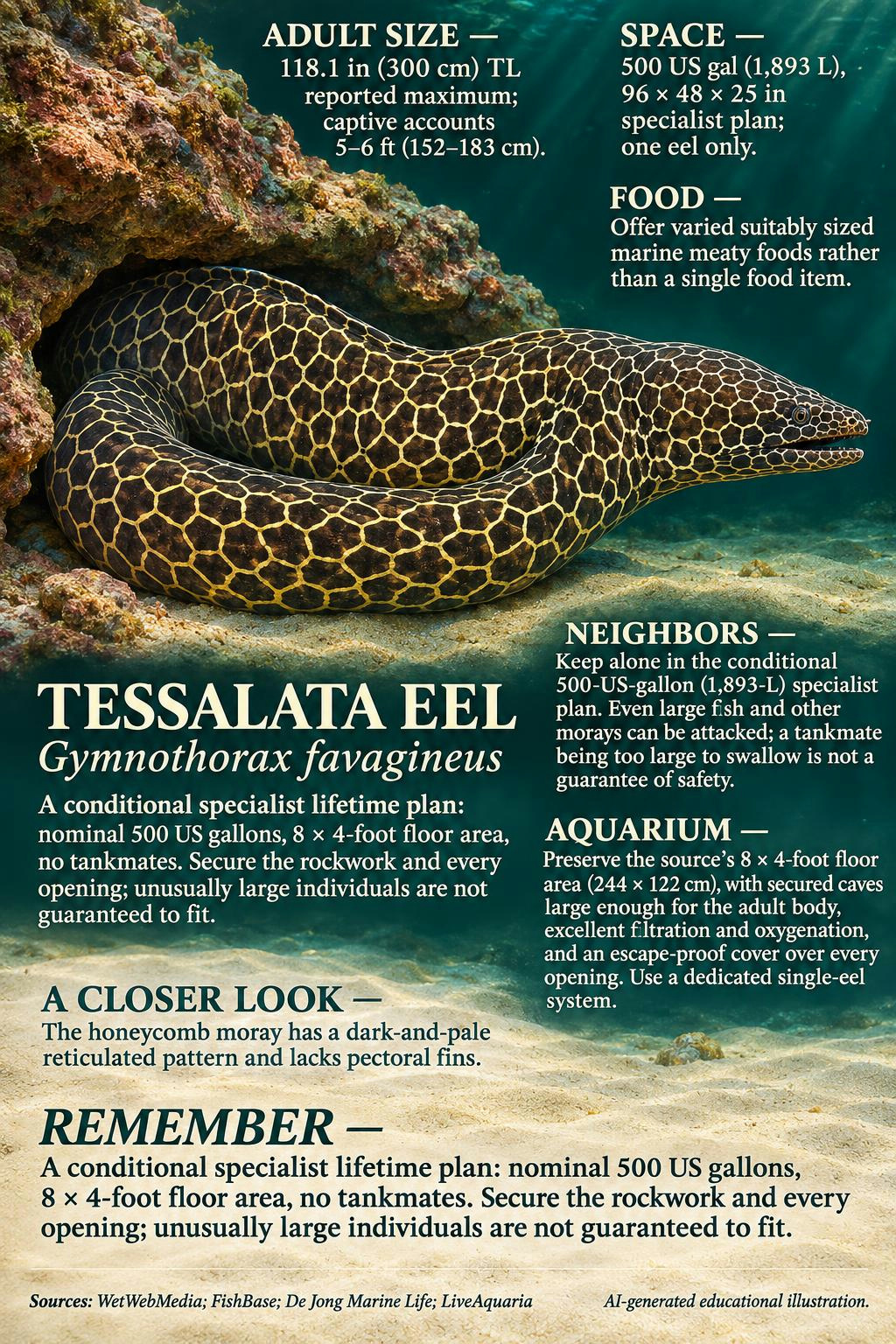
The honeycomb moray has a dark-and-pale reticulated pattern and lacks pectoral fins.
Read the infographic as text
- ADULT SIZE — 118.1 in (300 cm) TL reported maximum; captive accounts 5–6 ft (152–183 cm).
- SPACE — 500 US gal (1,893 L), 96 × 48 × 25 in specialist plan; one eel only.
- FOOD — Offer varied suitably sized marine meaty foods rather than a single food item.
- NEIGHBORS — Keep alone in the conditional 500-US-gallon (1,893-L) specialist plan. Even large fish and other morays can be attacked; a tankmate being too large to swallow is not a guarantee of safety.
- AQUARIUM — Preserve the source’s 8 × 4-foot floor area (244 × 122 cm), with secured caves large enough for the adult body, excellent filtration and oxygenation, and an escape-proof cover over every opening. Use a dedicated single-eel system.
- A CLOSER LOOK — The honeycomb moray has a dark-and-pale reticulated pattern and lacks pectoral fins.
- REMEMBER — A conditional specialist lifetime plan: nominal 500 US gallons, 8 × 4-foot floor area, no tankmates. Secure the rockwork and every opening; unusually large individuals are not guaranteed to fit.
How to use these figures
Published care ranges and suggested tank sizes are starting points, not guarantees. Tank footprint, group size, filtration, feeding, companions and the individual fish all matter. Standard length excludes the tail fin. Do not abruptly change established water conditions to match a number on a page.
Use a cycled aquarium, monitor water quality and quarantine new arrivals using a suitable species-specific plan. Persistent appetite loss, rapid breathing or weight loss warrants investigation.
Common questions
What should I know before choosing this fish?
A conditional specialist lifetime plan: nominal 500 US gallons, 8 × 4-foot floor area, no tankmates. Secure the rockwork and every opening; unusually large individuals are not guaranteed to fit. Keep alone in the conditional 500-US-gallon (1,893-L) specialist plan. Even large fish and other morays can be attacked; a tankmate being too large to swallow is not a guarantee of safety.
What should I feed it?
Offer varied suitably sized marine meaty foods rather than a single food item.
How much space does an adult need?
WetWebMedia explicitly endorses one eel for life in a dedicated 96 × 48 × 25-inch tank (244 × 122 × 64 cm), nominally 500 US gallons (1,893 L), provided it has enough caves, excellent filtration and NO tankmates. This is the qualifying specialist plan, not any tank labelled 500 gallons. The same specialist prefers 600–750 US gallons (2,271–2,839 L); De Jong recommends about 1,321 US gallons (5,000 L). Retain the reported 300 cm species maximum: this plan is not a guarantee for an exceptionally large individual.
Sources & review
Checked November 12, 2026. Retailer care guidance is not a universal biological minimum.
- WetWebMedia — Tessalata eel (honeycomb moray)
- tessalata-fishbase — Gymnothorax favagineus
- tessalata-dejong — Gymnothorax favagineus
- tessalata-la-conditions — Gymnothorax favagineus — reviewed care reference
- tessalata-reefapp — Gymnothorax favagineus