
At a glance
- Adult size
- Up to about 2.8 inches (7 cm) standard length, excluding the tail fin
- Aquarium space
- At least an 18 × 12 inch (45 × 30 cm) base.
- Feeding
- Small portions of complete betta food plus variety.
- Compatibility
- One betta per aquarium is this guide’s default.
Starting guidance, not a universal minimum. See the care details and sources below.
Adult size
Up to about 2.8 inches (7 cm) standard length, excluding the tail fin
Aquarium space
Seriously Fish recommends a base of at least 18 × 12 inches (45 × 30 cm). Use this footprint rather than a tiny jar; the volume depends on tank height. This guide recommends one betta per aquarium.
Water conditions
Seriously Fish reports 72–86°F (22–30°C), pH 6.0–8.0 and 1–15 dGH for ornamental stock. These are broad maintenance ranges, not instructions to cycle between extremes. Choose a stable temperature appropriate to your fish and use a thermometer.
Natural home
Wild populations inhabit still or slowly moving, often densely vegetated waters in Thailand. Ornamental long-finned fish are selectively bred and should not be presented as the typical wild form.
Food and feeding
Offer suitable complete betta food with small live or frozen invertebrate foods for variety. Use small portions and monitor body condition; do not substitute plant roots for feeding.
Tankmates and behavior
Keep singly as the default. Do not house two males together or assume a male and female are a safe permanent pair. Long fins and aggression can complicate community arrangements.
Setting up the habitat
Provide gentle filtration, plant cover and resting places near the surface. Leave easy access to the air above the water and use a lid with an air gap. Avoid strong currents that constantly push the fish around.
A closer look
A labyrinth organ lets the fish supplement gill breathing with atmospheric air. Males build bubble nests and tend eggs; a bubble nest is not a complete test of health or water quality.
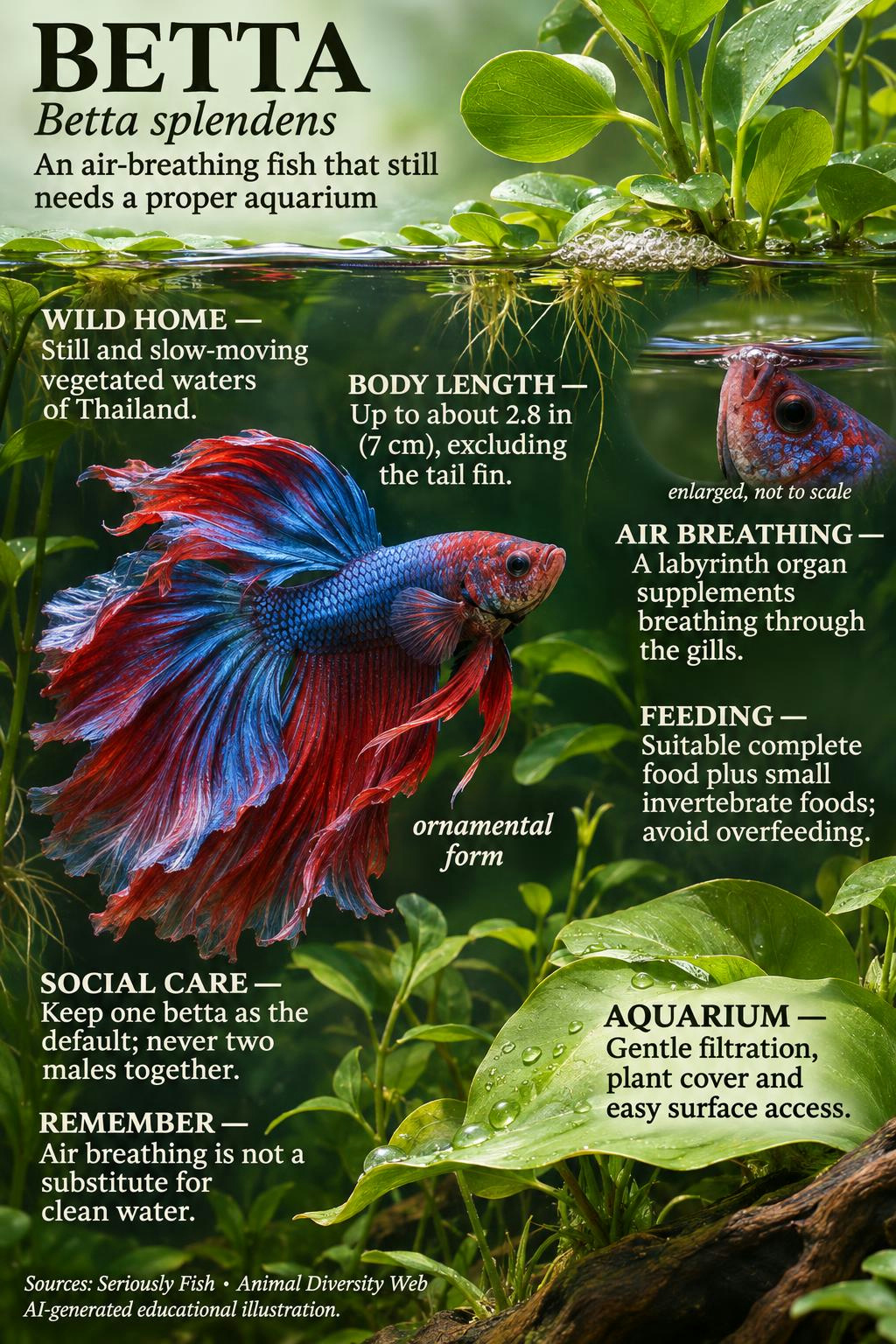
Read the infographic as text
- WILD HOME — Still and slow-moving vegetated waters of Thailand.
- BODY LENGTH — Up to about 2.8 in (7 cm), excluding the tail fin.
- AIR BREATHING — A labyrinth organ supplements breathing through the gills.
- FEEDING — Suitable complete food plus small invertebrate foods; avoid overfeeding.
- AQUARIUM — Gentle filtration, plant cover and easy surface access.
- SOCIAL CARE — Keep one betta as the default; never two males together.
- REMEMBER — Air breathing is not a substitute for clean water.
How to use these figures
Published care ranges and suggested tank sizes are starting points, not guarantees. Tank footprint, group size, filtration, feeding, companions and the individual fish all matter. Standard length excludes the tail fin. Do not abruptly change established water conditions to match a number on a page.
Use a cycled aquarium, monitor water quality and quarantine new arrivals using a suitable species-specific plan. Persistent appetite loss, rapid breathing or weight loss warrants investigation.
Common questions
Does breathing air mean a betta can live in a small bowl?
Breathing air does not make dirty water or a tiny bowl suitable. Seriously Fish recommends a base of at least 18 × 12 inches (45 × 30 cm). Use this footprint rather than a tiny jar; the volume depends on tank height. This guide recommends one betta per aquarium. Provide gentle filtration, plant cover and resting places near the surface. Leave easy access to the air above the water and use a lid with an air gap. Avoid strong currents that constantly push the fish around.
Can two male bettas live together?
Keep singly as the default. Do not house two males together or assume a male and female are a safe permanent pair. Long fins and aggression can complicate community arrangements.
Sources & review
Checked November 12, 2026. Retailer care guidance is not a universal biological minimum.