
At a glance
- Adult size
- About 3.9 in body length
- Space
- 31 × 12 in base for a pair
- Social needs
- Best kept as a pair, alone or with very peaceful small fish. Males fight constantly when housed together, and females squabble.
Starting guidance, not a universal minimum. See the care details and sources below.
Adult size
Seriously Fish reports a maximum standard length of 100 mm (3.9 in), excluding the tail fin; FishBase gives only 6.7 cm SL. Males tend to grow larger than females.
Aquarium space
Seriously Fish says a base of 31 × 12 in (80 × 30 cm; about 72 litres, 19 US gallons) is sufficient for a pair. Fit the tightest cover you can: the fry need a layer of warm, humid air.
Water conditions
Seriously Fish lists 68–77°F (20–25°C), pH 4.0–6.0 and 0–5 dGH; FishBase gives 24–26°C and pH 4.4–5.7. These are maintenance ranges, not targets to swing between; avoid abrupt changes.
Natural home
Still, shady pools above rainforest waterfalls in Brunei and northern Sarawak, Borneo, over gravel and leaf litter in clear, brown water.
Food and feeding
Plenty of small live or frozen foods such as Daphnia, Artemia or bloodworm; dried foods are taken once recognised. Do not overfeed.
Tankmates and behavior
Best kept as a pair, alone or with very peaceful small fish. Males fight constantly when housed together, and females squabble.
Setting up the habitat
Driftwood arranged to make shady spots, clay pots or pipes for shelter, and dried leaf litter; many breeders skip the substrate.
A closer look
IUCN Vulnerable, and banned from export by the Sultan of Brunei. Its Sarawak habitat may become an oil palm plantation.
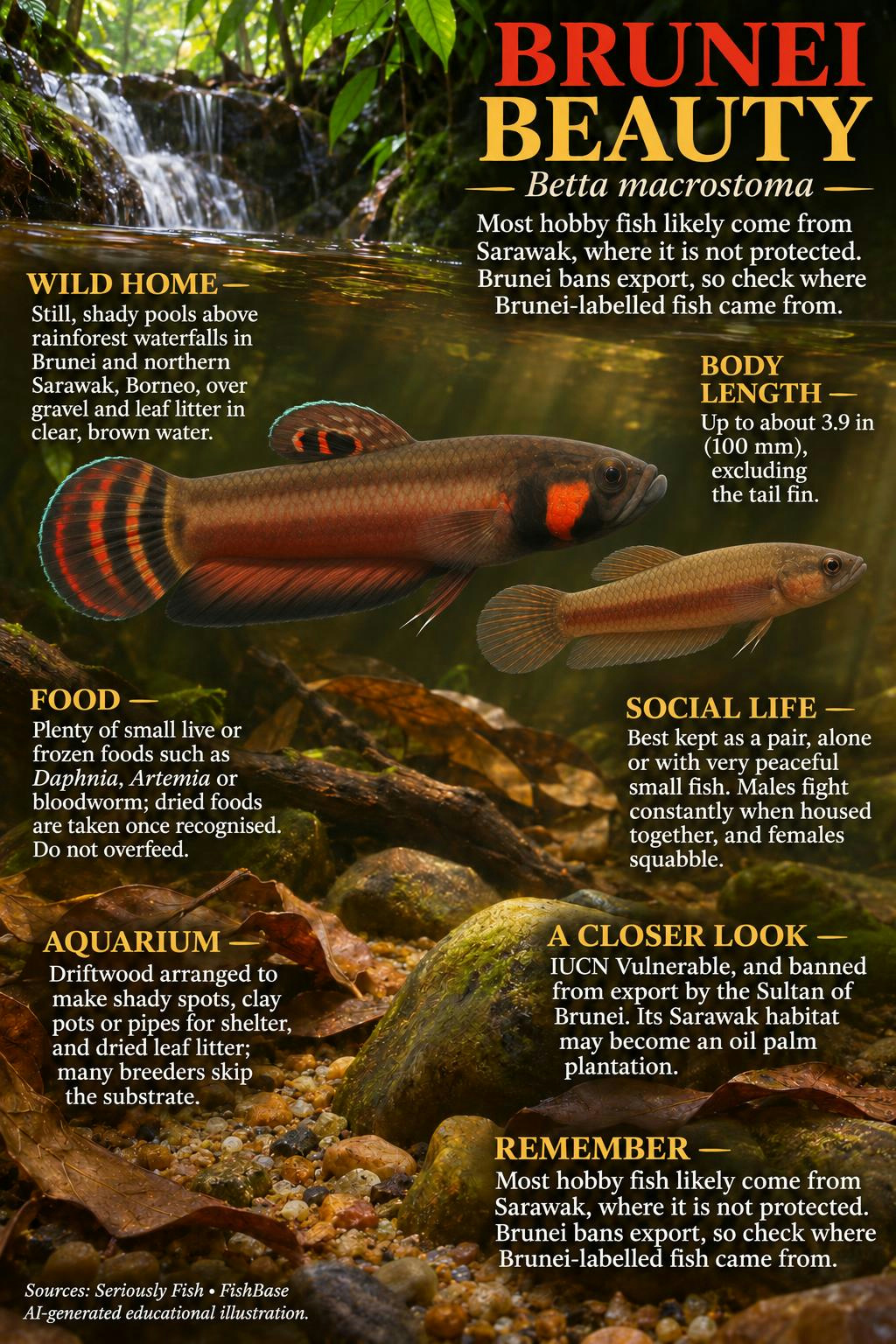
Read the infographic as text
- WILD HOME — Still, shady pools above rainforest waterfalls in Brunei and northern Sarawak, Borneo, over gravel and leaf litter in clear, brown water.
- BODY LENGTH — Up to about 3.9 in (100 mm), excluding the tail fin.
- FOOD — Plenty of small live or frozen foods such as Daphnia, Artemia or bloodworm; dried foods are taken once recognised. Do not overfeed.
- SOCIAL LIFE — Best kept as a pair, alone or with very peaceful small fish. Males fight constantly when housed together, and females squabble.
- AQUARIUM — Driftwood arranged to make shady spots, clay pots or pipes for shelter, and dried leaf litter; many breeders skip the substrate.
- A CLOSER LOOK — IUCN Vulnerable, and banned from export by the Sultan of Brunei. Its Sarawak habitat may become an oil palm plantation.
- REMEMBER — Most hobby fish likely come from Sarawak, where it is not protected. Brunei bans export, so check where Brunei-labelled fish came from.
How to use these figures
Published care ranges and suggested tank sizes are starting points, not guarantees. Tank footprint, group size, filtration, feeding, companions and the individual fish all matter. Standard length excludes the tail fin. Do not abruptly change established water conditions to match a number on a page.
Use a cycled aquarium, monitor water quality and quarantine new arrivals using a suitable species-specific plan. Persistent appetite loss, rapid breathing or weight loss warrants investigation.
Common questions
What should I know before choosing this fish?
Most hobby fish likely come from Sarawak, where it is not protected. Brunei bans export, so check where Brunei-labelled fish came from. Best kept as a pair, alone or with very peaceful small fish. Males fight constantly when housed together, and females squabble.
What should I feed it?
Plenty of small live or frozen foods such as Daphnia, Artemia or bloodworm; dried foods are taken once recognised. Do not overfeed.
Why is it rare?
IUCN Vulnerable, and banned from export by the Sultan of Brunei. Its Sarawak habitat may become an oil palm plantation.
Sources & review
Checked November 12, 2026. Retailer care guidance is not a universal biological minimum.