
At a glance
- Adult size
- About 2.3 in body length (FishBase)
- Space
- 31 × 12 in base for a pair or small group
- Social needs
- Best alone or with very peaceful small cyprinids or loaches from similar waters; bigger, livelier fish outcompete it. A pair or group.
Starting guidance, not a universal minimum. See the care details and sources below.
Adult size
FishBase lists a maximum standard length of 5.9 cm (about 2.3 inches), excluding the tail fin. Seriously Fish gives a maximum size of “80 - 85” with no unit; if that means millimetres, it is about 3.1–3.3 inches, perhaps total length, but the profile does not say.
Aquarium space
Seriously Fish says a 31 × 12 in (80 × 30 cm) base, about 72 litres (19 US gallons), could house a pair or small group. Fit the tightest cover you can and do not fill to the top: fry need warm, humid air.
Water conditions
Seriously Fish lists 75–82°F (24–28°C), pH 3.5–6.0 and 0–5 dGH and says it needs a steady temperature; its peat-swamp water carries almost no dissolved minerals. FishBase gives no water figures. Seriously Fish rates it difficult. Change small amounts of water regularly. These are maintenance ranges, not targets to swing between; avoid abrupt changes.
Natural home
Peat swamps and blackwater streams on Bangka, an island off Sumatra, Indonesia; the type fish came from a pool made by habitat change.
Food and feeding
Takes dried food once learned; give plenty of small live or frozen Daphnia, Artemia or bloodworm, and fruit flies or crickets fed flake first.
Tankmates and behavior
Best alone or with very peaceful small cyprinids or loaches from similar waters; bigger, livelier fish outcompete it. A pair or group.
Setting up the habitat
Paternal mouthbrooder; the male broods eggs 10–21 days. Dim light, roots, leaf litter, floating plants, gentle sponge filter, tight lid.
A closer look
Known only from Bangka island, and FishBase lists it as Critically Endangered; Seriously Fish rates its care as difficult.
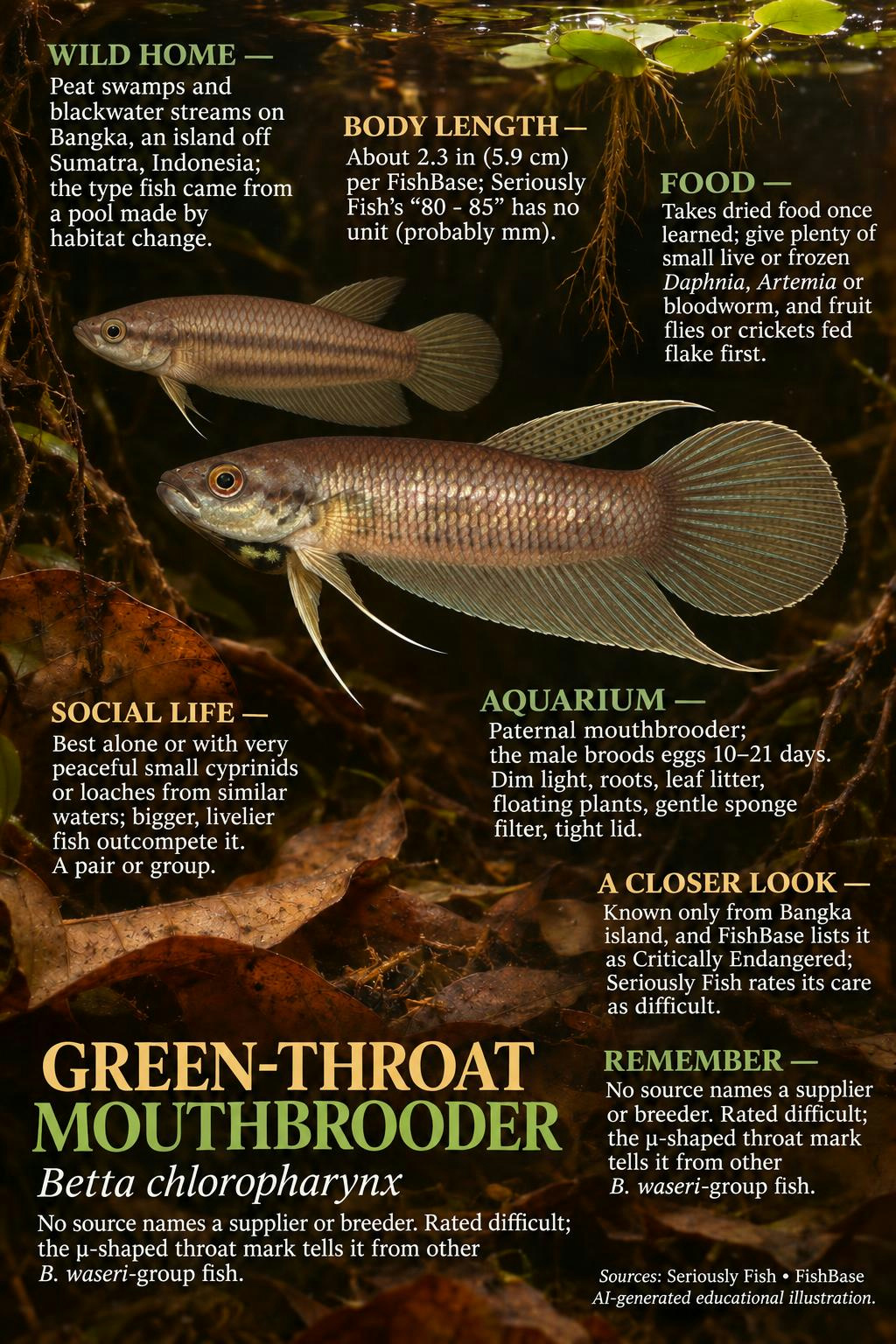
Read the infographic as text
- WILD HOME — Peat swamps and blackwater streams on Bangka, an island off Sumatra, Indonesia; the type fish came from a pool made by habitat change.
- BODY LENGTH — About 2.3 in (5.9 cm) per FishBase; Seriously Fish’s “80 - 85” has no unit (probably mm).
- FOOD — Takes dried food once learned; give plenty of small live or frozen Daphnia, Artemia or bloodworm, and fruit flies or crickets fed flake first.
- SOCIAL LIFE — Best alone or with very peaceful small cyprinids or loaches from similar waters; bigger, livelier fish outcompete it. A pair or group.
- AQUARIUM — Paternal mouthbrooder; the male broods eggs 10–21 days. Dim light, roots, leaf litter, floating plants, gentle sponge filter, tight lid.
- A CLOSER LOOK — Known only from Bangka island, and FishBase lists it as Critically Endangered; Seriously Fish rates its care as difficult.
- REMEMBER — No source names a supplier or breeder. Rated difficult; the μ-shaped throat mark tells it from other B. waseri-group fish.
How to use these figures
Published care ranges and suggested tank sizes are starting points, not guarantees. Tank footprint, group size, filtration, feeding, companions and the individual fish all matter. Standard length excludes the tail fin. Do not abruptly change established water conditions to match a number on a page.
Use a cycled aquarium, monitor water quality and quarantine new arrivals using a suitable species-specific plan. Persistent appetite loss, rapid breathing or weight loss warrants investigation.
Common questions
What should I know before choosing this fish?
No source names a supplier or breeder. Rated difficult; the μ-shaped throat mark tells it from other B. waseri-group fish. Best alone or with very peaceful small cyprinids or loaches from similar waters; bigger, livelier fish outcompete it. A pair or group.
What should I feed it?
Takes dried food once learned; give plenty of small live or frozen Daphnia, Artemia or bloodworm, and fruit flies or crickets fed flake first.
Why is it rare?
Known only from Bangka island, and FishBase lists it as Critically Endangered; Seriously Fish rates its care as difficult.
Sources & review
Checked November 12, 2026. Retailer care guidance is not a universal biological minimum.