
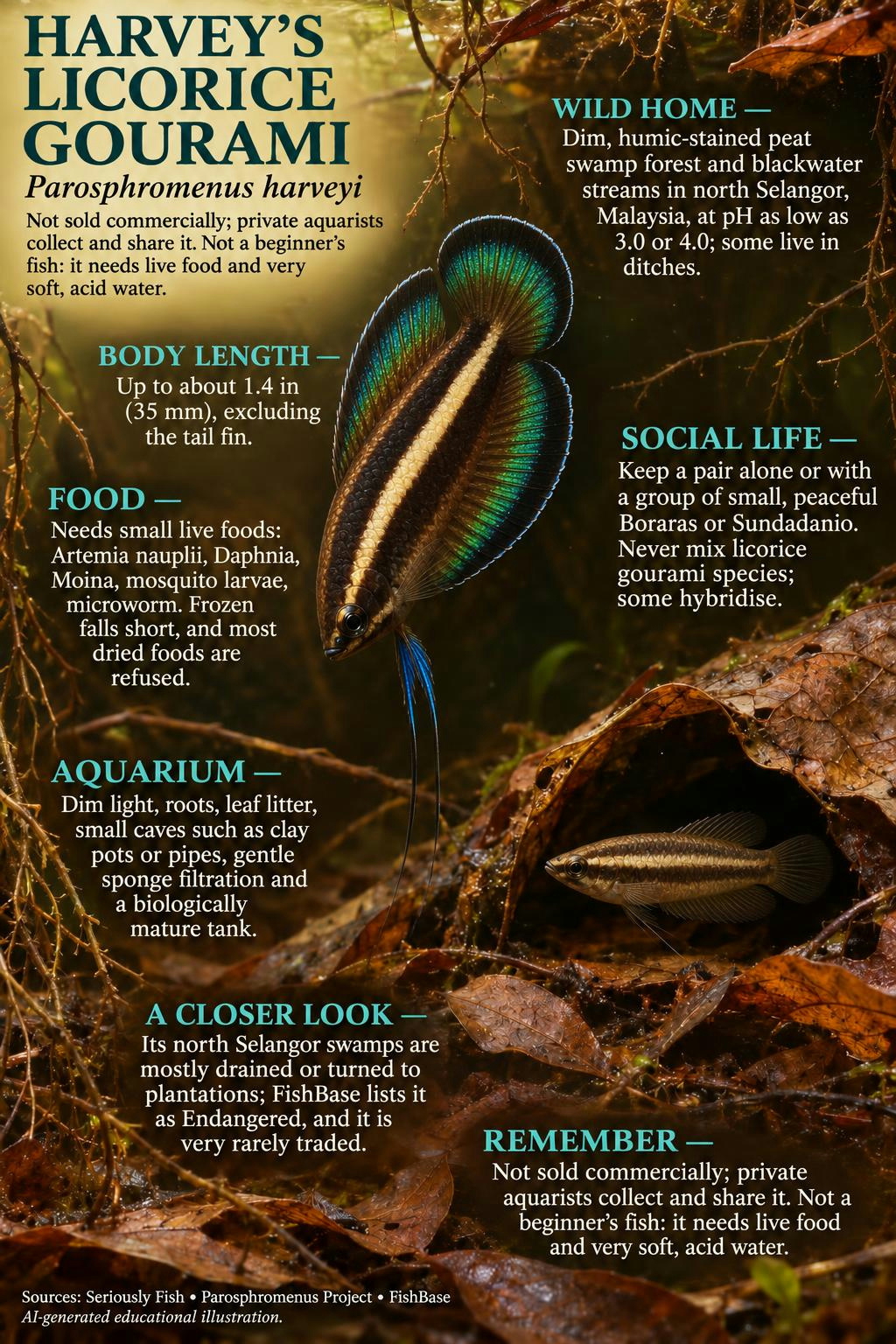
At a glance
- Adult size
- About 1.4 in body length
- Space
- 16 × 8 in base for a pair
- Social needs
- Keep a pair alone or with a group of small, peaceful Boraras or Sundadanio. Never mix licorice gourami species; some hybridise.
Starting guidance, not a universal minimum. See the care details and sources below.
Adult size
Seriously Fish reports a maximum standard length of 35 mm (about 1.4 inches), excluding the tail fin; the Parosphromenus Project gives a maximum length of 4.0 cm. FishBase lists only 1.1 cm, far below both.
Aquarium space
Seriously Fish says a 16 × 8 in (40 × 20 cm) base, about 16 litres (4 US gallons), is enough for a pair.
Water conditions
Seriously Fish lists 72–82°F (22–28°C), pH 3.0–6.5 and 1–4 dGH, with negligible carbonate hardness, so reverse osmosis or similar soft water may be needed. The Parosphromenus Project asks for cooler water, 22–24°C (72–75°F), not 27–28°C; pH no higher than 6.0 and possibly as low as 4.0; conductivity below 100 microsiemens/cm; and no detectable KH. Make small weekly water changes of 5–10%; Seriously Fish advises against irregular or larger ones. These are maintenance ranges, not targets to swing between; avoid abrupt changes.
Natural home
Dim, humic-stained peat swamp forest and blackwater streams in north Selangor, Malaysia, at pH as low as 3.0 or 4.0; some live in ditches.
Food and feeding
Needs small live foods: Artemia nauplii, Daphnia, Moina, mosquito larvae, microworm. Frozen falls short, and most dried foods are refused.
Tankmates and behavior
Keep a pair alone or with a group of small, peaceful Boraras or Sundadanio. Never mix licorice gourami species; some hybridise.
Setting up the habitat
Dim light, roots, leaf litter, small caves such as clay pots or pipes, gentle sponge filtration and a biologically mature tank.
A closer look
Its north Selangor swamps are mostly drained or turned to plantations; FishBase lists it as Endangered, and it is very rarely traded.
Read the infographic as text
- WILD HOME — Dim, humic-stained peat swamp forest and blackwater streams in north Selangor, Malaysia, at pH as low as 3.0 or 4.0; some live in ditches.
- BODY LENGTH — Up to about 1.4 in (35 mm), excluding the tail fin.
- FOOD — Needs small live foods: Artemia nauplii, Daphnia, Moina, mosquito larvae, microworm. Frozen falls short, and most dried foods are refused.
- SOCIAL LIFE — Keep a pair alone or with a group of small, peaceful Boraras or Sundadanio. Never mix licorice gourami species; some hybridise.
- AQUARIUM — Dim light, roots, leaf litter, small caves such as clay pots or pipes, gentle sponge filtration and a biologically mature tank.
- A CLOSER LOOK — Its north Selangor swamps are mostly drained or turned to plantations; FishBase lists it as Endangered, and it is very rarely traded.
- REMEMBER — Not sold commercially; private aquarists collect and share it. Not a beginner’s fish: it needs live food and very soft, acid water.
How to use these figures
Published care ranges and suggested tank sizes are starting points, not guarantees. Tank footprint, group size, filtration, feeding, companions and the individual fish all matter. Standard length excludes the tail fin. Do not abruptly change established water conditions to match a number on a page.
Use a cycled aquarium, monitor water quality and quarantine new arrivals using a suitable species-specific plan. Persistent appetite loss, rapid breathing or weight loss warrants investigation.
Common questions
What should I know before choosing this fish?
Not sold commercially; private aquarists collect and share it. Not a beginner’s fish: it needs live food and very soft, acid water. Keep a pair alone or with a group of small, peaceful Boraras or Sundadanio. Never mix licorice gourami species; some hybridise.
What should I feed it?
Needs small live foods: Artemia nauplii, Daphnia, Moina, mosquito larvae, microworm. Frozen falls short, and most dried foods are refused.
Why is it rare?
Its north Selangor swamps are mostly drained or turned to plantations; FishBase lists it as Endangered, and it is very rarely traded.
Sources & review
Checked November 12, 2026. Retailer care guidance is not a universal biological minimum.