
At a glance
- Adult size
- About 2 in body length
- Space
- 16 × 8 in base for a pair
- Social needs
- Never aggressive, though some are very timid. Seriously Fish advises a pair with no other fishes, since breeding it is the priority.
Starting guidance, not a universal minimum. See the care details and sources below.
Adult size
Seriously Fish reports a maximum standard length of 50 mm (about 2.0 inches), excluding the tail fin, but FishBase gives only 4.0 cm total length, tail included; the fischgarage breeding report says about 3–6 cm. The sources disagree.
Aquarium space
Seriously Fish says a single pair needs a base of at least 16 × 8 in (40 × 20 cm), about 16 litres (4 US gallons). The fischgarage report agrees a small tank suits a pair if it has caves and roots.
Water conditions
Seriously Fish lists 73–79°F (23–26°C), pH 5.0–7.5 and 1–8 dGH and says it needs a steady temperature; FishBase gives 24–28°C and pH 5.5–7.5. The fischgarage breeder describes wild streams with very soft water near 25°C (77°F) and pH 6–6.5. These are maintenance ranges, not targets to swing between; avoid abrupt changes.
Natural home
Small, shaded, slow streams in Sri Lanka’s southwestern wet zone, with clear, soft, slightly acid water over sand and leaf litter.
Food and feeding
Small live or frozen Daphnia, Artemia, white or grindal worm. Dried food is pecked at, not eaten enough. One breeder’s fish refused frozen.
Tankmates and behavior
Never aggressive, though some are very timid. Seriously Fish advises a pair with no other fishes, since breeding it is the priority.
Setting up the habitat
Dim light, floating plants, roots, leaf litter, half-coconut shells or clay pots as nest caves, a gentle sponge filter and a tight lid.
A closer look
Protected by law in Sri Lanka and Endangered (IUCN); fischgarage reports no imports since a 1996 law, and few aquarists breed it.
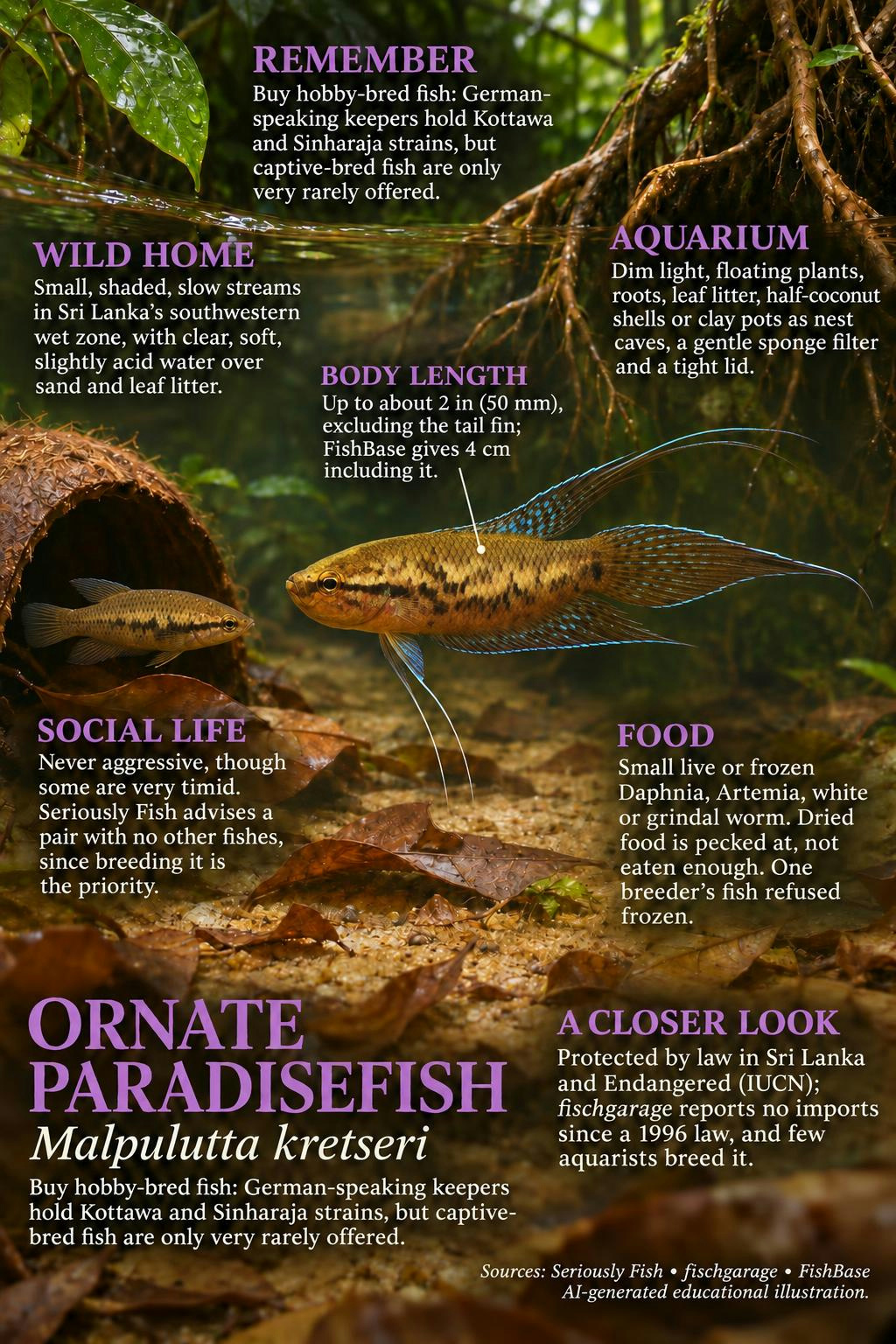
Read the infographic as text
- WILD HOME — Small, shaded, slow streams in Sri Lanka’s southwestern wet zone, with clear, soft, slightly acid water over sand and leaf litter.
- BODY LENGTH — Up to about 2 in (50 mm), excluding the tail fin; FishBase gives 4 cm including it.
- FOOD — Small live or frozen Daphnia, Artemia, white or grindal worm. Dried food is pecked at, not eaten enough. One breeder’s fish refused frozen.
- SOCIAL LIFE — Never aggressive, though some are very timid. Seriously Fish advises a pair with no other fishes, since breeding it is the priority.
- AQUARIUM — Dim light, floating plants, roots, leaf litter, half-coconut shells or clay pots as nest caves, a gentle sponge filter and a tight lid.
- A CLOSER LOOK — Protected by law in Sri Lanka and Endangered (IUCN); fischgarage reports no imports since a 1996 law, and few aquarists breed it.
- REMEMBER — Buy hobby-bred fish: German-speaking keepers hold Kottawa and Sinharaja strains, but captive-bred fish are only very rarely offered.
How to use these figures
Published care ranges and suggested tank sizes are starting points, not guarantees. Tank footprint, group size, filtration, feeding, companions and the individual fish all matter. Standard length excludes the tail fin. Do not abruptly change established water conditions to match a number on a page.
Use a cycled aquarium, monitor water quality and quarantine new arrivals using a suitable species-specific plan. Persistent appetite loss, rapid breathing or weight loss warrants investigation.
Common questions
What should I know before choosing this fish?
Buy hobby-bred fish: German-speaking keepers hold Kottawa and Sinharaja strains, but captive-bred fish are only very rarely offered. Never aggressive, though some are very timid. Seriously Fish advises a pair with no other fishes, since breeding it is the priority.
What should I feed it?
Small live or frozen Daphnia, Artemia, white or grindal worm. Dried food is pecked at, not eaten enough. One breeder’s fish refused frozen.
Why is it rare?
Protected by law in Sri Lanka and Endangered (IUCN); fischgarage reports no imports since a 1996 law, and few aquarists breed it.
Sources & review
Checked November 12, 2026. Retailer care guidance is not a universal biological minimum.