
At a glance
- Adult size
- About 8–9 in
- Space
- 180 US gallons
- Social needs
- Fights other tangs, especially Zebrasoma: keep it as the only tang and add it last. Reef compatible.
Starting guidance, not a universal minimum. See the care details and sources below.
Adult size
FishBase records a maximum of 21.0 cm (about 8.3 inches) total length, including the tail; FishLore says most adults reach about 8 inches, and a retailer care sheet lists 9 inches.
Aquarium space
A retailer care sheet says 180 US gallons (681 litres) or larger is necessary for swimming room; FishLore gives a minimum of 120 US gallons (454 litres) and prefers much larger. Plan on 180 gallons.
Water conditions
A retailer care sheet lists 72–78°F (22–26°C), pH 8.1–8.4, dKH 8–12 and specific gravity 1.020–1.025; FishLore gives 74–82°F (23–28°C), pH 8.1–8.4, specific gravity 1.021–1.025 and dKH 8–12. These are maintenance ranges, not targets to swing between; avoid abrupt changes.
Natural home
Lagoons and seaward reefs, usually 8–35 m deep, from the Line, Marquesas, Society and Tuamotu islands to the Pitcairn Group.
Food and feeding
Marine seaweed as the staple, on a clip daily or every other day, plus mysis, brine shrimp and pellets; wild fish eat filamentous algae.
Tankmates and behavior
Fights other tangs, especially Zebrasoma: keep it as the only tang and add it last. Reef compatible.
Setting up the habitat
180 gallons with lots of swimming room, plenty of live rock for grazing and night shelter, strong flow, high oxygen and heavy skimming.
A closer look
Collected in only a few places, where divers rarely see it; most wild fish come from Tahiti, with a few seasonally from Kiritimati.
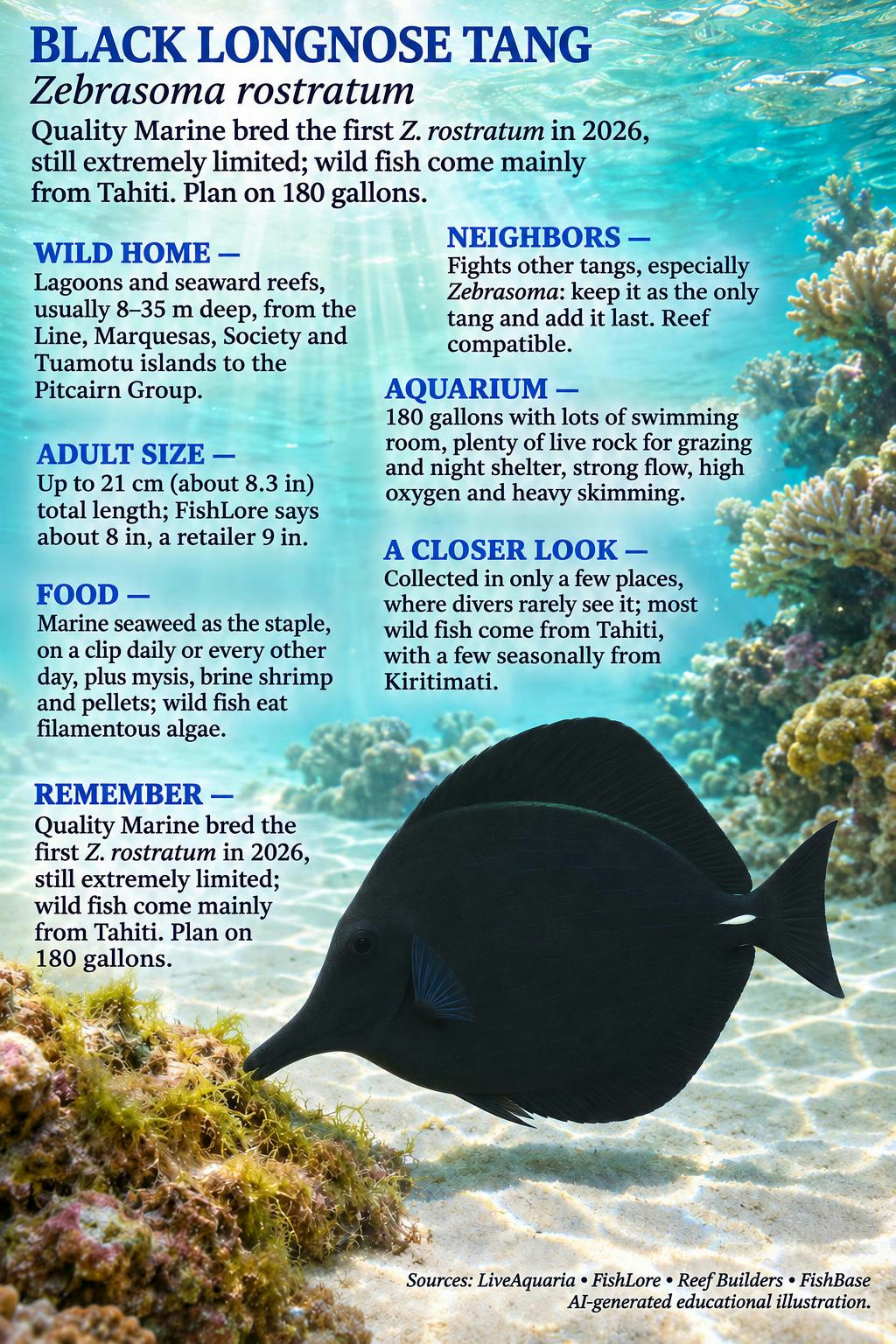
Read the infographic as text
- WILD HOME — Lagoons and seaward reefs, usually 8–35 m deep, from the Line, Marquesas, Society and Tuamotu islands to the Pitcairn Group.
- ADULT SIZE — Up to 21 cm (about 8.3 in) total length; FishLore says about 8 in, a retailer 9 in.
- FOOD — Marine seaweed as the staple, on a clip daily or every other day, plus mysis, brine shrimp and pellets; wild fish eat filamentous algae.
- NEIGHBORS — Fights other tangs, especially Zebrasoma: keep it as the only tang and add it last. Reef compatible.
- AQUARIUM — 180 gallons with lots of swimming room, plenty of live rock for grazing and night shelter, strong flow, high oxygen and heavy skimming.
- A CLOSER LOOK — Collected in only a few places, where divers rarely see it; most wild fish come from Tahiti, with a few seasonally from Kiritimati.
- REMEMBER — Quality Marine bred the first Z. rostratum in 2026, still extremely limited; wild fish come mainly from Tahiti. Plan on 180 gallons.
How to use these figures
Published care ranges and suggested tank sizes are starting points, not guarantees. Tank footprint, group size, filtration, feeding, companions and the individual fish all matter. Standard length excludes the tail fin. Do not abruptly change established water conditions to match a number on a page.
Use a cycled aquarium, monitor water quality and quarantine new arrivals using a suitable species-specific plan. Persistent appetite loss, rapid breathing or weight loss warrants investigation.
Common questions
What should I know before choosing this fish?
Quality Marine bred the first Z. rostratum in 2026, still extremely limited; wild fish come mainly from Tahiti. Plan on 180 gallons. Fights other tangs, especially Zebrasoma: keep it as the only tang and add it last. Reef compatible.
What should I feed it?
Marine seaweed as the staple, on a clip daily or every other day, plus mysis, brine shrimp and pellets; wild fish eat filamentous algae.
Why is it rare?
Collected in only a few places, where divers rarely see it; most wild fish come from Tahiti, with a few seasonally from Kiritimati.
Sources & review
Checked November 12, 2026. Retailer care guidance is not a universal biological minimum.