
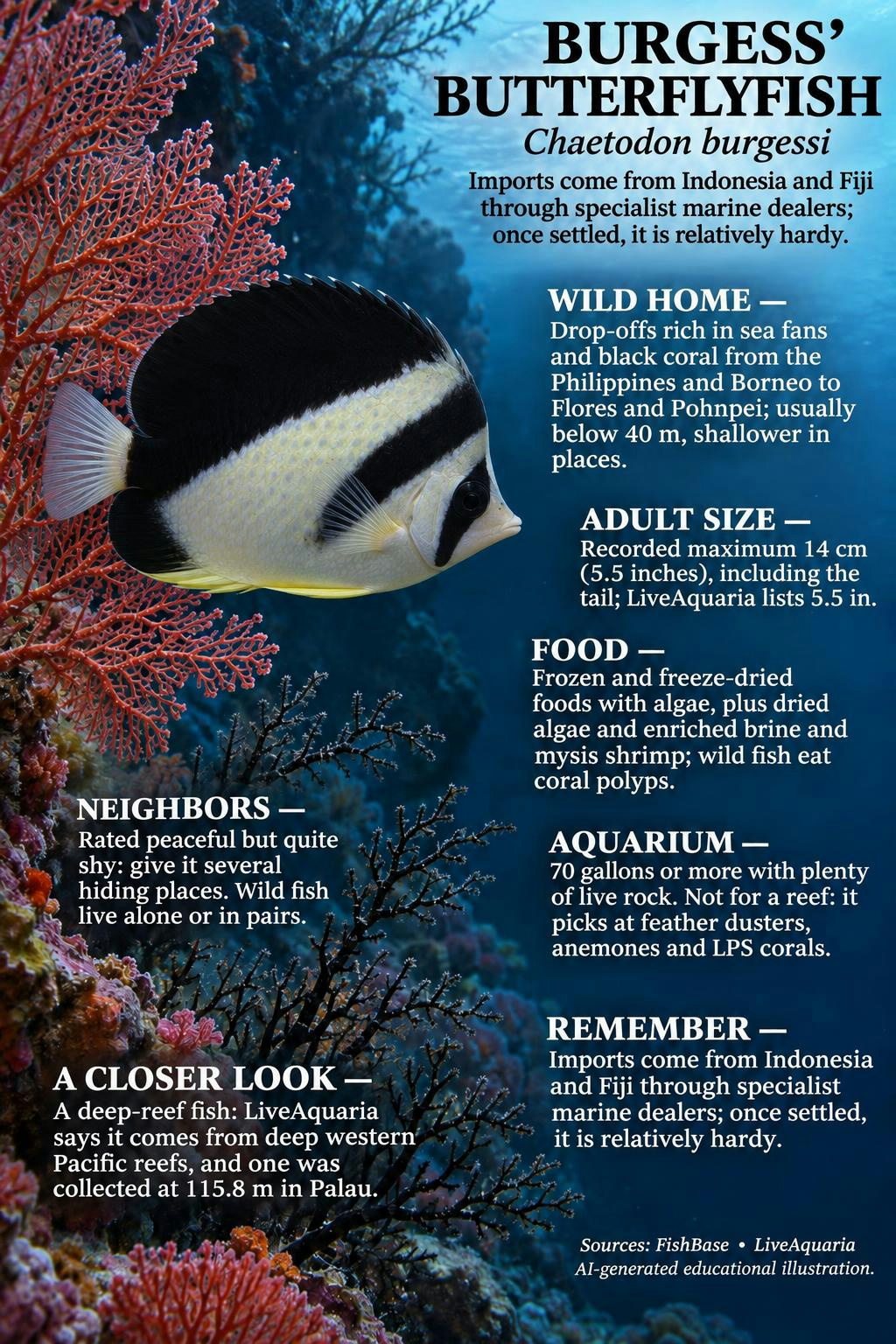
At a glance
- Adult size
- LiveAquaria lists 5.5 in; FishBase records 14 cm TL
- Space
- 70+ US gallons
- Social needs
- Rated peaceful but quite shy: give it several hiding places. Wild fish live alone or in pairs.
Starting guidance, not a universal minimum. See the care details and sources below.
Adult size
FishBase reports a maximum recorded length of 14 cm (5.5 inches), including the tail. A recorded maximum is not a promise of typical aquarium size. LiveAquaria lists a maximum of 5.5 inches.
Aquarium space
LiveAquaria says the ideal aquarium is at least 70 US gallons (265 litres), with plenty of live rock for cover from the light and extra food.
Water conditions
LiveAquaria’s quick-facts panel lists 72–78°F (22–26°C), pH 8.1–8.4, dKH 8–12 and specific gravity 1.020–1.025. These are maintenance ranges, not targets to swing between; avoid abrupt changes.
Natural home
Drop-offs rich in sea fans and black coral from the Philippines and Borneo to Flores and Pohnpei; usually below 40 m, shallower in places.
Food and feeding
Frozen and freeze-dried foods with algae, plus dried algae and enriched brine and mysis shrimp; wild fish eat coral polyps.
Tankmates and behavior
Rated peaceful but quite shy: give it several hiding places. Wild fish live alone or in pairs.
Setting up the habitat
70 gallons or more with plenty of live rock. Not for a reef: it picks at feather dusters, anemones and LPS corals.
A closer look
A deep-reef fish: LiveAquaria says it comes from deep western Pacific reefs, and one was collected at 115.8 m in Palau.
Read the infographic as text
- WILD HOME — Drop-offs rich in sea fans and black coral from the Philippines and Borneo to Flores and Pohnpei; usually below 40 m, shallower in places.
- ADULT SIZE — Recorded maximum 14 cm (5.5 inches), including the tail; LiveAquaria lists 5.5 in.
- FOOD — Frozen and freeze-dried foods with algae, plus dried algae and enriched brine and mysis shrimp; wild fish eat coral polyps.
- NEIGHBORS — Rated peaceful but quite shy: give it several hiding places. Wild fish live alone or in pairs.
- AQUARIUM — 70 gallons or more with plenty of live rock. Not for a reef: it picks at feather dusters, anemones and LPS corals.
- A CLOSER LOOK — A deep-reef fish: LiveAquaria says it comes from deep western Pacific reefs, and one was collected at 115.8 m in Palau.
- REMEMBER — Imports come from Indonesia and Fiji through specialist marine dealers; once settled, it is relatively hardy.
How to use these figures
Published care ranges and suggested tank sizes are starting points, not guarantees. Tank footprint, group size, filtration, feeding, companions and the individual fish all matter. Standard length excludes the tail fin. Do not abruptly change established water conditions to match a number on a page.
Use a cycled aquarium, monitor water quality and quarantine new arrivals using a suitable species-specific plan. Persistent appetite loss, rapid breathing or weight loss warrants investigation.
Common questions
What should I know before choosing this fish?
Imports come from Indonesia and Fiji through specialist marine dealers; once settled, it is relatively hardy. Rated peaceful but quite shy: give it several hiding places. Wild fish live alone or in pairs.
What should I feed it?
Frozen and freeze-dried foods with algae, plus dried algae and enriched brine and mysis shrimp; wild fish eat coral polyps.
Why is it rare?
A deep-reef fish: LiveAquaria says it comes from deep western Pacific reefs, and one was collected at 115.8 m in Palau.
Are there yellow Burgess’ butterflyfish?
Now and then. Most are white with three angular black bands, as drawn here, but a yellow one occasionally reaches the trade. Reef Builders reported in 2022 that Burgess’ from some regions are naturally a bit yellower, and that this group of butterflyfish hybridizes a lot, so a yellow fish may carry hybrid genes. Colour alone is not a reliable way to tell these deep-reef species apart.
Sources & review
Checked November 12, 2026. Retailer care guidance is not a universal biological minimum.
- FishBase — Chaetodon burgessi species account
- LiveAquaria — Burgess’ Butterflyfish care profile — reviewed care reference
- Reef Builders — Aqua Gift’s yellow Chaetodon burgessi may have hybrid DNA (2022)