
At a glance
- Adult size
- About 5 in
- Space
- 75+ US gallons
- Social needs
- Peaceful; keep with peaceful or non-aggressive fish, other butterflyfish included. Not safe with corals or other invertebrates.
Starting guidance, not a universal minimum. See the care details and sources below.
Adult size
FishBase records a maximum of 12.0 cm (about 4.7 inches) total length, including the tail; Saltcorner gives 5 inches.
Aquarium space
Saltcorner gives a minimum of 75 US gallons (284 litres) and recommends a larger, peaceful fish-only aquarium. It is the only care sheet; no other source gives a tank size.
Water conditions
Saltcorner lists 72–82°F (22–28°C), specific gravity 1.020–1.026 and pH 8.0–8.5; FishBase gives no water figures and calls it tropical. These are maintenance ranges, not targets to swing between; avoid abrupt changes.
Natural home
Rocky and sandy bottoms to 23 m in the Marquesas and Line Islands (FishBase); Saltcorner instead says coral reef slopes 25–40 m deep.
Food and feeding
Wild fish eat coral polyps, fanworms, crustaceans, tunicates and algae. Start with live brine shrimp or blackworms, then frozen mysis.
Tankmates and behavior
Peaceful; keep with peaceful or non-aggressive fish, other butterflyfish included. Not safe with corals or other invertebrates.
Setting up the habitat
A larger fish-only tank with open swimming space, live rock hiding places and micro- and macroalgae growth; juveniles settle in best.
A closer look
Lives only around the Marquesas and Kiritimati in the Line Islands; the sources give no other reason for its rarity.
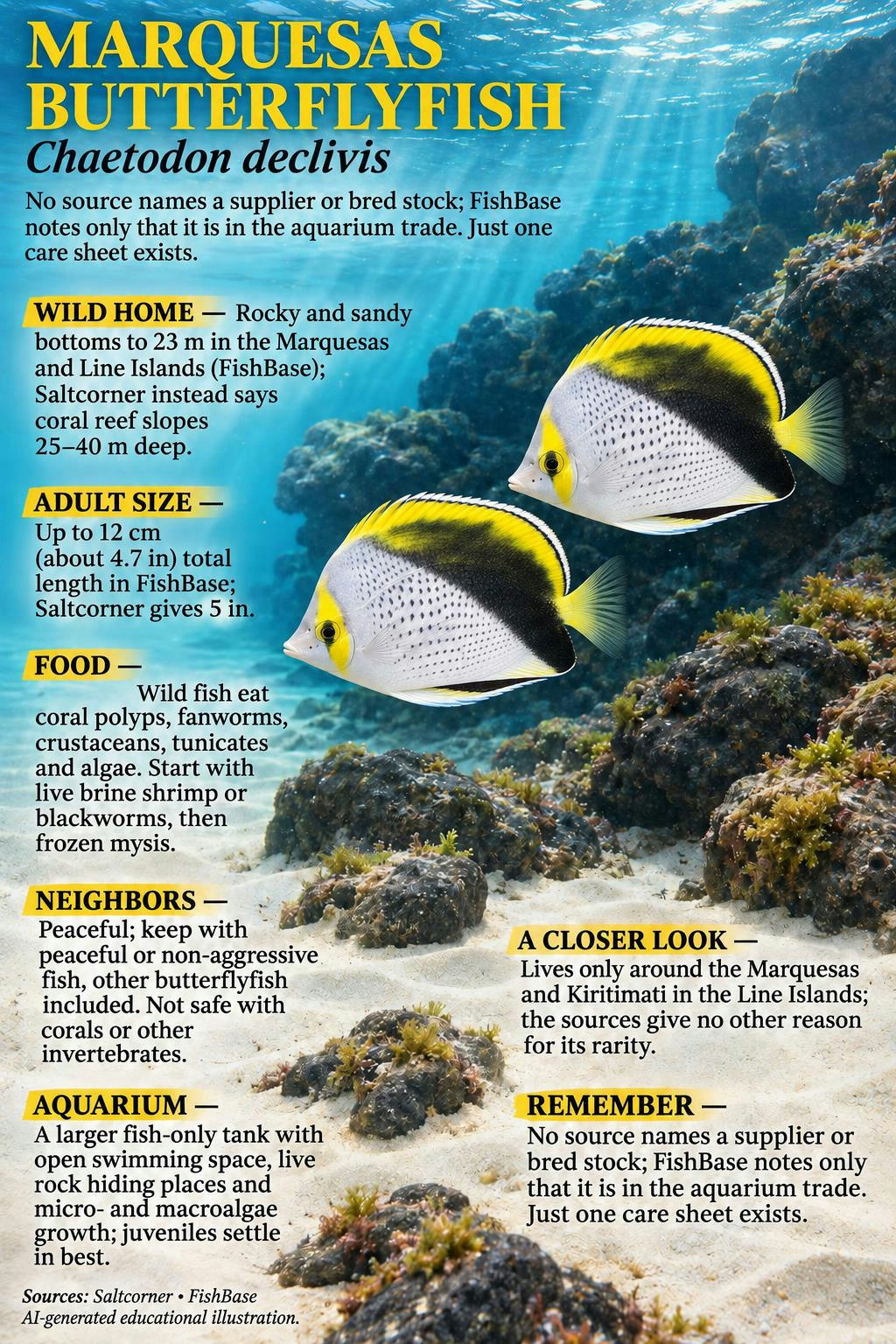
Read the infographic as text
- WILD HOME — Rocky and sandy bottoms to 23 m in the Marquesas and Line Islands (FishBase); Saltcorner instead says coral reef slopes 25–40 m deep.
- ADULT SIZE — Up to 12 cm (about 4.7 in) total length in FishBase; Saltcorner gives 5 in.
- FOOD — Wild fish eat coral polyps, fanworms, crustaceans, tunicates and algae. Start with live brine shrimp or blackworms, then frozen mysis.
- NEIGHBORS — Peaceful; keep with peaceful or non-aggressive fish, other butterflyfish included. Not safe with corals or other invertebrates.
- AQUARIUM — A larger fish-only tank with open swimming space, live rock hiding places and micro- and macroalgae growth; juveniles settle in best.
- A CLOSER LOOK — Lives only around the Marquesas and Kiritimati in the Line Islands; the sources give no other reason for its rarity.
- REMEMBER — No source names a supplier or bred stock; FishBase notes only that it is in the aquarium trade. Just one care sheet exists.
How to use these figures
Published care ranges and suggested tank sizes are starting points, not guarantees. Tank footprint, group size, filtration, feeding, companions and the individual fish all matter. Standard length excludes the tail fin. Do not abruptly change established water conditions to match a number on a page.
Use a cycled aquarium, monitor water quality and quarantine new arrivals using a suitable species-specific plan. Persistent appetite loss, rapid breathing or weight loss warrants investigation.
Common questions
What should I know before choosing this fish?
No source names a supplier or bred stock; FishBase notes only that it is in the aquarium trade. Just one care sheet exists. Peaceful; keep with peaceful or non-aggressive fish, other butterflyfish included. Not safe with corals or other invertebrates.
What should I feed it?
Wild fish eat coral polyps, fanworms, crustaceans, tunicates and algae. Start with live brine shrimp or blackworms, then frozen mysis.
Why is it rare?
Lives only around the Marquesas and Kiritimati in the Line Islands; the sources give no other reason for its rarity.
Sources & review
Checked November 12, 2026. Retailer care guidance is not a universal biological minimum.