
At a glance
- Adult size
- LiveAquaria lists 5.5 in; FishBase records 15 cm TL
- Space
- 120+ US gallons
- Social needs
- Rated peaceful. Wild fish live alone or in pairs, and occasionally in small groups; LiveAquaria also sells pairs.
Starting guidance, not a universal minimum. See the care details and sources below.
Adult size
FishBase reports a maximum recorded length of 15 cm (5.9 inches), including the tail. A recorded maximum is not a promise of typical aquarium size. LiveAquaria lists a maximum of 5.5 inches.
Aquarium space
LiveAquaria says it requires a moderately lit aquarium of 120 US gallons (454 litres) or larger.
Water conditions
LiveAquaria’s quick-facts panel lists 72–78°F (22–26°C), pH 8.1–8.4, dKH 8–12 and specific gravity 1.020–1.025. These are maintenance ranges, not targets to swing between; avoid abrupt changes.
Natural home
Steep slopes 27–180 m deep. Once thought endemic to Hawaii, it is also recorded from Johnston Island and the Marshall Islands.
Food and feeding
Varied meaty items and enriched mysis and brine shrimp, with some vegetables; wild fish eat plankton and small invertebrates.
Tankmates and behavior
Rated peaceful. Wild fish live alone or in pairs, and occasionally in small groups; LiveAquaria also sells pairs.
Setting up the habitat
120 gallons or more under moderate light. Not for a reef: it may pick at mushroom corals, anemones and stony corals.
A closer look
FishBase calls it a high-priced aquarium export; it lives deep, at 27–180 m, around Hawaii, Johnston Island and the Marshalls.
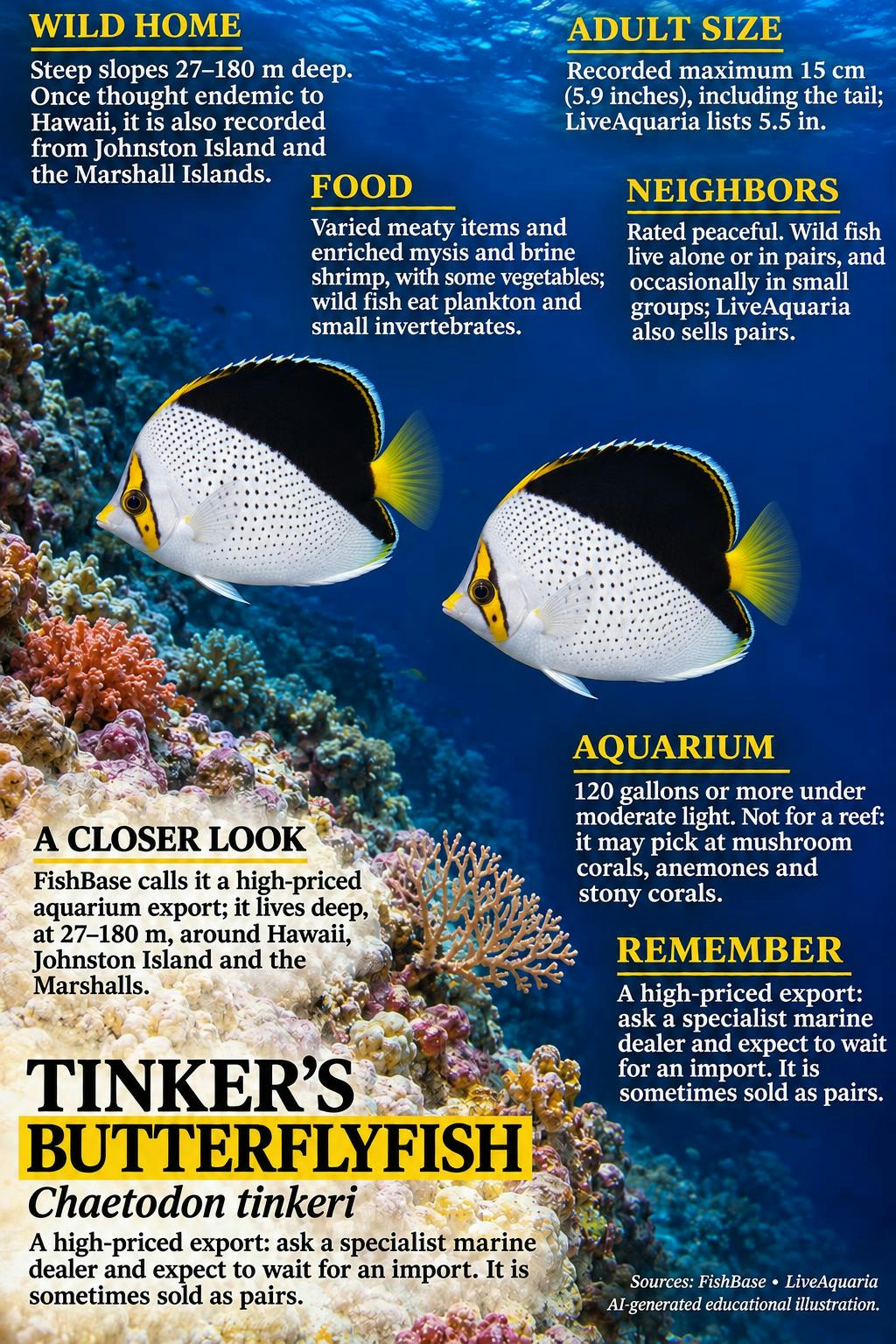
Read the infographic as text
- WILD HOME — Steep slopes 27–180 m deep. Once thought endemic to Hawaii, it is also recorded from Johnston Island and the Marshall Islands.
- ADULT SIZE — Recorded maximum 15 cm (5.9 inches), including the tail; LiveAquaria lists 5.5 in.
- FOOD — Varied meaty items and enriched mysis and brine shrimp, with some vegetables; wild fish eat plankton and small invertebrates.
- NEIGHBORS — Rated peaceful. Wild fish live alone or in pairs, and occasionally in small groups; LiveAquaria also sells pairs.
- AQUARIUM — 120 gallons or more under moderate light. Not for a reef: it may pick at mushroom corals, anemones and stony corals.
- A CLOSER LOOK — FishBase calls it a high-priced aquarium export; it lives deep, at 27–180 m, around Hawaii, Johnston Island and the Marshalls.
- REMEMBER — A high-priced export: ask a specialist marine dealer and expect to wait for an import. It is sometimes sold as pairs.
How to use these figures
Published care ranges and suggested tank sizes are starting points, not guarantees. Tank footprint, group size, filtration, feeding, companions and the individual fish all matter. Standard length excludes the tail fin. Do not abruptly change established water conditions to match a number on a page.
Use a cycled aquarium, monitor water quality and quarantine new arrivals using a suitable species-specific plan. Persistent appetite loss, rapid breathing or weight loss warrants investigation.
Common questions
What should I know before choosing this fish?
A high-priced export: ask a specialist marine dealer and expect to wait for an import. It is sometimes sold as pairs. Rated peaceful. Wild fish live alone or in pairs, and occasionally in small groups; LiveAquaria also sells pairs.
What should I feed it?
Varied meaty items and enriched mysis and brine shrimp, with some vegetables; wild fish eat plankton and small invertebrates.
Why is it rare?
FishBase calls it a high-priced aquarium export; it lives deep, at 27–180 m, around Hawaii, Johnston Island and the Marshalls.
Sources & review
Checked November 12, 2026. Retailer care guidance is not a universal biological minimum.
- FishBase — Chaetodon tinkeri species account
- LiveAquaria — Tinkeri Butterflyfish care profile — reviewed care reference