
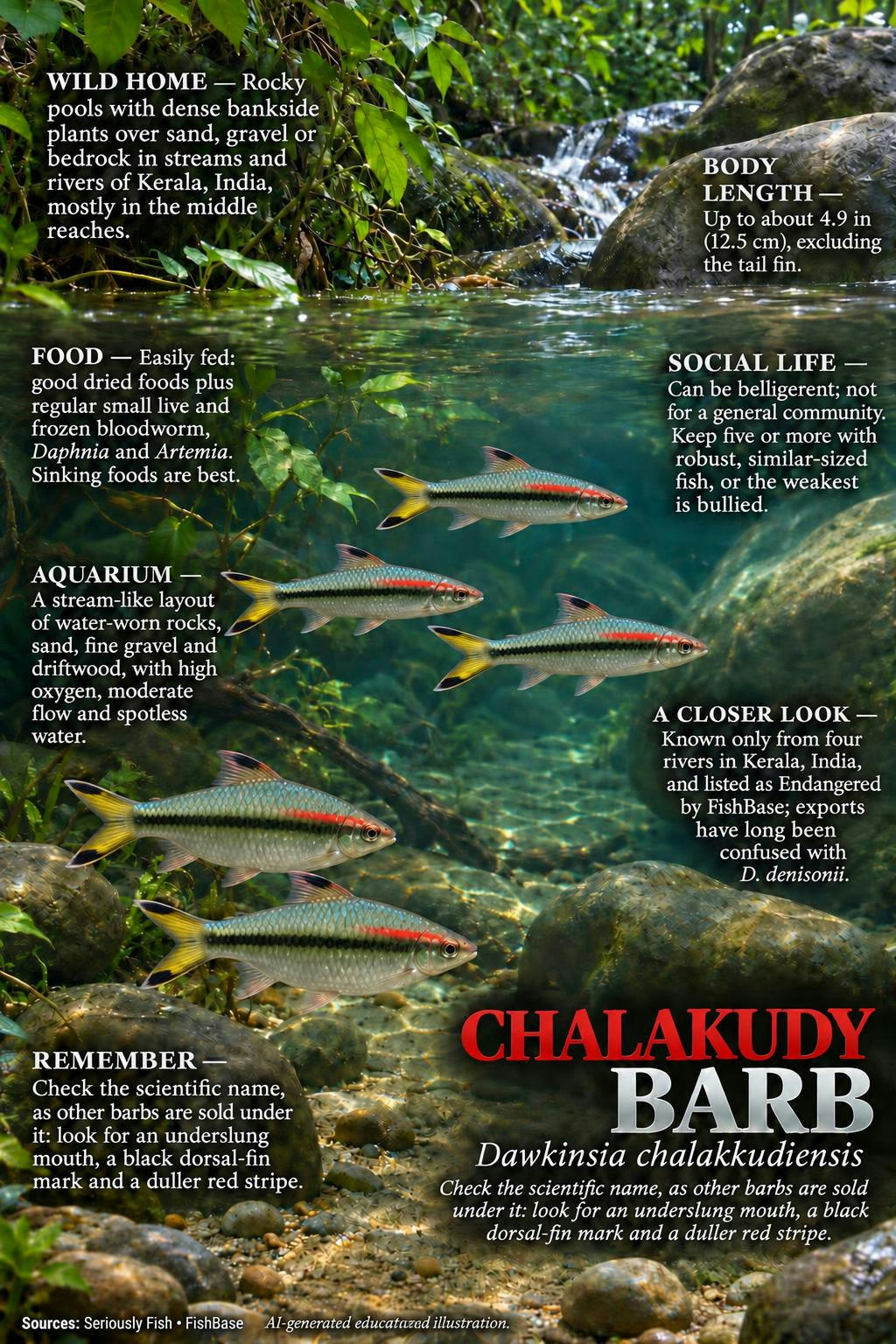
At a glance
- Adult size
- About 4.9 in body length
- Space
- 120 × 45 cm (48 × 18 in) base, about 64 US gallons
- Social needs
- Can be belligerent; not for a general community. Keep five or more with robust, similar-sized fish, or the weakest is bullied.
Starting guidance, not a universal minimum. See the care details and sources below.
Adult size
Seriously Fish gives a maximum standard length of 12.5 cm (about 4.9 inches), excluding the tail fin; FishBase gives 12.5 cm as total length. Adult females grow a little larger than males.
Aquarium space
Seriously Fish requires a base of at least 120 × 45 cm (48 × 18 in), about 243 litres (64 US gallons).
Water conditions
Seriously Fish lists a wide 59–77°F (15–25°C), pH 6.5–7.5 and 5–20 dGH, and says it needs a steady pH and a well-established tank. It needs more or less spotless, oxygen-rich water with moderate movement, and weekly water changes of 30–50% are routine. These are maintenance ranges, not targets to swing between; avoid abrupt changes.
Natural home
Rocky pools with dense bankside plants over sand, gravel or bedrock in streams and rivers of Kerala, India, mostly in the middle reaches.
Food and feeding
Easily fed: good dried foods plus regular small live and frozen bloodworm, Daphnia and Artemia. Sinking foods are best.
Tankmates and behavior
Can be belligerent; not for a general community. Keep five or more with robust, similar-sized fish, or the weakest is bullied.
Setting up the habitat
A stream-like layout of water-worn rocks, sand, fine gravel and driftwood, with high oxygen, moderate flow and spotless water.
A closer look
Known only from four rivers in Kerala, India, and listed as Endangered by FishBase; exports have long been confused with D. denisonii.
Read the infographic as text
- WILD HOME — Rocky pools with dense bankside plants over sand, gravel or bedrock in streams and rivers of Kerala, India, mostly in the middle reaches.
- BODY LENGTH — Up to about 4.9 in (12.5 cm), excluding the tail fin.
- FOOD — Easily fed: good dried foods plus regular small live and frozen bloodworm, Daphnia and Artemia. Sinking foods are best.
- SOCIAL LIFE — Can be belligerent; not for a general community. Keep five or more with robust, similar-sized fish, or the weakest is bullied.
- AQUARIUM — A stream-like layout of water-worn rocks, sand, fine gravel and driftwood, with high oxygen, moderate flow and spotless water.
- A CLOSER LOOK — Known only from four rivers in Kerala, India, and listed as Endangered by FishBase; exports have long been confused with D. denisonii.
- REMEMBER — Check the scientific name, as other barbs are sold under it: look for an underslung mouth, a black dorsal-fin mark and a duller red stripe.
How to use these figures
Published care ranges and suggested tank sizes are starting points, not guarantees. Tank footprint, group size, filtration, feeding, companions and the individual fish all matter. Standard length excludes the tail fin. Do not abruptly change established water conditions to match a number on a page.
Use a cycled aquarium, monitor water quality and quarantine new arrivals using a suitable species-specific plan. Persistent appetite loss, rapid breathing or weight loss warrants investigation.
Common questions
What should I know before choosing this fish?
Check the scientific name, as other barbs are sold under it: look for an underslung mouth, a black dorsal-fin mark and a duller red stripe. Can be belligerent; not for a general community. Keep five or more with robust, similar-sized fish, or the weakest is bullied.
What should I feed it?
Easily fed: good dried foods plus regular small live and frozen bloodworm, Daphnia and Artemia. Sinking foods are best.
Why is it rare?
Known only from four rivers in Kerala, India, and listed as Endangered by FishBase; exports have long been confused with D. denisonii.
Sources & review
Checked November 12, 2026. Retailer care guidance is not a universal biological minimum.