
At a glance
- Adult size
- Rarely the 16 in maximum in aquariums; 8–12 in with good care
- Space
- 71 × 24 in base or larger; see details
- Social needs
- A social loach requiring a group and a very large aquarium; avoid slow, long-finned companions.
Starting guidance, not a universal minimum. See the care details and sources below.
Adult size
Seriously Fish reports a maximum standard length of 40 cm (about 15.7 inches), excluding the tail fin. Aquarium fish rarely get that big: the same profile says most specimens fail to reach their potential in captivity. Loaches Online describes quick growth to about 5 inches (13 cm), then slower growth, with well-kept fish in a large tank reaching 8 to 12 inches (20–30 cm). That is still a big, bulky, long-lived fish, so plan space for a group of that size.
Aquarium space
Seriously Fish recommends an aquarium base at least 71 × 24 inches (180 × 60 cm). Group size, adult behavior and additional companions may require more room. This large social species needs a group, not a solitary fish purchased for snail control.
Water conditions
The species profile lists 75–86°F (24–30°C) and pH 5.0–7.0. These are maintenance ranges, not targets to swing between; match the stock’s history and avoid abrupt changes. The same profile lists 1–12 dGH; water hardness is particularly important when choosing compatible fish.
Natural home
River systems of Borneo and Sumatra in Indonesia.
Food and feeding
Varied sinking foods, invertebrate foods and suitable vegetable matter.
Tankmates and behavior
A social loach requiring a group and a very large aquarium; avoid slow, long-finned companions.
Setting up the habitat
Mature oxygenated water, smooth shelters, secure lid and no trapping gaps.
A closer look
It can eat snails, but snail control is not a reason to buy a large social fish.
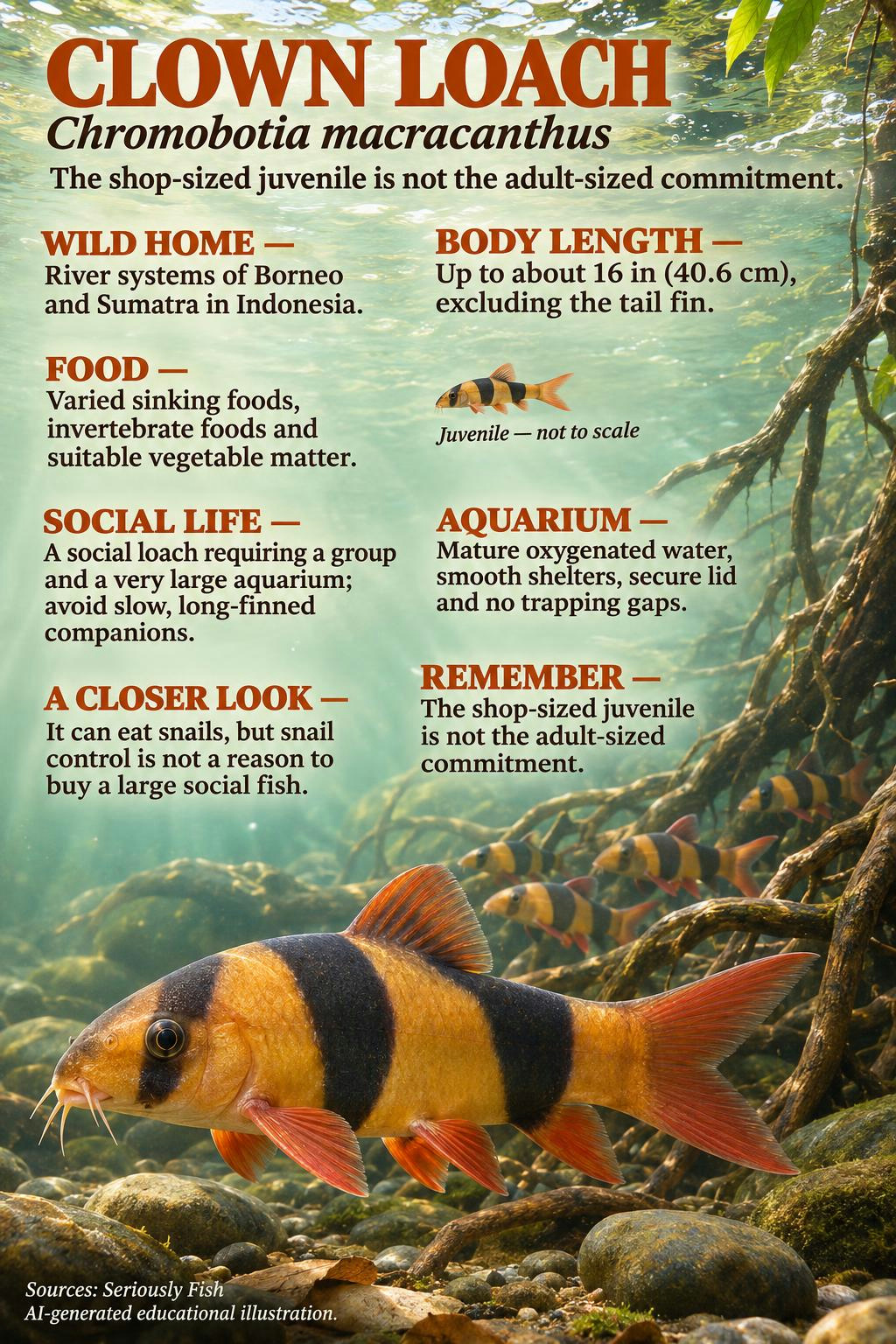
Read the infographic as text
- WILD HOME — River systems of Borneo and Sumatra in Indonesia.
- BODY LENGTH — Up to about 16 in (40.6 cm), excluding the tail fin.
- FOOD — Varied sinking foods, invertebrate foods and suitable vegetable matter.
- SOCIAL LIFE — A social loach requiring a group and a very large aquarium; avoid slow, long-finned companions.
- AQUARIUM — Mature oxygenated water, smooth shelters, secure lid and no trapping gaps.
- A CLOSER LOOK — It can eat snails, but snail control is not a reason to buy a large social fish.
- REMEMBER — The shop-sized juvenile is not the adult-sized commitment.
How to use these figures
Published care ranges and suggested tank sizes are starting points, not guarantees. Tank footprint, group size, filtration, feeding, companions and the individual fish all matter. Standard length excludes the tail fin. Do not abruptly change established water conditions to match a number on a page.
Use a cycled aquarium, monitor water quality and quarantine new arrivals using a suitable species-specific plan. Persistent appetite loss, rapid breathing or weight loss warrants investigation.
Common questions
What should I know before choosing this fish?
The shop-sized juvenile is not the adult-sized commitment. A social loach requiring a group and a very large aquarium; avoid slow, long-finned companions.
What should I feed it?
Varied sinking foods, invertebrate foods and suitable vegetable matter.
Will my clown loach really reach 16 inches?
Rarely in an aquarium. About 16 inches (40 cm) is the recorded maximum, and Seriously Fish notes most specimens fail to reach their potential in captivity. Loaches Online reports well-kept fish in large tanks reaching 8 to 12 inches (20–30 cm) after fast early growth slows. Plan for a group of large, long-lived fish, not for a fish that stays shop-sized.
Sources & review
Checked November 12, 2026. Retailer care guidance is not a universal biological minimum.